


Browse and search a portion of the collections of the Tides Institute & Museum of Art available online (now consisting of over 8,000 online records in process of completion). The Online Collections are best viewed using Google Chrome or Mozilla Firefox. Search Hints: To search by phrase or multiple word names wrap your criteria in quotes. Example: “Martin Johnson Heade” or “Grand Manan”. For an overview of the collections, see: Collections Overview.
Wabanaki
The Wabanki collection includes late 19th century to contemporary Passamaquoddy and Mi’Kmaq basketry, late 19th century to early 20th century Passamaquoddy basket molds, photographs, Passamaquoddy and Penobscot place name maps, a late 19th century temperance broadside in English and Passamaquoddy and books including the Indian Good Book and the Passamaquoddy-Maliseet Dictionary/Peskotomuhkati Wolastoqewi Latuwewakon.
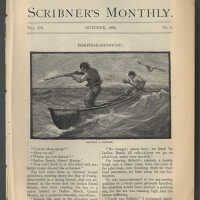
"Porpoise-Shooting" | Charles Caleb Ward | Scribner's Monthly, Vol. XX, No. 6, October, 1880
Includes several engraved illustrations by Charles Caleb Ward. Article content is situated around Grand Manan Island, New Brunswick and Passamaquoddy Bay. 2 copies.
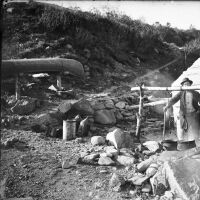
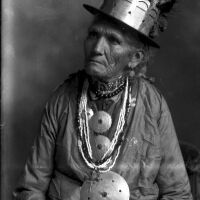
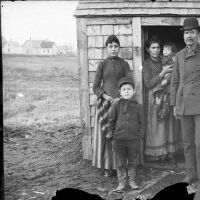
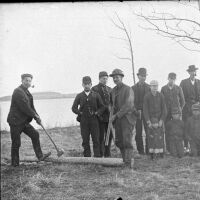
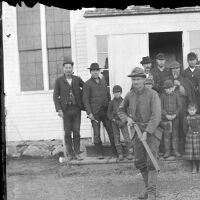
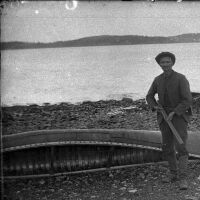
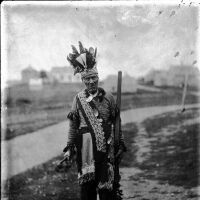
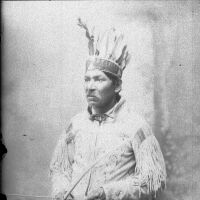
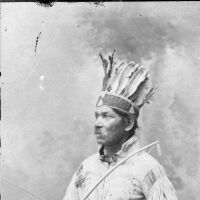
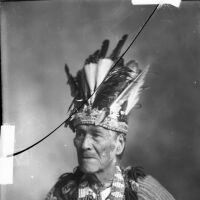
398-CEB-39~7.TIF | Charles E. Brown (1863-1945), Photographer, Glass Plate Negative | Passamaquoddy Tribal Chief Sapiel Selmore
Passamaquoddy Tribal Chief Sapiel Selmore's portrait is hand tinted. He was a member of the Sons of the American Revolution. His name sometimes is spelled "Sopiel." His father, Selmore Soctomah, was a captain in the marines and an Indian scout for the Maine Militia in the American Revolution. Chief Selmore was born in 1803.
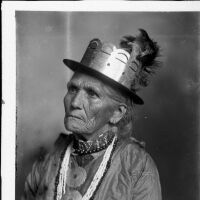
399-CEB-03~20.TIF | Charles E. Brown (1863-1945), Photographer, Glass Plate Negative | Mary Mitchell Selmore
Mary Mitchell Selmore, also called Mary and Mali Mitchell, lived from circa 1829 to 1911 and was an emblematic and respected member of the Passamaquoddy Nation. Selmore was a healer and artist who carried and taught traditional knowledge including by singing and dancing during community events at Sipayik, or Pleasant Point. Mary Mitchell Selmore was second wife of long-time Passamaquoddy Chief Sapiel Selmore, the traditional wampum keeper for the Passamaquoddy Nation who died only a few years prior to Mary at the approximate age of 100 years. Fluent in Passamaquoddy, English, and French, Mary Selmore excelled at trading and diplomacy, and together with Sopiel made a life creating baskets, moccasins, and other items that they sold to settler-colonialists visiting their territories. Both Sapiel and Mary Selmore were medicine people, and understood the special properties of plants for good health, and as medicines for physical and spiritual healing. Learn more about Mary Mitchell Selmore on Maine Memory Network: https://www.mainememory.net/record/10927
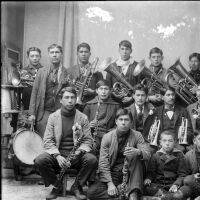
498-CEB-49~9.TIF | Charles E. Brown (1863-1945), Photographer, Glass Plate Negative
Passamaquoddy Indian Band, Sipayik/Pleasant Point, Maine.
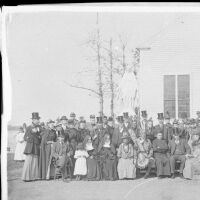
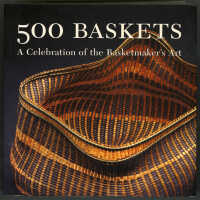

A Fishing Excursion in New Brunswick | The Illustrated London News. Sept. 5, 1863, p.249
Artist: The Illustrated London News. Sept. 5, 1863, p.249. Medium: Engraving. Copy 2 Old Accession Number: 407 Description: Single Page. Article with five engravings: 1) Crossing Lake Utopia in a Storm; 2) Lake Utopia – Evening; 3) John Francis, Chief of the Passamaquoddy Indians; 4) Entertaining the Chief; 5) The Sugar Camp.
A Fishing Excursion in New Brunswick. | The Illustrated London News. Sept. 5, 1863, p.249
Artist: The Illustrated London News. Sept. 5, 1863, p.249 Medium: Engraving. Copy 1 Old Accession Number: 406 Description: Single Page. Article with five engravings: 1) Crossing Lake Utopia in a Storm; 2) Lake Utopia – Evening; 3) John Francis, Chief of the Passamaquoddy Indians; 4) Entertaining the Chief; 5) The Sugar Camp. .
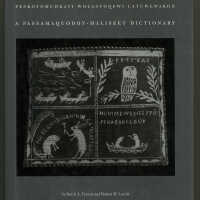
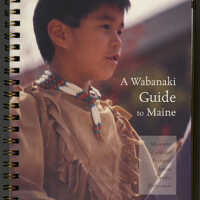
A Wabanaki Guide to Maine: A Visitors Guide to Native American Culture in Maine
A Wabanaki Guide to Maine: A Visitors Guide to Native American Culture in Maine : Museums, Galleries, Festivals, Artists, Guides, Performers : Penobscot, Passamaquoddy, Micmac (Mi'kmaq), Maliseet Maine Indian Basketmakers Alliance, 2001, 86 pages
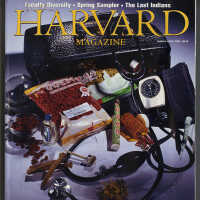
A Woodsplint Basket | Laurel Thatcher Ulrich | Harvard Magazine, Volume 104, Number 4, March - April, 2002, pp. 50 - 56, 102 - 103
Includes Passamaquoddy. ”An historian's scrutiny of an everyday object helps reveal the story of New England's last Indians.“
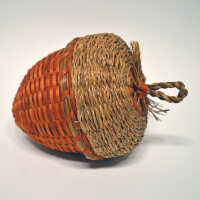
Acorn Basket | Molly Parker
Artist: Molly Parker Classification: North American Basket Old Accession Number: 1503 Description: Passamaquoddy. Acorn Basket.
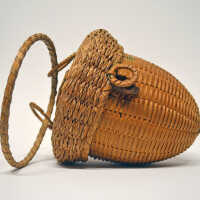
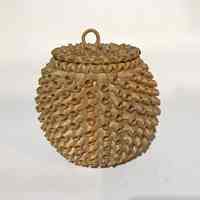
Acorn shaped basket with attached lid and hoop handle [?Passamaquoddy] | Unknown Artist
Artist: Unknown artist Classification: North American Basket Old Accession Number: 630 Description: ?Passamaquoddy. Acorn shaped basket with attached lid and hoop handle. Top Shelf.
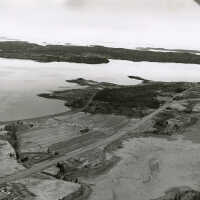
Aerial View | Looking Southeast from Sipayik/Pleasant Point, Maine towards Deer Island, New Brunswick | U. S. Army Corps. of Engineers
Artist: U. S. Army Corps. of Engineers Description: May 1, 1957. Old Accession Number: 1743 Passamaquoddy
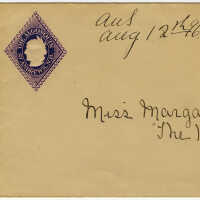
Algonquin Envelope - 1896
Classification: Prints Circa: 1896 Description: August 12, 1896 Old Accession Number: 1302 St. Andrews, New Brunswick
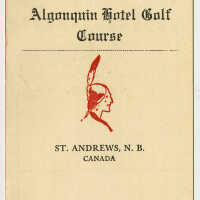
Algonquin Hotel Golf Course [St. Andrews, New Brunswick] |
Old Accession Number: 1306
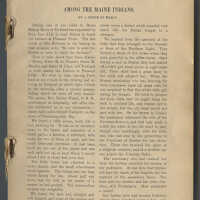
Among the Maine Indians | By A Sister of Mercy | pp. 291 - 298
Includes Passamaquoddy
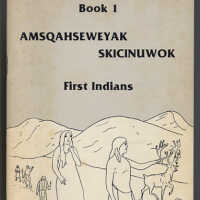
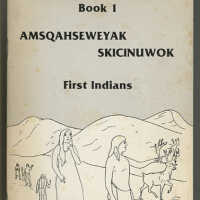
Amsqahseweyak Skicinuwok / First Indians | Book 1
Produced by Title VII Bilingual Program under the direction of Joseph A. Nicholas, Director and David A. Francis, Sr., Language Coordinator, Perry, Maine Passamaquoddy tribe.
An Early Nineteenth Century Passamaquoddy Bark Box with an Anthropomorphic Decoration | Ernest S. Dodge | Bulletin of the Massachusetts Archaeological Society, January, 1953
Bulletin of the Massachusetts Archaeological Society, Vol. XIV, No. 2, January, 1953, pp. 77 - 78
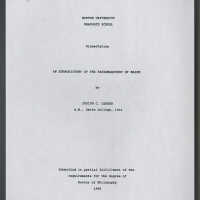
An Ethnohistory of the Passamaquoddy of Maine | Judith C. Leader | Ph.D. Dissertation, 1995, Boston University
Dissertation submitted in partial fulfillment of the requirements for the degree of Doctor of Philosophy, Anthropology, Boston University Graduate School, 1995
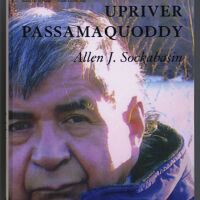

Andrew Steeves of Gaspereau Press | Jeremy Dutcher Workshop & Concert Poster, July 22, 2023 | Letterpress | 2023
Limited edition letterpress poster designed and printed by Andrew Steeves of Gaspereau Press, Kentville, Nova Scotia, 2023. 11" x 17". Edition of 100 copies. The Jeremy Dutcher concert held on July 22, 2023 at the Tides Institute & Museum of Art's North Church in Eastport, Maine was the first time that the Passamaquoddy/Maliseet language had ever been sung, spoken or heard in the 204 year history of the North Church building constructed in 1819.
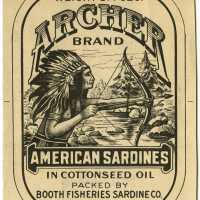
Archer Brand - American Sardines Label | Booth Fisheries Sardines Company | Eastport, Maine | 1903
Old Accession Number: 727 Classification: Prints Description: Archer Brand. American Sardines in Cottonseed Oil. Packed by Booth Fisheries Sardines Company, Eastport, Maine. Weight 3 1/4 Ounces. Patent, November 3, 1903, American Can Company, 32A-17. Original label purchased by the Tides Institute & Museum of Art from the collection of Julian "Barney" Rier of Lubec, Maine.
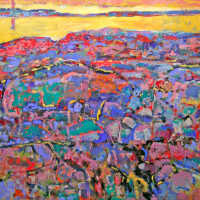
Arthur Cadieux (1943-2015) | Passamaquoddy Lament |
Artist: Arthur Cadieux Medium: Oil on canvas Classification: Paintings Old Accession Number: 79
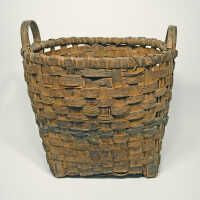
Artist Once Known | Herring Scale Basket [Passamaquoddy]
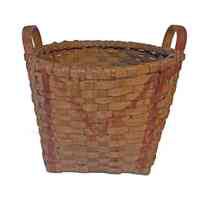
A large late 19th century herring basket made by the Passamaquoddies. It stands about 15” tall by about 19” in diameter. Made of woven strips of ash with an ash wood handle, thousands of such baskets were used in the fishing and particularly the sardine industry of the northeastern coast of Maine and southwestern coast of New Brunswick in the late 19th and early 20th centuries. Many were brought by canoes to the sardine factories from the nearby Passamaquoddy communities. The baskets were used to transport freshly caught herring from the holds of small sail powered carrier boats that brought the herring from where they had been caught in fish weirs to the sardine factory wharves. There the herrings were brought from the boats to the wharf decks one basket at a time using a simple hand pulled pulley and rope system. The baskets of fish were then dumped on tables where the heads of the herring were cut off by young laborers using large knives. The cut herring bodies were then poured back into baskets and lugged by hand to the next step in the then very labor intensive process of turning herring into canned sardines. This herring basket example is rare as few survived once the sardine industry became much more mechanized early in the 20th century and such baskets were no longer needed. Later the 20th century, such baskets were used by the thousands once again to deliver herring scales by boat to the newly developing pearl essence industry in the region that used herring scales in the production of such products as nail polish. Examples of these later herring baskets are much more common and are often marked with a large letter on the side of the basket to denote which pearl essence factory the basket belonged. The earlier late 19th century herring basket was found for sale on eBay by a seller in Quebec and purchased by the Tides Institute for its collections. When the basket arrived at the institute, it still had a few herring scales attached to the ash strips of the basket. Artist: Unknown Artist Classification: North American Basket Old Accession Number: 1516 Circa: 1920 Description: Herring Scale Basket. Passamaquoddy. Purchased on Ebay from Marc Boily of Quebec in 2003. Basket still had a few herring scales on it when first received in the mail.
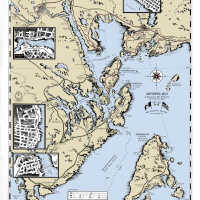
Artsipelago Map 2022 with Passamaquoddy and English Place Names
Artsipelago Map 2022. with Passamaquoddy and English Place Names
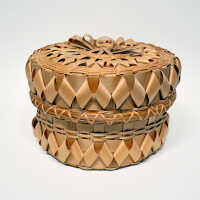
Basket with Lid [Mi’Kmaq] | Jane Zumbrunnen
Artist: Jane Zumbrunnen Classification: North American Basket Old Accession Number: 666 Description: Mi’Kmaq Basket with Lid. November 14, 1996. Bottom Shelf.
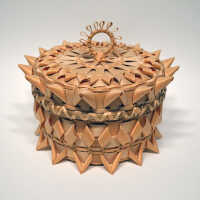
Basket with Lid [Mi’Kmaq] | Jane Zumbrunnen
Artist: Jane Zumbrunnen Classification: North American Basket Old Accession Number: 659 Description: Mi’Kmaq Basket with Lid. May 21, 2003. Second Shelf from Bottom.
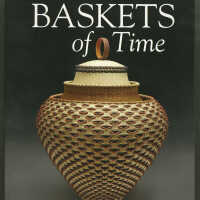
Baskets of the Dawnland People
32 page booklet produced by Project Indian PRIDE under the direction of Joseph A. Nicholas, Director, Maine Indian Education, Calais, Maine. 3 copies.
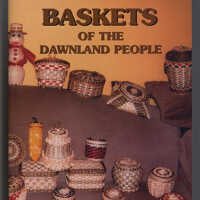
Baskets of the Dawnland People | Revised and Updated, 2008 | Produced by Joseph A. Nicholas | Edited by Stephanie Francis and Scott Francis with Assistance by Tribal Historic Preservation Office, Donald Soctomah
Edited by Stephanie Francis and Scott Francis with Assistance by Tribal Historic Preservation Office, Donald Soctomah. 2 copies.
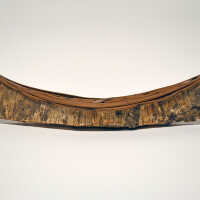
Birch Bark Canoe Model [Passamaquoddy] | Edit Unknown artist 664 8/16/12 1:58pm
Artist: Unknown artist Description: 664. ?Passamaquoddy. Birch Bark Canoe Model. Bottom Shelf.
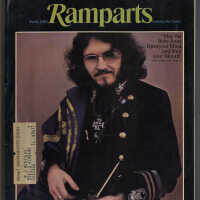
Brothers of Passamaquoddia | David Welsh | Ramparts [Magazine], Volume 5, Number 9, March, 1967, pp. 40 - 45
Article about the Passamaquoddy
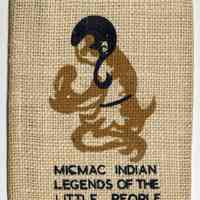
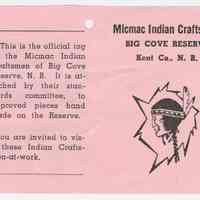
Card Holder | Micmac (Mi'kmaq) Indian Craftsmen | Big Cove Reserve, New Brunswick
Printed design on burlap
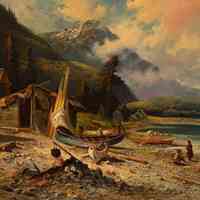
Carl Philipp Weber (1849-1922) | Passamaquoddy Fishing Encampment, Grand Manan Island, New Brunswick | Oil on canvas, 1878
22 x 36 in. (55.9 x 91.4 cm.) Frame: 26 1/4 x 40 1/4 in. (66.7 x 102.2 cm.) Provenance: Private collection, Ontario. Born in Germany, C. Philipp Weber, and his cousin the artist Carl Weber, lived and worked in Philadelphia and were active in several artists groups there. Both artists focused on painting vigorous, untamed nature in the Barbizon tradition. Like Alfred Thompson Bricher, C. Philipp Weber traveled to Grand Manan Island, New Brunswick during the 1870s. Aside from the fishing camp depicted in the present painting, Weber also painted from Fish Head at the tip of the island. Based primarily in the state of Maine, the Passamaquoddy tribe used Grand Manan and its surrounding islands as summertime hunting grounds.
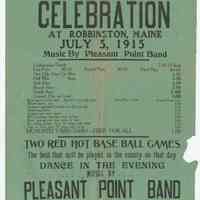
Celebration Poster, Robbinston, Maine, July 5, 1915 | Music by Pleasant Point Band
Printed in Eastport, Maine. Gift of Hank Young of Eastport, Maine, c.2022.
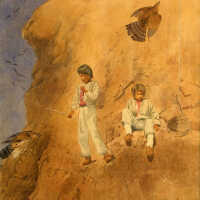
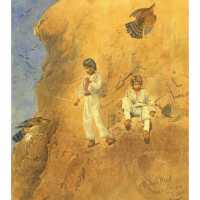
Charles Caleb Ward (1831-1896) | Cliff Climbers, Grand Manan | 1869
An 1869 watercolor (9.5 inches by 11.5 inches) by New Brunswick artist, Charles Caleb Ward of Peskotomuhkati/Passamaquoddy youths gathering gull eggs on the cliffs of nearby Grand Manan island in New Brunswick. Historically, for the Passamaquoddies, Maine’s current political boundary line was non-existent and Passamaquoddies homeland and territory extended to both sides of the border. In the nineteenth century and long before, they were frequently on Grand Manan for fishing and sealing, to collect gull eggs found on the steep island cliffs and for other activities. In 2004, the Tides Institute learned of the existence of this painting from a tip from Donald Soctomah, long time Passamaquoddy tribal historic preservation officer. The watercolor was coming up for auction at Heritage Auction in Dallas, Texas and the Tides Institute was able to mount the successful bid after raising the necessary funds to cover the bid. It is one of two paintings by Ward in the Institute’s collections. The other is an oil painting portraying a Passamaquoddy hunter in the woods of Charlotte County, New Brunswick. Charles Caleb Ward did many paintings of the Passamaquoddies during this time while living and working in St. George, New Brunswick. He was born in Saint John, New Brunswick in 1831. Later he spent time in Liverpool, England to learn about the shipping business, but also learned figure painting with the English artist, William Henry Hunt. Ward also lived in New York City for awhile where he studied landscape painting with artist, Asher B. Durand, and maintained a studio in the city. He died in 1896. Artist: Charles Caleb Ward Medium: Watercolor Classification: Watercolors Circa: 1869 Old Accession Number: 169 Purchased in 2004 from Heritage Gallery and Auctioneers, Dallas, Texas.
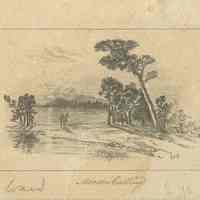
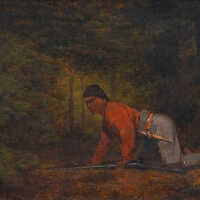
Charles Caleb Ward | Passamaquoddy Scout |
Artist: Charles Caleb Ward Medium: Oil on canvas Old Accession Number: 17
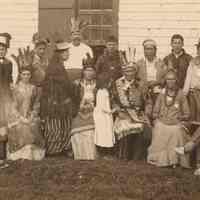
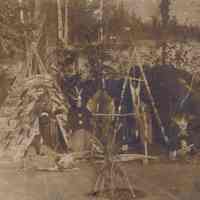
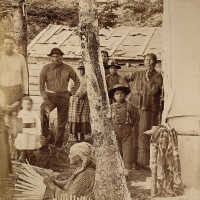
Charles E. Brown | Portrait of Members of the Peskotomuhkati/Passamaquoddy Tribe, Sipayik (Pleasant Point), Maine | c.1890
Portrait of Members of the Peskotomuhkati/Passamaquoddy Tribe, Sipayik (Pleasant Point), Maine, c.1890. Photograph by Charles E. Brown of Eastport, Maine.

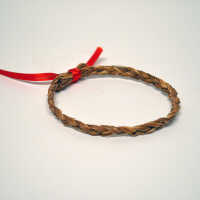
Circular Braid of Sweetgrass [Passamaquoddy] | Unknown artist
Artist: Unknown artist Old Accession Number: 637 Description: 637. Passamaquoddy. Circular Braid of Sweetgrass. Second Shelf from Top.
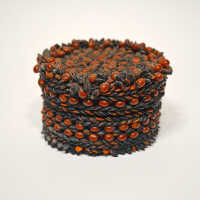
Circular berry covered basket with lid [Passamaquoddy] | Unknown Artist
Artist: Unknown artist Classification: North American Basket Old Accession Number: 643 Description: ?Passamaquoddy. Circular berry covered basket with lid. Middle Shelf.
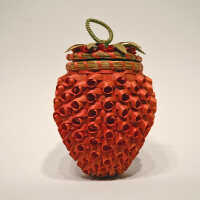
Clara Keezer (1930-2016) | Small Strawberry Basket [Passamaquoddy] |
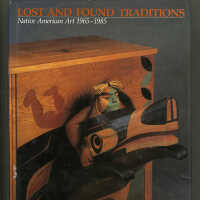
A Passamaquoddy strawberry splint ash and sweetgrass basket by master basketmaker, Clara Neptune Keezer. The basket stands five and a half inches high and three and a half inches wide. Keezer was born in Sipayik, Maine in 1930. She came from a long line of basketmakers before her, learning how to make baskets from her grandmother and her mother. She made her first basket at age eight. At this time, basketmaking was in decline among the Passamaquoddy, Penobscot and other tribes of Maine and Keezer became involved in revitalizing this craft tradition using traditional basketmaking materials of splint brown ash and sweetgrass. One particular traditional basket form she excelled at was the strawberry basket that she took to a new more elegant form and intricate level. She also made blueberry and corn shaped baskets as well as a basket in the shape of a bell. Her baskets soon began to be exhibited elsewhere including in the influential Lost and Found Traditions: Native American Art 1965-85 exhibit that opened at the American Museum of Natural History in New York City in 1986. Ralph T. Coe, the curator of the exhibit, had spent the decade before traveling across the United States, seeking out examples of indigenous art and craft that were undergoing revival and reinvention. Of Clara Keezer, he said, she "is the finest splint craftswoman I met in the Northeast.” Sixteen years later, in 2002, Keezer was recognized as a National Heritage Fellow for her basketmaking talents by the National Endowment for the Arts. She continued basketweaving and teaching young people basketmaking techniques until her death in 2016 at the age of 86. The Tides Institute acquired the strawberry basket through eBay auction. Artist: Clara Keezer Classification: North American Basket Old Accession Number: 625 Description: Passamaquoddy. Small red color strawberry basket. Top Shelf.
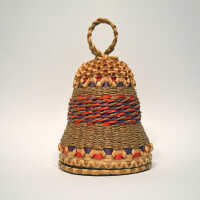
Clara Neptune Keezer (1930-2016) | Bell Shaped Basket [Passamaquoddy]
Artist: Clara Keezer Classification: North American Basket Circa: 1993 Old Accession Number: 650 Description: Passamaquoddy. Bell Shaped Basket. April, 1993. Middle Shelf.
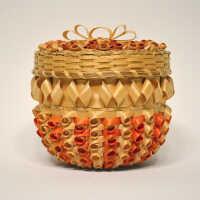
Clara Neptune Keezer (1930-2016) | Medium sized basket with alternating red color [Passamaquoddy]
Artist: Clara Keezer Classification: North American Basket Old Accession Number: 640 Description: Passamaquoddy. Medium sized basket with alternating red color. Second Shelf from Top.
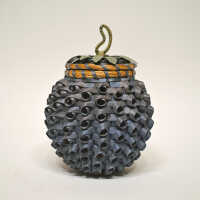
Clara Neptune Keezer (1930-2016) | Small blueberry basket [Passamaquoddy]
Artist: Clara Neptune Keezer Classification: North American Basket Old Accession Number: 631 Description: Passamaquoddy. Small blue color blueberry basket. Top Shelf.
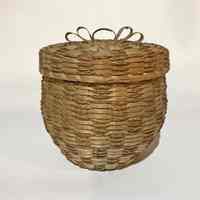
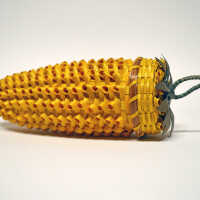
Clara Neptune Keezer (1930-2016) | Yellow Corn Shaped Basket [Passamaquoddy]
Artist: Clara Keezer Classification: North American Basket Old Accession Number: 668 Description: Passamaquoddy. Yellow Corn Shaped Basket. Bottom Shelf.
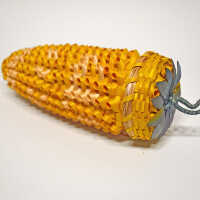
Clara Neptune Keezer (1930-2016) | Yellow Corn Shaped Basket with Lid [Passamaquoddy]
Artist: Clara Keezer Classification: North American Basket Old Accession Number: 653 Description: Passamaquoddy. Yellow Corn Shaped Basket with Lid. 2008. Second Shelf from Bottom.
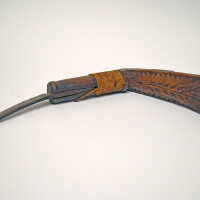
Crooked knife with carved handle [Passamaquoddy] | Unknown Artist
Artist: Unknown artist Classification: North American Basket Old Accession Number: 638 Description: ?Passamaquoddy. Crooked knife with carved handle. Second Shelf from Top.
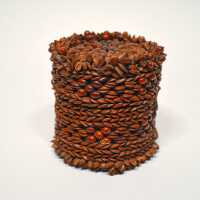
Cylinder berry covered basket with lid [Passamaquoddy] | Unknown Artist
Artist: Unknown artist Classification: North American Basket Old Accession Number: 644 Description: ?Passamaquoddy. Cylinder berry covered basket with lid. Middle Shelf.
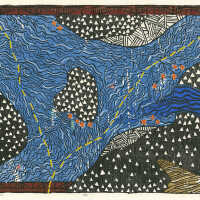
David Umholtz (1943-2014) | Webster Ashburton Treaty 1842
A large (21”/53.3cm x 33”/83.8cm) hand printed woodcut, “Webster-Ashburton Treaty,” by artist, David Umholtz. Born in 1943 in Harrisburg, Pennsylvania, Umholtz migrated to Canada in 1973 and spent much of his early years there in Manitoba where he established Moosehead Press 1977. Through his career, he taught at several universities in Canada as well as Carnegie Mellon in Pittsburgh. In the 1980s he began to summer on Deer Island, New Brunswick where he built a studio and eventually moved there full time. He created a whole body of work that had map like qualities, some with historical references like “Webster-Ashburton Treaty” and some with geographical references like “Le Grand Vortex II” (also in the collections of the Tides Institute) associated with the large “Old Sow” whirlpool off the southern tip of Deer Island. The Webster-Ashburton Treaty of 1842 between the United States and Great Britain gave final definition to the boundary line through Passamaquoddy Bay where Deer Island is located with Grand Manan Island going to Great Britain (now Canada) and Moose Island (where Eastport, Maine is located) going to the United States. In addition to his career as a printmaker, Umholtz was also an avid sailor and could often be seen traversing the waters of Passamaquoddy Bay as he slowly made his way in his small sail powered dory from Deer Island crossing the Canada/U.S. border to Eastport. Late in his career, Umholtz was awarded the two leading artist awards in New Brunswick, the Strathbutler Prize in 2009 and the Lieutenant Governor's Award for Excellence in Visual Art in 2012. Umholtz died in 2014. This particular woodcut was a gift to the Tides Institute by the artist. Artist: David Umholtz Medium: Woodcut. 4/25 Classification: Prints Old Accession Number: 95
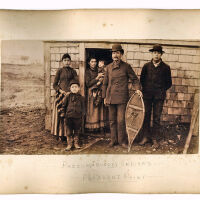
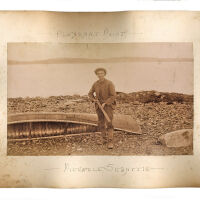
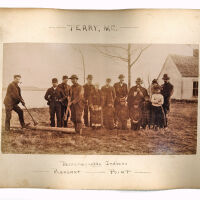
Davis Loring (1819-1891) Photograph Album 1, page 98 | "Passamaquoddy Indians." Pleasant Point, Sipayik, Perry, Maine.
"Passamaquoddy Indians." Pleasant Point, Sipayik, Perry, Maine. Photograph by Davis Loring.
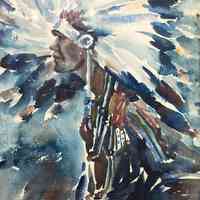
Enid Spidell (1905-?) | Passamaquoddy Portrait | Watercolor | 1933
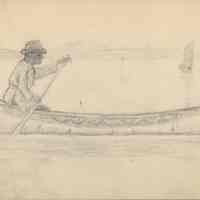
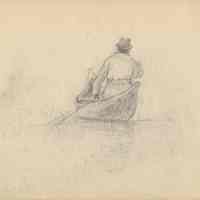
On permanent loan from the Peavey Memorial Library, Eastport, Maine, 2025. Permanent loan agreement on file. Eastport Sentinel July 6, 1932 Page 1, column 2 STRONGER CORPS OF TEACHERS—GOOD REGISTRATION George Pearse Ennis opened the Eastport Summer School of Art on Tuesday July 5th. Mr. Robert C. Craig, Hilton Leach and Stow Wengenroth were at the school to organize their classes. The activity of instructors and students during the past year in the various national exhibitions proves the strength and value of this professional Art School to the Art World of America. Many of the last year’s members of this colony were accepted in New York, Philadelphia and Chicago National Exhibitions. A new class was started this year under the direction of Mr. Stow Wengenroth. Lithograph is developing rapidly and coming into a much fuller place in the sun, people of this country are realizing the beauty and decorative value of fine prints. Mr. Wengenroth has had a great success this year and the students registered in his class are fortunate to have the chance to study with him. Another advance this year is the rebuilding of our etching room, which puts it on a par with the best organized etching rooms of the larger cities. Mr. Leach has produced much excellent work during his stay in Florida this winter. Mr. Ennis and Mr. Leach both had excellent classes at Sarasota, Florida, and a winter school will open there November 15th with George Ennis as director. It is an interesting tie-up Eastport, Maine in summer and a Golf coast school at Sarasota for the winter, the two schools should strengthen and benefit each other. A number of students came from Florida to join the Eastport Colony, Mr. Wilton Taylor of Barton, Fla,, Hannah Low, Miami, Francis Goodell, Bradenton, Margaret McLaughlin Tampa, Fla., and others are expected soon. Miss Eleanoa S. Bulmer, Carson Davenport, Miss Betty Carter, Miss Emy M. Gibbs, Mr. And Mrs. Barton Griffen. Mrs. Griffen is the daughter of D. Henry R. Pattersen whom many Eastport people know as he had spent several summers here; Miss G. M. Knox of Schenectady, N. Y. Miss Dorothea MacDairmaid, Miss Enid Spidell, Miss Anna L. Schadt, Miss Clara Van Beuschoten, Miss Katherine Worcester, Wally D. Richards, Stevan Dohanes, Miss Elizabeth Saltonstall, Bessy E. Creighton, Jack Wilson, Miss Carolin Bradley, Mr. Rotin, Mrs. Gordon and Miss De Bar King. Others are expected, also Mr. and Mrs. Benjamin Turner Kurtz who is associated with Mr. Ennis in the Florida school. The Clipper Ship opened Sunday and a continuous exhibition will be on view in the large dining room. This picture exhibition should interest visitors as it does the Eastport people and they are cordially invited as the dining room is open all day. A new large decorative map of Eastport is being designed and executed to take the place of the one painted several years ago. That was shipped to New York to be framed, but it was stolen from the Grand Central Art Galleries. This map will be 4 x 8 feet and will show tours, locations of interest and harbor. It will be installed permanently in the entrance way to the building. We hope to make this city the most important art colony on the coast and all cooperation from the city will be welcomed and returned. GEORGE PEARSE ENNIS. Eastport Sentinel August 16, 1933 Summer School of Art Special Edition Page 1, column 3 ’33 ART EXHIBIT FINEST ON RECORD BRILLIANT DISPLAY AT ART SCHOOL—LARGEST AND BEST OF SERIES The annual exhibition of the Eastport Summer School of Art is now in progress at the School gallery on High Street having opened there on Saturday. It will continue until after Sunday next, admission to the public being unrestricted and without charge. More than 160 pictures are shown this year, making this the largest exhibition yet attempted by the Art School, and in the opinion of many who have seen the entire series this is best in quality as well as in size. Certainly it excels all its predecessors in breadth of subject, treatment and presentation. The media includes oils, etchings, lithographs, pencils, and watercolor the last being as one might expect, by far the most popular. It would be difficult to select the work of any one artist as outstanding but perhaps the most impressive group is one of seven watercolors by Kenneth How who has developed a characteristic technique distinguishing his style from that of all the others. Equally individual but along wholly different lines is the work of Alice Geary, whose very attractive paintings are not assembled in one group but are found here and there throughout the entire exhibit. Some of these were painted in the Gaspe coast, from which she arrived only a short time ago. One of the most versatile of the students is Irving Brokaw, who won distinction as an athlete in his younger days, culminating a long series of triumphs by winning the national figure-skating championship. He has been successful as a painter in oils, one of his works now being hung in (Continued to page 10 col. 4) the Luxembourg Palace at Paris. In water color, which he took up for the first time last winter he has has made rapid progress. His subjects include flowers, figures, scenes about Eastport and its environs. Barton B. Griffin, painting with massed and contrasted colors, has some fine pictures, and among his work with the pencil are two interesting sketches of well-known local residents. Albert Sumpter Kelley’s work shows much variety and talent, and that of Mrs. Jordan, Miss Spidell, Miss Jones, are broad and decorative. Mrs. Gladys Atwood Ennis is displaying some fine paintings, with two or three very fine efforts among the etchings. Other exhibitors are Del Guercio, G.M. Knox, Dora Pintnsr, Miss Pohl, Miss Grafie, Schaadt and Thompson. All are well worth examination, and at no other place east of Boston can an art lover spend an hour with greater pleasure or profit. Eastport people will be particularly interested in the treatment of various familiar local scenes and subjects by the artists. They have devoted special attention to the regions about Houston’s Cove and Martin’s Dock. Some of the character studies they have made are from such well-known residents as “Willie” Lake, “Gaddie” Hayden and “Sam” Hickery, wharf scenes, flowers, workers among fish, and Indians are also represented among the subjects depicted. An interesting innovation this year is the fact that sealed bids can be made for any painting, a box being provided where these bids can be deposited. One of the paintings also is to be purchased and presented to the Public Library from funds left over from those taken in by the Down East Gallery exhibition last year. Eastport Sentinel August 8, 1934 Page 1, Column 1 ART SCHOOL TO OPEN EXHIBIT SATURDAY PUBLIC RECEPTION IN AFTERNOON—EXHIBITION TO CONTINUE THROUGH NEXT THURSDAY The annual exhibition of the Eastport Summer School of Art will be held this year from Saturday to Thursday next, Aug. 11-16, at the Art School gallery on High Street. It will be opened with a public reception at from 3 to 6, to which all residents and summer visitors here are invited. After Saturday, the exhibition will be open to the public in the afternoon of each day, at from 2 to 5 o’clock. It will be in charge of Mrs. N.M. Atwood on Sunday, of Mrs. Frank T. Wadsworth on Monday, of Mrs. Edward L. Wadsworth on Tuesday, of Mrs. Kenneth How on Wednesday and Of Miss Dorothy Waide on Thursday. Among the students exhibiting are Miss Esther Peck, Cecil Ashdown, Miss Edith Bell, Irving Brokaw, Miss Barbara Bradford, Miss Grace Knox, Miss Ruth Jones, E.W. Jenny, Kenneth How, Robt. W. Huntington, John Huntington, Miss Lena Newcastle, Miss Dorothy Whittier, Mrs. Lena Jordan, Miss Clara VanBenschoten, Miss Gertrude Goodrick, Sylvia Fogel, Anna Schadt, Miss E.O. Cozzens, Miss Elizabeth Balmer, A.W. Gazzette, Dr. Vance of New York, Enid Spidell, Jack Frost, Jim Jollotta, Ted Hamilton and Prof. Waugh. Visiting artists who are exhibiting include: John R. Koopman of New York, Ernest Townsend of New York, Miss Rhoda Low and Wm. Low, Jr., Hugh Collins of Washington, D.C., Daniel Leighton, S. Peter Wagner of Rockville, Md., and Oscar S. Julius of Long Island, N.Y. Work by Robert C. Craig, George Pearse Ennis and Mrs. Gladys Atwood Ennis will also be included in the Exhibition. Eastport Sentinel August 15, 1934 Page 1, Column 3 ART EXHIBIT OPENED SATURDAY LARGEST AND FINEST OF THE SERIES—PROBABLY BEST ON NEW ENGLAND COAST The annual exhibition of paintings by students and teachers at the Eastport Summer School of Art was opened Saturday afternoon, at the gallery on Boynton Street, and not only are there more and better canvases than have been shown here in previous years, but they are better arranged and displayed. In the opinion of more than one critic who has viewed similar exhibits at other points on the New England coast, this is easily the most important in number and quality alike. Dominating the entire exhibition is a remarkable group of four watercolors by Kenneth How. They deal with scenes from the southern section of the town, so idealized and executed with such mastery of composition and loveliness of coloring, as to command instant attention. Robert Craig’s lithographs, and those of Grace Knox and Van Benschoten, are superb. One of the outstanding works shown is a painting by George Pearse Ennis, an interesting portrait of a well-known local resident, Frank Thompson, who lives near the Art School building and assists Mr. Ennis at times by handling various chores there. In this manner his possibilities as a subject for a study in portraiture were called to the artist’s attention, and this painting is the result. A group by Gladys Atwood Ennis’ work in oils and water colors is worthy of careful study, and a series of water colors by Irving Brokaw shows how rapidly he is progressing in this difficult department. Miss Spidell’s portraiture of Indians in which she accomplished unusual effects last year, is nothing short of masterly. Professor Waugh’s etchings are very fine, and a head by Dorothy Whittler shows talent of the first order. An oil painting by Peter Wagner ranks among the best pieces in the exhibition. Jack Huntington, who is spending his first summer here, has completed a group of watercolors that show remarkable ability. He has chosen subjects in the main that have been overlooked by other artists. Other exhibitors, all of whose work is most creditable include Townsend, Ashdown, Jenney, Bradford, Fogel, Goodrich, Pohl, Robert Huntington, Newcastle, Whittier, Cozzins, Laiten, Schadt, Gavett, Jordan and Koopman. Local art students have made a notable contribution to the exhibition. “Ted” Hamilton has a wood block print in black and an oil painting. He has also a pictorial map of Eastport in colors. “Jack” Frost has work in pencil, water color, oils and etching, among the latter being the fine picture of the “Mississippi,” of which he has already sold some fifty copies. James Jollatta is showing his portrait of Franklin D. Roosevelt with the President’s signature. The exhibition is sufficiently large this year to require the use of the walls in the entry and along the stairway and landing, and the walls, of the main gallery formerly the assembly room of the old Boynton High School, are well filled. The interior of the building was thoroly renovated and redecorated this spring, and it now forms a most satisfactory setting for what has come to be recognized as the outstanding exhibition of paintings in Maine. A reception was held at the gallery Saturday afternoon, attended by several hundred people, and the gallery has been visited by crowds on each afternoon since. Many distinguished people have registered there, one of the best known being young John Jacob Astor of New York who visited there today with a party of friends.
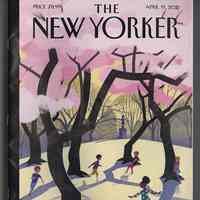
Final Say: How a Self-Taught Linguist Came to Own an Indigenous Language | Alice Gregory | The New Yorker, April 19, 2021
About Carol Dana of the Penobscot Nation
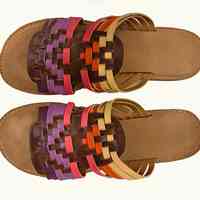
Gabriel Frey (1980 - ) | Leather Sandals | Passamaquoddy | Manitobah
The Gabriel Frey Collection is now available. A celebrated Passamaquoddy artist and master of basketmaking, Gabriel brings his family’s black ash weaving tradition into a new form—woven leather sandals designed in collaboration with Manitobah. These woven leather sandals are named in honour of his children, each pair a tribute to the next generation, grounded in the wisdom of those who shaped his path. Crafted with care and intention, the collection carries stories of land, language, and legacy—meant not only to be worn, but to be shared with the world. A timeless craft, reimagined for the journey ahead. Gabriel Frey (Passamaquoddy) shared his wisdom through his woven sandal collection, teaching us the tradition and care that comes from weaving and basket-making.
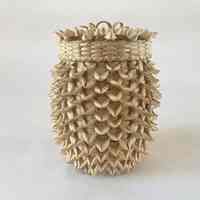
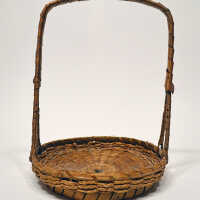
Gathering Basket with Tall Handle [Passamaquoddy] | Unknown Artist
Artist: Unknown artist Description: 662. ?Passamaquoddy. ?Flower gathering basket with tall handle. Bottom Shelf. Old Accession Number: 662
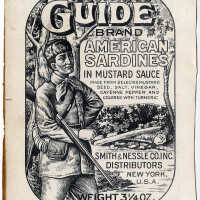
Guide Brand | American Sardines in Mustard Sauce
Old Accession Number: 792 Description: Smith and Nessle Co. INC. Distributors. New York, U.S.A.
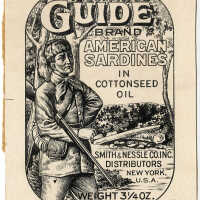
Guide Brand. American Sardines in Cottonseed Oil. | [No Artist Defined]
Old Accession Number: 790 Description: Smith and Nessle Co. INC. Distributors. New York, U.S.A.
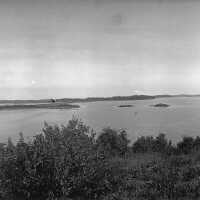
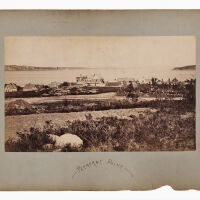
Half Moon Cove, Sipayik/Pleasant Point, Maine | [No Artist Defined]
Classification: Photographs Circa: 1900 Print from photographic negative. Gift of Margaret "Meg" McGarvey of Eastport, Maine. Old Accession Number: 1772 Passamaquoddy
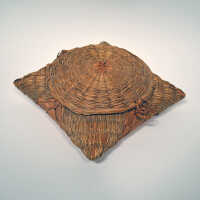
Handkerchief Pillow Basket with Large Circular Lid [Passamaquoddy or Penobscot] | Unknown Artist
Artist: Unknown artist Classification: North American Basket Old Accession Number: 649 Description: ?Passamaquoddy or Penobscot Handkerchief Basket. Large circular lid. Middle Shelf.
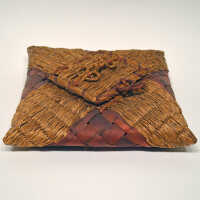
Handkerchief Pillow Basket with Small Square Lid (Passamaquoddy or Penobscot) | Unknown Artist
Artist: Unknown artist Classification: North American Basket Old Accession Number: 646 Description: ?Passamaquoddy or Penobscot Handkerchief Basket. Small square lid. Middle Shelf.
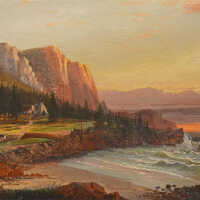
Harrison Bird Brown (1831-1915) | Grand Manan Island, New Brunswick | c.1870
An oil painting of a scene along the coast of Grand Manan Island, New Brunswick by Portland, Maine based artist, Harrison Bird Brown. The painting dates to about 1870. The Tides Institute raised the necessary funds to secure the painting at auction in Detroit. The painting shows encampments along a section of Grand Manan’s shoreline known as “Indian Beach” that was frequented by Passamaquoddies who would come there for the summer months to harvest porpoise and fish from the nearby waters. They would dry the harvest on the seawall along the beach. The camps they built to live in were used only during the summer months. They did not spend the winters there. A larger similar oil painting by Brown titled, “Camping on Grand Manan with the W.H. Pratt of Boston Offshore” shows much the same scene and is in the collections of the Portland (Maine) Museum of Art. Brown was an American painter who was born in Portland, Maine in 1831. He is best known for his marine paintings as well as his landscape paintings of the White Mountains of New Hampshire. Aid from art critic and patron, John Neal, allowed Brown to become Portland’s most successful nineteenth century artist. He and others established the Portland Society of Art in 1882 that would later become known as the Portland Museum of Art. During his life time, Brown exhibited his work at the National Academy of Design. He moved to London in 1892 to live with his daughter and he died there in 1915. Artist: Harrison Bird Brown Medium: Oil on canvas Classification: Paintings Old Accession Number: 75
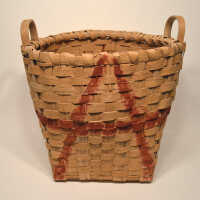
Herring Scale Basket [Passamaquoddy] | Unknown Artist
Artist: Unknown Artist Classification: North American Basket Circa: 1950 Old Accession Number: 1517 Description: Herring Scale Basket. "A" painted on basket stands for Argenta Pearl Essence Factory that was located on Sea Street in Eastport, Maine.
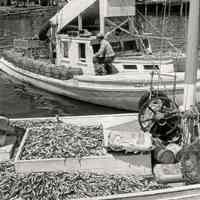
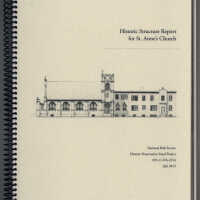
Historic Structure Report for St. Anne's Church | National Park Service, Historic Preservation Fund Project #23-11-NA-2314, July, 2013
Sipayik, Pleasant Point, Maine Passamaquoddy Tribe Roman Catholic Church/Diocese
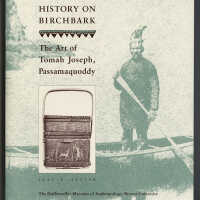
History on Birchbark: The Art of Tomah Joseph, Passamaquoddy | Joan A. Lester | Exhibition Catalogue | The Haffenreffer Museum of Anthropology
The Haffenreffer Museum of Anthropology, Brown University, Bristol, Rhode Island March 7 - August 31, 1993 Robert Abbe Museum, Bar Harbor, Maine September 12 - October 31, 1993
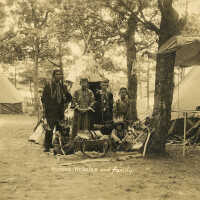
Horace Nicholas and Family |
Classification: Photographs Circa: 1921 Old Accession Number: 1622 Description: Photograph of Horace Nicholas and family (Passamaquoddies) from Maine. Photo was taken at Plymouth, Massachusetts in 1921 during the 300th anniversary of the Plymouth Colony.
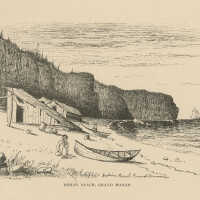
Indian Beach | Grand Manan, New Brunswick
Medium: Engraving Old Accession Number: 355
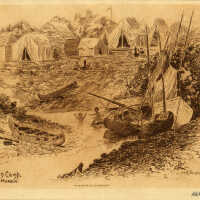
Indian Camp Bar Harbor | H. R. Blaney
Artist: H. R. Blaney Medium: Etching Classification: Prints Circa: 1887 Old Accession Number: 374
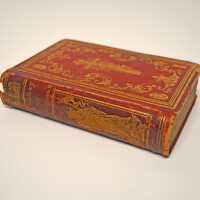
Indian Good Book | Eugene Vetromile
Artist: Eugene Vetromile Circa: 1857 Old Accession Number: 1594
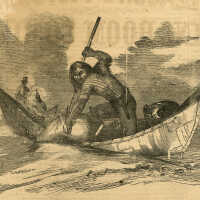
Indian Mode Of Catching Porpoises | Gleason’s Pictorial Drawing-Room Companion, November 29, 1851, Page 496
Medium: Engraving Classification: Prints Old Accession Number: 393 Description: From: Gleason’s Pictorial Drawing-Room Companion, November 29, 1851, Page 496
Indians of North America with Their Weapons of War | Unknown Artist
Artist: Unknown Artist Medium: Engraving Old Accession Number: 8
Large Sewing Basket with Loop Perimeter Band and without Lid [Passamaquoddy] | Edit Unknown artist 660 8/16/12 1:57pm
Artist: Unknown artist Description: 660. ?Passamaquoddy. Large Sewing Basket with loop perimeter band and without lid. Second Shelf from Bottom.
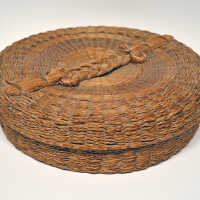
Large low round basket with braided handle [Passamaquoddy] | Unknown Artist
Artist: Unknown artist Classification: North American Basket Old Accession Number: 639 Description: ?Passamaquoddy. Large low round basket with braided handle. Second Shelf from Top.
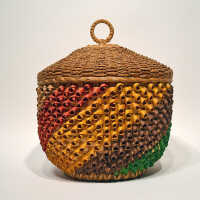
Large multi swirl color basket [Passamaquoddy] | Sylvia Gabriel
Artist: Sylvia Gabriel Classification: North American Basket Old Accession Number: 634 Description: Passamaquoddy. Large multi swirl color basket. Top Shelf.
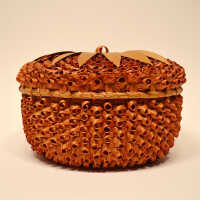
Large round shaped strawberry basket [Passamaquoddy] | Unknown Artist
Artist: Unknown artist Classification: North American Basket Old Accession Number: 629 Description: Passamaquoddy. Large round shaped red color strawberry basket. Unsigned. Top Shelf.
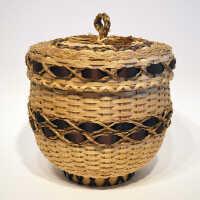
Larger banded basket with lid [Passamaquoddy] | Doris Chapman
Artist: Doris Chapman Classification: North American Basket Old Accession Number: 633 Description: Passamaquoddy. Larger banded basket with lid. November 30, 1997. Top Shelf.
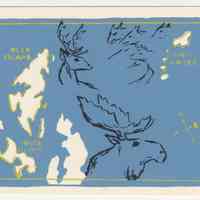
Legend of the Islands | Screen Printed Card | Micmac (Mi'kmaq) Indian Craftsmen, Big Cove Reserve, New Brunswick
Back of Card reads: THE LEGEND OF THE ISLANDS One day, as Glooscap was paddling his canoe near the International border at St. Stephen, he saw some wolves chasing a moose and a deer, who in their fear ran into the sea. They would have been killed or drowned had Glooscap not turned them all into Islands. Today they are known as Deer Island and The Wolves Islands which are part of Canada, while Moose Island is off the coast of Maine. Original tapestry, 100' x 3', at Travel Bureau, St. Stephen, N. B. Designed by Marjory Donaldson and woven by Ivan H. Crowell. Screen printed by Micmac Indian Craftsmen, Big Cove, Reserve, N. B. Card No. 7 Printed in Canada LEGEND OF THE ISLANDS: — DEER ISLAND, MOOSE ISLAND (EASTPORT), THE WOLVES! Front cover of card, one of five cards each featuring different art work on the front, that recently came into our collections. The cards were screen printed and produced by “Micmac Indian Craftsmen” of Big Cove, New Brunswick in the 1960s. Thousands of such cards were produced, but they became largely lost to time until a recent exhibition, Wabanaki Modern: The Artistic Legacy of the 1960s “Micmac Indian Craftsmen”, opened last year at the Beaverbrook Art Gallery in Fredericton and brought them to light again. Curated by our own John Leroux (we’ll claim him as he is on our board of trustees; in real life he is Manager of Collections and Exhibitions at the Beaverbrook), the exhibition recently won a major national Canadian museum award. The exhibition heads to the Abbe Museum in Bar Harbor next where it opens later this year. The back of the card posted here gives the Legend of the Islands: One day, as Glooscap was paddling his canoe near the International border at St. Stephen, he saw some wolves chasing a moose and a deer, who in their fear ran into the sea. They would have been killed or drowned had Glooscap not turned them all into Islands. Today they are known as Deer Island and The Wolves Islands which are part of Canada, while Moose Island is off the coast of Maine.
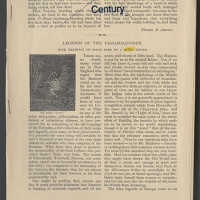
Legends of the Passamaquoddy | Charles G. Leland | The Century Illustrated Monthly Magazine, September, 1884, pp. 668 - 677
"With drawings on birch bark by a Quadi Indian."
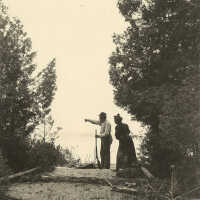
Lillie Kelly and Guide | William Lyman Underwood
Artist: William Lyman Underwood Medium: Photograph Circa: 1896 Old Accession Number: 1432 Description Lillie Kelly and Guide
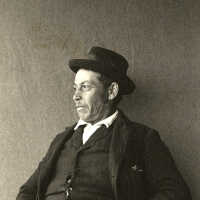
Louis Kutrim[?], Guide, Duck Lake, Maine | William Lyman Underwood
Artist: William Lyman Underwood Medium: Photograph Circa: 1896 Old Accession Number: 1435 Description Louis ____, Guide, Duck Lake
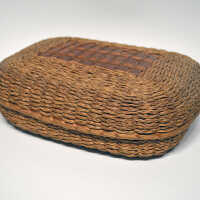
Low Rectangular Shaped Sweet Grass Basket with Rounded Corners [Passamaquoddy] | ?Mary Gabriel
Artist: ?Mary Gabriel Classification: North American Basket Old Accession Number: 656 Description: ?Passamaquoddy. Low rectangular shaped sweet grass basket with rounded corners. Second Shelf from Bottom.
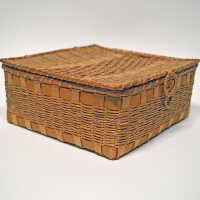
Low Square Shaped Basket with Lid [Passamaquoddy] | Unknown Artist
Artist: Unknown artist Classification: North American Basket Old Accession Number: 655 Description: Passamaquoddy. Low Square Shaped Basket with Lid. Written inside lid: ____ Present From Mrs Brown, Feb. 6, 1897. [Brown may have been wife of Passamaquoddy State Indian Agent]. Second Shelf from Bottom.
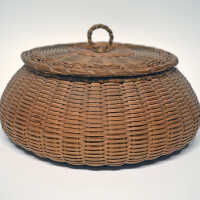
Low Urchin Shaped Basket with Lid [Passamaquoddy] | Unknown Artist
Artist: Unknown artist Classification: North American Basket Old Accession Number: 658 Description: ?Passamaquoddy. Low Urchin Shaped Basket with Lid. Second Shelf from Bottom.
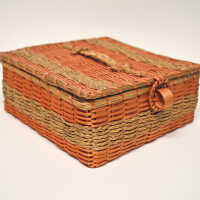
Low square basket with braided handle on top [Passamaquoddy] | Unknown Artist
Artist: Unknown artist Classification: North American Basket Old Accession Number: 641 Description: ?Passamaquoddy. Low square basket with braided handle on top. Second Shelf from Top.
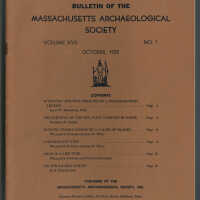
M'Teoulin and Two Versions of a Passamaquoddy Legend | Isaac W. Kingsbury | Bulletin of the Massachusetts Archaeological Society, Volume XVII, No. 1, October, 1955, pp. 1 - 3
Bulletin of the Massachusetts Archaeological Society, Volume XVII, No. 1, October, 1955, pp. 1 - 3 2 copies.
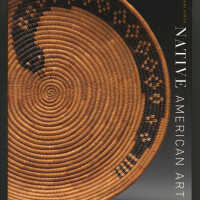
MFA Highlights: Native American Art
Museum of Fine Arts, Boston
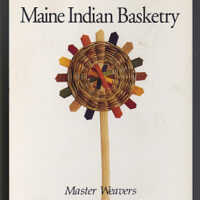
Maine Basketry: Past to Present | Exhibition Catalogue, 1989 | Co-Sponsored by the Maine Crafts Association, Colby College Museum of Art, and the University of Maine at Presque Isle |
Exhibition Catalogue, 1989 | Co-Sponsored by the Maine Crafts Association, Colby College Museum of Art, and the University of Maine at Presque Isle | October 1-November 22, 1989: Colby College Museum of Art January 14-February 16, 1990: University of Maine, Presque Isle
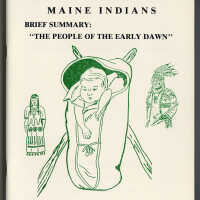
Maine Indians, Brief Summary: "The People of the Early Dawn" | Prepared by Waponahki Museum and Resource Center, Perry, Maine
Joseph A. Nicholas, Director and David A. Francis, Co-Director, text prepared by Alberta Francis Passamaquoddy tribe. 2 copies.
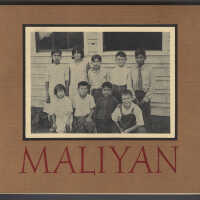
Maliyan / Mary Ann | Mary Ellen Socobasin | Wabnaki Bilingual Education Program, 1979
Passamaquoddy story written by Mary Ellen Socobasin English version by Mary Ellen Socobasin and Robert M. Leavitt
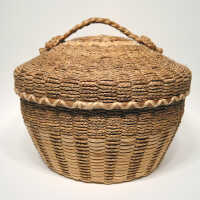
Mary Mitchell Gabriel (1908-2004) | Large Fancy Basket [Passamaquoddy]
A large Passamaquoddy brown ash splint and sweetgrass fancy basket by Mary Mitchell Gabriel. It measures 11 1/4 inches wide and 9 inches high. The basket cover is topped by Gabriel’s trademark braided frog handle that she invented. The basket has a particularly tight weave, another characteristic that her baskets are known for. The bottom of the basket is signed “Mary Gabriel.” Gabriel was the first Maine indigenous American to receive the prestigious National Heritage Fellowship from the American National Endowment for the Arts in 1994. Eleven such fellowships were presented that year and Gabriel was the only recipient from New England. Gabriel was born in 1908 in Motahkomikuk/Indian Township in northern Washington County, Maine. Her mother and grandmother were basket makers, and her father built birch-bark canoes, paddles, and snowshoes. She learned basketmaking from her grandmother and made her first basket when she was about seven years old. Later as an adult and a single mother with seven children, Gabriel moved to Bangor, Maine and earned a living working at the Emple Knitting Mill for 25 years. She continued to make baskets when she could. After the Maine Indian Land Claims Settlement of 1980, Gabriel returned to Motahkomikuk and greatly expanded her basketmaking. She bought the sweetgrass and brown ash splints from other members of the Passamaquoddy tribe. Gabriel died in 2004. The Tides Institute purchased this basket from a collector of Gabriel’s baskets one year before Gabriel passed away. Artist: Mary Mitchell Gabriel Classification: North American Basket Old Accession Number: 1194 Description. Passamaquoddy. Large fancy basket.
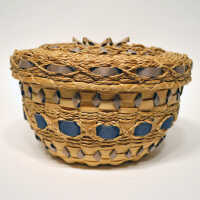
Medium Size Basket [Passamaquoddy] | Gal Frey
Artist: Gal Frey Classification: North American Basket Old Accession Number: 665 Description: Medium Size Basket. Bottom Shelf.
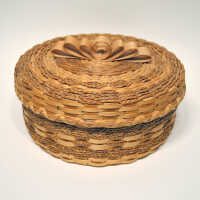
Medium Size Sweet Grass and Ash Basket [Passamaquoddy] | Molly Neptune
Artist: Molly Neptune Classification: North American Basket Old Accession Number: 667 Description: Passamaquoddy. Medium Sized Sweet Grass and Ash Basket. Bottom Shelf.
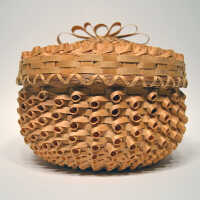
Medium Sized Basket with Ribbon Bow on Top of lid [Passamaquoddy] | D. Campbell
Artist: D. Campbell Classification: North American Basket Old Accession Number: 647 Description: D. Campbell. Passamaquoddy. Medium sized basket with ribbon bow on top of lid. 2001. Middle Shelf.
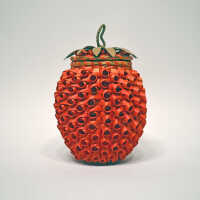
Medium Sized Strawberry Basket [Passamaquoddy] | Unknown Artist
Artist: Unknown artist Classification: North American Basket Old Accession Number: 648 Description: ?Passamaquoddy. Medium sized strawberry basket. Middle Shelf.
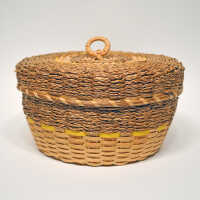
Medium size round basket [Passamaquoddy] | Irene Dana
Artist: Irene Dana Classification: North American Basket Circa: 1995 Old Accession Number: 635 Description: Passamaquoddy. Medium size round basket. Second Shelf from Top.
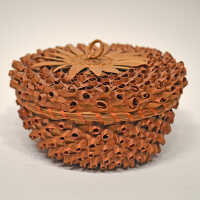
Medium size round red color (now very faded) ?strawberry basket [Passamaquoddy] | Unknown Artist
Artist: Unknown artist Classification: North American Basket Old Accession Number: 642 Description: ?Passamaquoddy. Medium size round red color (now very faded) ?strawberry basket. Second Shelf from Top.
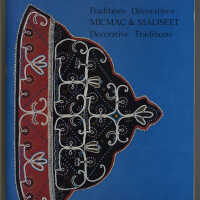
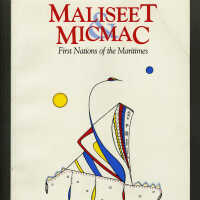
Micmac & Maliseet Decorative Traditions | Edited with an Introduction by Gaby Pelletier | New Brunswick Museum, 1977
A catalogue featuring a selection of Maliseet and Micmac (Mi'kmaq) decorative arts from the collections of the New Brunswick Museum Saint John, New Brunswick
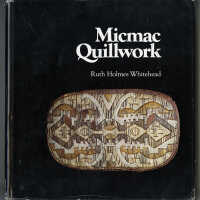
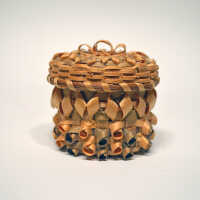
Miniature Basket [Passamaquoddy] | Theresa Neptune Gardner
Artist: Theresa Neptune Gardner Classification: North American Basket Old Accession Number: 657 Description: Passamaquoddy. Miniature Basket. 1995. Second Shelf from Bottom.
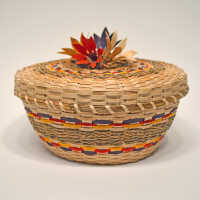
Molly Neptune Parker (1939-2020) | Medium Size Fancy Basket [Passamaquoddy]
A colorful Passamaquoddy fancy basket (7 1/2” wide x 5 1/2 high”) made by Passamaquoddy master basketmaker, Molly Neptune Parker. She wove the basket together using thin strips of split ash and strands of braided sweetgrass adding a series of carved flowers to the top that was a signature characteristic of her baskets as its was her mother’s who was also a basketmaker. This basket is one of three baskets, including an acorn shaped basket, made by Parker in the collections of the Tides Institute. Parker specialized in making fancy baskets, a style of decorative basket developed by the Passamaquoddies and other Native Americans in the latter part of the 19th century to sell to European-American tourists who begin to visit the area in increasing numbers at the same time. Parker was born in 1939 in Motahkomikuk/Indian Township in northern Washington County, Maine. She made a great many baskets over her life, among other forms some were in the shape of strawberries, others in the shape of acorns that she was particularly known for. To make a fancy basket might take five days from start to finish. In 2012, the National Endowment for the Arts named Parker a National Heritage Fellow. She was also a founder and president of the Maine Indian Basketmakers Alliance that sought to preserve, revive and extend the basketmaking craft. She taught basketmaking workshops in the area and sold her work locally as well as across the United States. She died in 2020. Artist: Molly Neptune Parker Classification: North American Basket Circa: 2008 Old Accession Number: 1518 Description: Passamaquoddy. Medium size fancy basket.
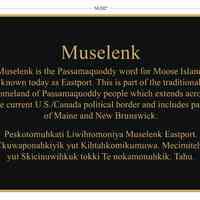
Muselenk Place Name Bronze Plaque | 2023
Bronze plaque (14" wide by 9" high) for Passamaquoddy place name, Muselenk, with description in English and Passamaquoddy. English wording by Donald Soctomah, director of the Passamaquoddy Cultural Heritage Museum and director of the Passamaquoddy Historic Preservation Office at Motahkomikuk, Maine. Passamaquoddy translation by Dwayne Tomah, director of the Sipayik Museum at Sipayik. Plaque is to be placed in the summer of 2023 on the front of the main building of the Tides Institute & Museum of Art in downtown Eastport, Maine. This is the first time that the Muselenk place name is publicly visible in Eastport and the first time that the Passamaquoddy language is publicly visible in Eastport. Muselenk Muselenk is the Passamaquoddy word for Moose Island, known today as Eastport. This is part of the traditional homeland of Passamaquoddy people which extends across the current U.S./Canada political border and includes parts of Maine and New Brunswick. Peskotomuhkati Liwihtomoniya Muselenk Eastport. Ckuwaponahkiyik yut Kihtahkomikumuwa. Mecimitehc yut Skicinuwihkuk tokki Te nokamonuhkik. Tahu.
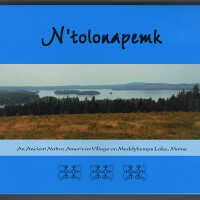
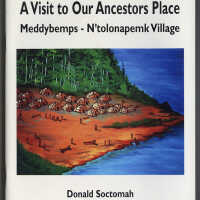
N'tolonapemk: An Ancient Native-American Village on Meddybemps Lake, Maine
32 page booklet produced by the University of Maine at Farmington Archaeology Research Center and the Passamaquoddy Tribe.
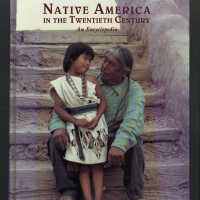
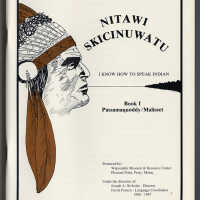
Nitawi Skicinuwatu | I Know How to Speak Indian | Passamaquoddy / Maliseet Book
Produced by Waponahki Museum & Resource Center, Pleasant Point, Perry, Maine Under the direction of Joseph A. Nicholas, Director, and David Francis, Language Coordinator, 1986 - 1987
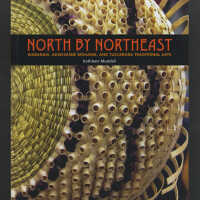
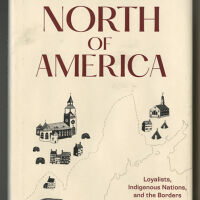
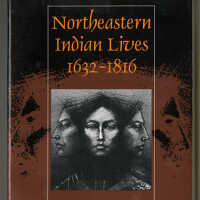
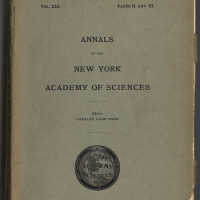
Notes on Passamaquoddy Literature | J. Dynely Prince | Annals of the New York Academy of Sciences, Vol XIII, 1900 - 1901, Parts II and III, pp. 381 - 386
Annals of the New York Academy of Sciences, Vol XIII, 1900 - 1901, Parts II and III, pp. 381 - 386
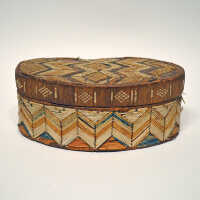
Oval Shaped Quill Box/basket [Mi’Kmaq] | Unknown Artist
Artist: Unknown artist Classification: North American Basket Old Accession Number: 645 Description: Mi’Kmaq oval shaped quill box/basket. Middle Shelf.
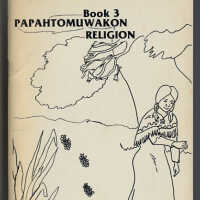
Papahtomuwakon / Religion | Book 3
Produced by Title VII Bilingual Program under the direction of Joseph A. Nicholas, Director and David A. Francis, Sr., Language Coordinator, Perry, Maine Passamaquoddy tribe.
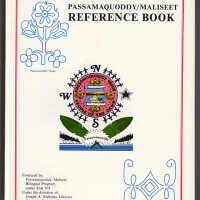
Passamaquoddy / Maliseet Reference Book | Produced by Passamaquoddy Maliseet Bilingual Program, 1988
Produced by Passamaquoddy Maliseet Bilingual Program under Title VII Under the director of Joseph A. Nicholas, Director; David A. Francis, Coordinator; and Alberta Nicholas, Bilingual Secretary 1988
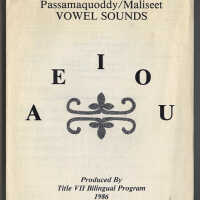
Passamaquoddy / Maliseet Vowel Sounds | A E I O U | Produced by Title VII Bilingual Program, 1986
Produced by Title VII Bilingual Program under the direction of Joseph A. Nicholas, Director and David A. Francis, Sr., Language Coordinator, Perry, Maine Passamaquoddy tribe.
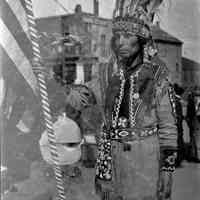
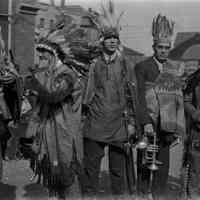
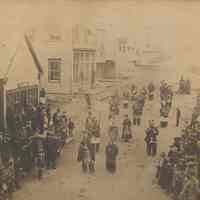
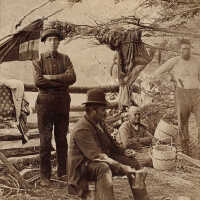
Passamaquoddy Basket Making, Campobello Island, New Brunswick | Davis Loring
Artist: Davis Loring Classification: Photographs Circa: 1885 Old Accession Number: 1634 Description: Passamaquoddies on Campobello Island, New Brunswick.
Passamaquoddy Basket Making, Campobello Island, New Brunswick | Davis Loring
Artist: Davis Loring Classification: Photographs Circa: 1885 Old Accession Number: 1633 Description: Passamaquoddies on Campobello Island, New Brunswick.
Passamaquoddy Children | Charles Caleb Ward
Artist: Charles Caleb Ward Classification: Publication Old Accession Number: 2322 Description: One of a set of 20 large scale posters of images of artwork in the collections of the Tides Institute & Museum of Art, Eastport, Maine. Poster set was produced as part of the ArtLink Project that distributed poster sets to schools throughout Washington County, Maine.
Passamaquoddy Community Vision, 1996: A Design for Community Development | Passamaquoddy Tribe any Pleasant Point, Sipayik, Perry, Maine
In Passamaquoddy/Wabanaki Vertical Files. 2 copies
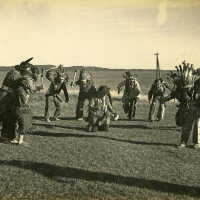
Passamaquoddy Dancers | [No Artist Defined]
Classification: Photographs Circa: 1938 Old Accession Number: 1823
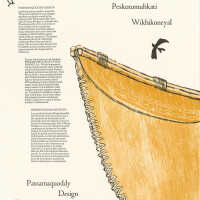
Passamaquoddy Design | David Wolfe / David Moses Bridges | 2010
A letterpress printed poster, “Peskotomuhkati Wikhikoneyal,” produced by the Tides Institute in 2010 in collaboration with letterpress printer and designer, David Wolfe, of Wolfe Editions of Portland, Maine and Passamaquoddy artist, David Moses Bridges. In English, the title of the poster is “Passamaquoddy Design” and in French, “Dessin Passamaquoddy.” Two hundred and fifty copies of the 15 7/8” (width) x 22 3/8” (height) tri-language poster were printed as part of a limited edition. The poster image was carved by David on birch bark, reinforced with a wood backing and then inked and printed directly on to the surface of the poster paper. Passamaquoddy design motifs have been used for centuries. There are hundreds of such designs and they are deeply rooted in the culture of the Passamaquoddy. David Moses Bridges was a contemporary Passamaquoddy artist and he used many many of these design motifs - sometimes traditional ones, sometimes adaptations, sometimes new ones of his own creation - in his birchbark canoes and birchbark containers. This poster reproduces one of the traditional motifs that David used in his work. The two tone color between the birchbark surface and the motif carving accentuates the design and its simplicity. David died in 2017. The Passamaquoddy text was written and translated by Joan Dana, Brenda Dana Lozada and Wayne Newell with assistance of Donald Soctomah. The French text was written and translated by Ross Paradis with assistance of Sheila Jans. Photo caption: Letterpress printed poster, “Peskotomuhkati Wikhikoneyal,,” 15 7/8” (width) x 22 3/8” (height), 250 copies, 2010. Letterpress printed poster produced by the Tides Institute in collaboration with letterpress printer, David Wolfe, of Wolfe Editions of Portland, Maine and Passamaquoddy artist, David Moses Bridges. Artist: David Wolfe / David Moses Bridges Medium: Letterpress Dimensions: 15 7/8”w x 22 3/8”h Classification: Prints Circa: 2010 Old Accession Number: 895 Description: Poster designed and printed by David Wolfe. Part of the Hand Line Press series of posters produced by the Tides Institute & Museum of Art. A limited edition of 250 copies produced in 2010. Partial funding for this poster and related workshops comes from the Maine Arts Commission. Image printed directly from birch bark and wood. Passamaquoddy text written and translated by Joan Dana, Brenda Dana Lozada and Wayne Newell with assistance of Donald Soctomah. French text written and translated by Ross Paradis with assistance of Sheila Jans.
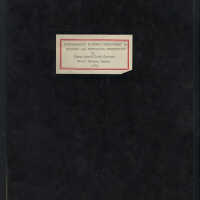
Passamaquoddy Economic Development in Cultural and Historical Perspective | Susan MacCulloch Stevens | Mount Vernon, Maine | 1973
Prepared under a contract with The Center for the Study of Man, Smithsonian Institution; and the U.S. Economic Development Administration Research Division.
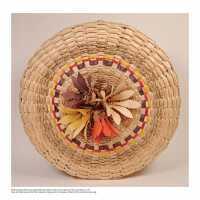
Passamaquoddy Fancy Basket | Molly Neptune Parker
Artist: Molly Neptune Parker Classification: Publication Old Accession Number: 2324 Description: One of a set of 20 large scale posters of images of artwork in the collections of the Tides Institute & Museum of Art, Eastport, Maine. Poster set was produced as part of the ArtLink Project that distributed poster sets to schools throughout Washington County, Maine.
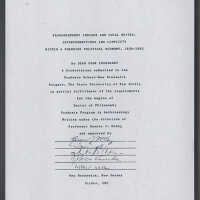
Passamaquoddy Indians and Local Whites: Interconnections and Conflicts within a Changing Political Economy, 1600 - 1983 | Joan Cook Luckhardt | Ph.D. Dissertation Thesis, 1985
A dissertation submitted to the Graduate School - New Brunswick, Rutgers, The State University of New Jersey, in partial fulfillment of the requirements for the degree of Doctor of Philosophy, Graduate Program in Anthropology, October, 1985
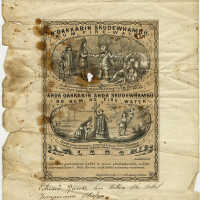
Passamaquoddy/English Temperance Pledge | 1870
A large Passamaquoddy/English language temperance pledge broadside that dates to 1870. The pledge is signed by Edward Quick of Eastport, Maine and by Catholic Jesuit priest, Eugene Vetromile, who served the Catholic churches at both Eastport and the nearby Passamaquoddy community at Sipayik, Maine in the mid-19th century. During his time as a Jesuit priest, he wrote several books on Wabanaki history and worked on a Wabanakii language dictionary as well. The Tides Institute acquired the broadside from a descendant of the Quirk family who wanted to see the broadside preserved and accessible in an institution in the region where the broadside originatted. Thanks to Donald Soctomah, historic preservation officer for the Passamaquoddy Tribe, the broadside was recently translated by Robert Leavitt and Margarett Apt. Their line by line translation is as follows: N'dakkabin = Rum Skudewhambu = firewater Peseku wonismuhinoh, nanquitchidahamal matchi Niweskum, anda kegus kepkuattasseu, metchinabi, te alihkle Alamkik If I lose track and drink, I will try to think of God, and not drink anything, otherwise I would die and go to Hell. Anda Dakkabin = no rum Anda Skudewhambu = no firewater Peseku esma wonismiu, nanguitchdahamal ketchi Niweskum, If I lose track and drink, I will try to think of God, n’messeli messinemon, sipkauso, tehetch ulitahaso lannihahali. I publicly show it, he will live a long life, he will be happy, Amen. Nia … niak’dihlel ndamina gatosmiwon hokbe te messi skudewhambu; I am going to swear that I will not drink any kind of liquor; wibitte acquamalsiane, lhite Doctol, niakdihlel ndamina wonsmiu. as soon as I feel better, I will go to the doctor, and I will not forget. Pledge No Drinking - Father Vetromile 1870 Translations by Margaret Apt & Robert Leavitt (2021) N'dakkabin = Rum This looks more like ntahkopim “my cold drink” (the word does not appear in the text below) Skudewhambu = firewater Sqotewop (literally, “fire-water”) anda dakkabin = no rum Ma-te ntahkopim (originally may have been ntama ntahkopim) anda skudewhambu = no firewater Ma-te sqotewop (originally may have been ntama sqotewop) Peseku wonismuhinoh, nanquitchidahamal matchi Niweskum, anda kegus kepkuattasseu, metchinabi, te alihkle Alamkik Pseqossomiyan, ntoqecitahama kci-Niweskum, ma-te keqoss nkotuwossomiw, nmehcin-op naka ntoli Lamkik. If I lose track and drink, I will try to think of God, and not drink anything, otherwise I would die and go to Hell. Peseku esma wonismiu, nanguitchdahamal ketchi Niweskum, Pseqossomiyan, ntoqecitahama kci-Niweskum, If I lose track and drink, I will try to think of God, n’messeli messinemon, sipkauso, tehetch ulitahaso lannihahali. nmessuwi-messunomon, sipkawsu-tehc, wolitahasu, niyalic. ??? I publicly show it, he will live a long life, he will be happy, ???Amen. Nia … niak’dihlel ndamina gatosmiwon hokbe te messi skudewhambu; Nila … Nila nkoti-wolaman, ntama-na nkotuhsomiwon psiw sqotewop; I am going to swear that I will not drink any kind of liquor; wibitte acquamalsiane, lhite Doctol, niakdihlel ndamina wonsmiu. woli-te aqamolsiyan, ihik taktalk nkoti-li, ntama-na nunitahasiw. as soon as I feel better, I will go to the doctor, and I will not forget. Temperance Pledge. Edward Quirk has taken the total Temperance Pledge. Eastport [Maine], January 8, 1870. Signed by Edward Quirk and Eugene Vetromile, Pastor. Purchased from Roger Quirk of Lubec, Maine in 2012. Old Accession Number: 1062
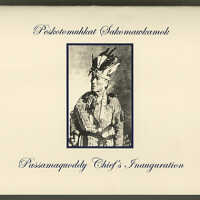
Peskotomuhkat Sakomawkamok | Passamaquoddy Chief's Inauguration | Invitation | 2015
Frederick Moore III, Tribal Chief of the Passamaquoddy at Sipayik Vera Francis, Vice-Chief of the Passamaquoddy at Sipayik Sunday, August 9, 2015
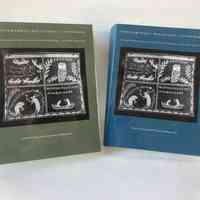
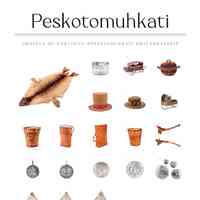
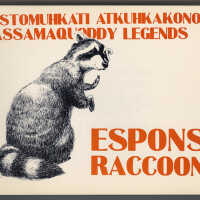
Pestomuhkati Atkuhkakonol / Passamaquoddy Legends | Espons / Raccoon
Wabnaki Bilingual Education Program, ESEA Title VII, Indian Township, Maine, 1976 2 copies.
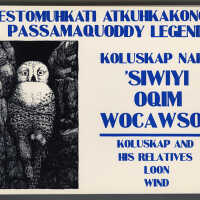
Pestomuhkati Atkuhkakonol / Passamaquoddy Legends | Koluskap Naka ’Siwiyi Oqim Wocawson / Koluskap and His Relatives Loon, Wind
Wabnaki Bilingual Education Program, ESEA Title VII, Indian Township, Maine, 1976 2 copies
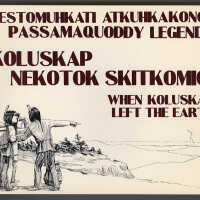
Pestomuhkati Atkuhkakonol / Passamaquoddy Legends | Koluskap Nekotok Skitkomiq / When Koluskap Left the Earth
Wabnaki Bilingual Education Program, ESEA Title VII, Indian Township, Maine, 1976
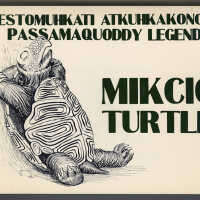
Pestomuhkati Atkuhkakonol / Passamaquoddy Legends | Mikcic / Turtle
Wabnaki Bilingual Education Program, ESEA Title VII, Indian Township, Maine, 1976 2 copies
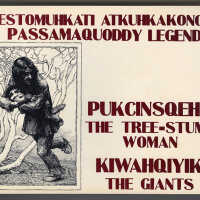
Pestomuhkati Atkuhkakonol / Passamaquoddy Legends | Pukcinsqehs / The Tree-Stump Woman | Kiwahqiyik / The Giants
Wabnaki Bilingual Education Program, ESEA Title VII, Indian Township, Maine, 1976
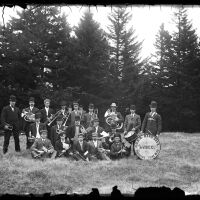
Photographer Once Known | Lubec, Maine Glass Plate Negative, Number 20
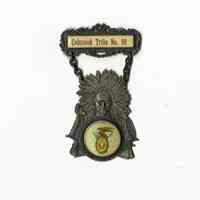
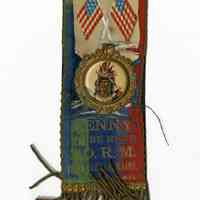
I.O.R.M. [Improved Order of Red Men] Band Association, Cobscook Tribe, No. 80, Lubec, Maine. Gift from the Estate of Sheila Fernald Malloch, 2022.
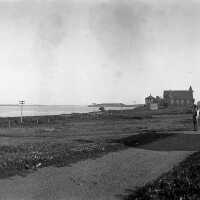
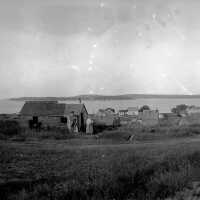
Pleasant Point / Sipayik, Maine | Charles E. Brown, Photographer
Print from photographic negative. Gift of Margaret "Meg" McGarvey of Eastport, Maine. Classification: Photographs Circa: 1900 Old Accession Number: 1660 Passamaquoddy
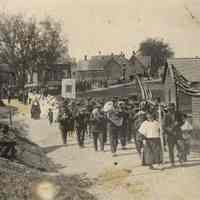
Pleasant Point / Sipayik, Maine | [No Artist Defined]
Print from photographic negative. Gift of Margaret "Meg" McGarvey of Eastport, Maine. Classification: Photographs Circa: 1900 Old Accession Number: 1680 Passamaquoddy
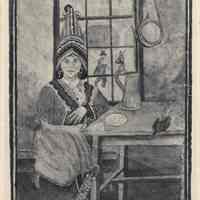
Portrait of Denny Neptune Soccabeson | Lt. Alexander Henry Charles Villiers (d. 1847-1849) | Photograph of Original Watercolor Painting
Photograph of original watercolor painting. Original painting is now in the collections of Colonial Williamsburg. See web link to Colonial Williamsburg entry on this painting. Description from Colonial Williamsburg web site: An interior scene with a Native woman seated, her arms crossed, on a bench in front of a table set with a pitcher, two dishes (one seems to be slipping off the table), and a feather object hanging over the edge of the table. The woman is dressed in an elaborate costume including a high-crowned, decorated hat completely covering her hair. She wears a cross on a chain around her neck and large hoops in her ears. A small cradleboard supporting a bound figure is propped beside her against a table leg. A water canteen hangs from a strap to the right of the window. The scene outside the window includes two men in military dress marching towards one another; one carries a rifle on his shoulder and the other carries a sword. Two large buildings are situated beyond the marching men. Artist unidentified. Label Text from Colonial Williamsburg web site: Native American women often accompanied their husbands on trading missions, sometimes carrying on the active business of bartering on these excursions. Likely this Passamaquoddy woman came to Fort Sullivan (now part of Eastport, Maine) for such a purpose. Shown seated in one of the barracks buildings, the sitter was the daughter of Francis Joseph Neptune, hereditary leader of the Passamaquoddy who occupied nearby Point Pleasant. Her colorful traditional attire includes a conical cap and overdress with leggings; she also wears two circular silver brooches, earrings, and a pendant cross on a bead necklace. The figure strapped onto the cradleboard in front of her represents a baby, not a doll. The town of Eastport was occupied by British troops during the War of 1812, with a garrison at Fort Sullivan. Access to the fort was strictly controlled during 1814-1818, so it is surmised that this 1817 portrait of Soccabeson was rendered by one of the British officers stationed there. Sketches of the bay and harbor executed by Lt. Alexander Henry Charles Villiers survive, making him a candidate for the portrait artist. A nineteenth-century history of the area describes Villiers as being "extremely fond of drawing."
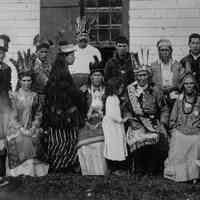
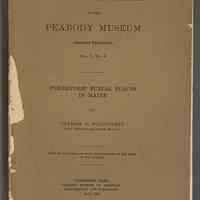
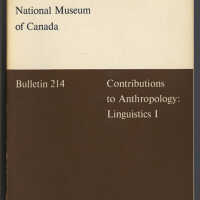
Preliminary Report on Malecite-Passamaquoddy | Karl V. Teeter | National Museum of Canada, Bulletin 214, Contributions to Anthropology: Linguistics I, pp. 157 - 162
National Museum of Canada, Bulletin 214, Contributions to Anthropology: Linguistics I, pp. 157 - 162
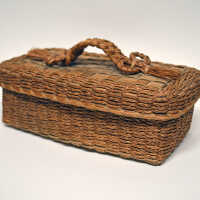
Retangular box shaped basket with braided handle on top [Passamaquoddy] | Unknown Artist
Artist: Unknown artist Classification: North American Basket Old Accession Number: 636 Description: ?Passamaquoddy. Retangular box shaped basket with braided handle on top. Second Shelf from Top.
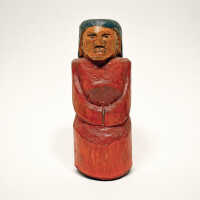
Rocky Keezer (1969- ) | Carved Wooden Female Figure [Passamaquoddy]
Artist: Rocky Keezer Old Accession Number: 628 Description: 628. Rocky Keezer. Passamaquoddy. Carved wooden female figure. Signed “R. Keezer.” Top Shelf.
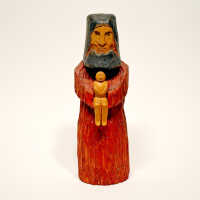
Rocky Keezer (1969- ) | Carved wooden bearded male figure holding baby/small child [Passamaquoddy]
Artist: Rocky Keezer Old Accession Number: 627 Description: 627. Rocky Keezer. Passamaquoddy. Carved wooden bearded male figure holding baby/small child. Initials “R.K.” Top Shelf.
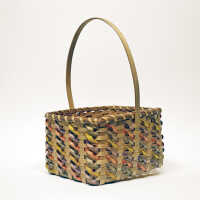
Rocky Keezer (1969- ) | Square basket with handle [Passamaquoddy]
Artist: Rocky Keezer Classification: North American Basket Old Accession Number: 624 Description: Passamaquoddy. Square basket with handle. March, 1990. Top Shelf.
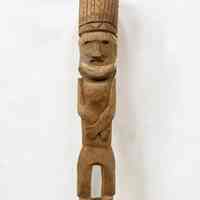
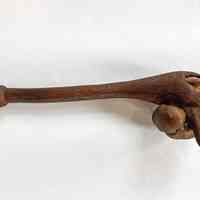
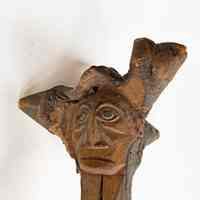
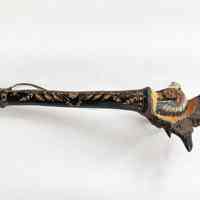
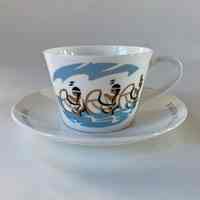
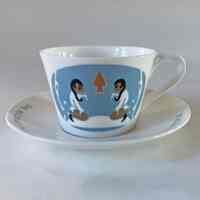
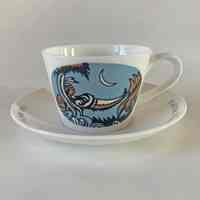
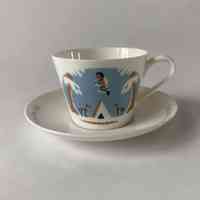
Royal Tuscan Cup and Saucer | Micmac (Mi'kmaq) Indian Craftsmen | Big Cove Reserve, New Brunswick
Gift of John Leroux, 2026.
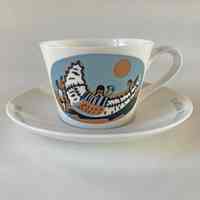
Royal Tuscan Cup and Saucer | Micmac (Mi'kmaq) Indian Craftsmen | Big Cove Reserve, New Brunswick
MICMAC CRAFTSMEN DESIGN, 1960s! We’ll have a exhibition beginning next August on the hugely successful “Micmac Indian Craftsmen” design collective based in New Brunswick during the 1960s. The collective designed notecards, tapestries, porcelain, and other objects and attracted an immediate following around the globe. Works in the exhibition will very largely be loans through the Beaverbrook Art Gallery in Fredericton, New Brunswick that organized an original and larger exhibition on the same the subject called “Wabanaki Modern” in 2022. The exhibition has been at the Abbe Museum in Bar Harbor, Maine for much of the past year. Now a portion of the exhibition will be coming here and will include a few pieces from our own collections including this English produced Royal Tuscan china teacup with Micmac design.
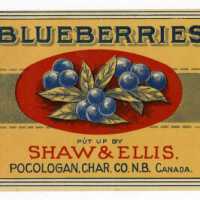
Shaw & Ellis, Indian Chief Brand Blueberries Label | [No Artist Defined]
Classification: Prints Circa: 1920 Old Accession Number: 1782 Description: Pocologan, Charlotte County, New Brunswick
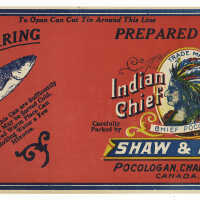
Shaw & Ellis, Indian Chief Brand Prepared Herring Label | [No Artist Defined]
Classification: Prints Circa: 1920 Old Accession Number: 1782 Description: Pocologan, Charlotte County, New Brunswick. Printed by Knowles Litho, Saint John, New Brunswick.
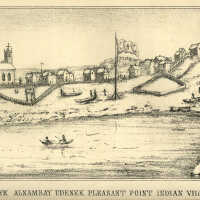
Sibayk Alnambay Udenek Pleasant Point Indian Village | [No Artist Defined]
Old Accession Number: 1590 From Indian Good Book - For The Benefit Of The Penobscot, Passamaquoddy, St. John's, Micmac, And Other Tribes Of The Abnaki Indians - 1856 by Eugene Vetromile
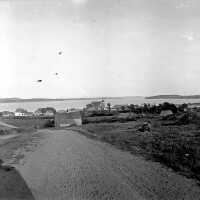
Sipayik/Pleasant Point, Maine | [No Artist Defined]
Classification: Photographs Circa: 1900 Print from photographic negative. Gift of Margaret "Meg" McGarvey of Eastport, Maine. Old Accession Number: 1776 Passamaquoddy
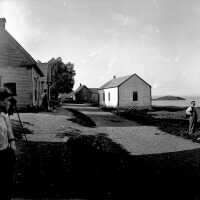
Sipayik/Pleasant Point, Maine | [No Artist Defined]
Classification: Photographs Circa: 1900 Print from photographic negative. Gift of Margaret "Meg" McGarvey of Eastport, Maine. Old Accession Number: 1774 Passamaquoddy
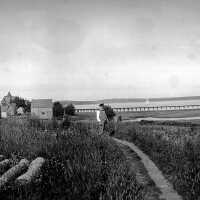
Sipayik/Pleasant Point, Maine | [No Artist Defined]
Classification: Photographs Circa: 1900 Print from photographic negative. Gift of Margaret "Meg" McGarvey of Eastport, Maine. Old Accession Number: 1773 Passamaquoddy
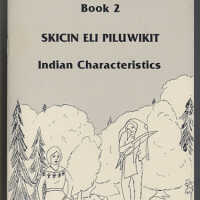
Skin Eli Piluwikit / Indian Characteristics | Book 2
Produced by Title VII Bilingual Program under the direction of Joseph A. Nicholas, Director and David A. Francis, Sr., Language Coordinator, Perry, Maine Passamaquoddy tribe.
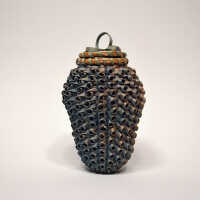
Small Green Color Fruit Shaped basket [Passamaquoddy] | Theresa Neptune Gardner
Artist: Theresa Neptune Gardner Classification: North American Basket Old Accession Number: 626 Description: Passamaquoddy. Small green color fruit? Shaped basket. Top Shelf.
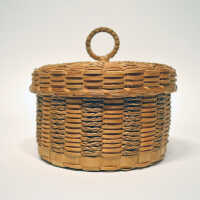
Small Lidded Basket [Passamaquoddy] | Mary Gabriel
Artist: Mary Gabriel Classification: North American Basket Old Accession Number: 663 Description: Passamaquoddy. Small lidded basket. Bottom Shelf.
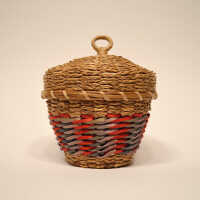
Small multi swirl color basket [Passamaquoddy] | Theresa Neptune Gardner
Artist: Theresa Neptune Gardner Classification: North American Basket Circa: 1995 Old Accession Number: 632 Description: Passamaquoddy. Small multi swirl color basket. Top Shelf. 1995.
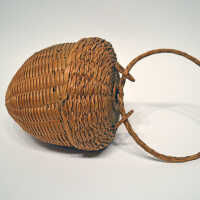
Smaller Acorn Shaped Basked with Hinged Lid and Hoop Handle [Passamaquoddy] | Unknown Artist
Artist: Unknown artist Classification: North American Basket Old Accession Number: 653 Description: ?Passamaquoddy. Smaller acorn shaped basked with hinged lid and loop handle. Middle Shelf.
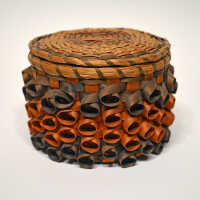
Smallish Orange and Black (Faded) Basket with Lid [Passamaquoddy] | Unkown Artist
Artist: Unkown artist Classification: North American Basket Old Accession Number: 652 Description: ?Passamaquoddy. Smallish orange and black (faded) basket with lid. Middle Shelf.
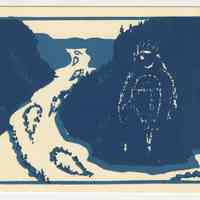
Snowshoe Island Legend | Screen Printed Card | Micmac (Mi'kmaq) Indian Craftsmen, Big Cove Reserve, New Brunswick
Back of Card reads: SNOWSHOE ISLAND LEGEND Long, long ago Glooscap walked up the Saint John river on his snow shoes, in the early spring. Compressed snow tracks are always slow to melt. This was true of Gloosacp's tracks, but his were so large and firm that many of them can still be seen as Islands. Watch for them as you drive along the Saint John river. Our Indians tell many legends of Glooscap, their great god. The Micmac language was one of the most complex and has been composed with Latin, Greek and Sanskrit. Original tapestry, 3' x 8', at Travel Bureau, Woodstock, N. B. Designed by Marjory Donaldson and woven by Ivan H. Crowell. Screen printed by Micmac Indian Craftsmen, Big Cove, Reserve, N. B. Card No. 10 Printed in Canada
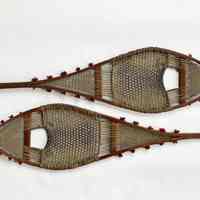
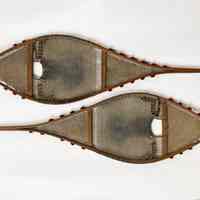
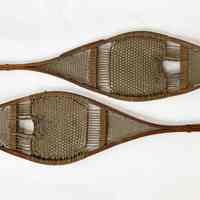
Snowshoes |
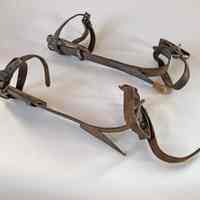
Written on one of the snowshoes: Snow Shoe, Indian Made, Canada Brought from Hudson Bay Post, Canada by Horace Nicholas, Passamaquoddy Indian, 1909. Used last by George, Feb. 1, 1923 Jno. and George Hill. 24 Silver Street, Waterville, Maine
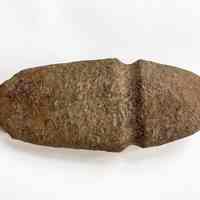
Stone Mallet 1 | Passamaquoddy
This mallet was made from 5,000 to 10,00 years ago. It was found at Shackford's Cove, Eastport, Maine in 1958 by Gerald McGarvey.
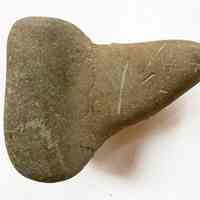
Stone Mallet 2 | Passamaquoddy
Found in the Dennysville, Maine area.
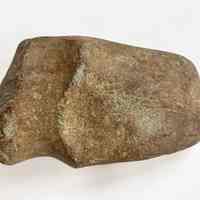
Stone Mallet 3 | Passamaquoddy
Found in the Dennysville, Maine area.
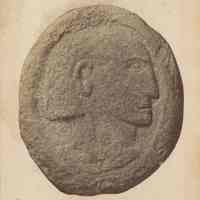
Stone Passamaquoddy Profile | Photograph by Charles Caleb Ward
Found along shores of Lake Utopia, St. George, New Brunswick. The stone profile is now part of the collections of the New Brunswick Museum, Saint John, New Brunswick.
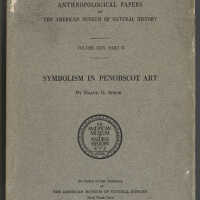
Symbolism in Penobscot Art | Frank G. Speck | Anthropological Papers of the American Museum of Natural History, Volume XXIV, Part II, 1927
Anthropological Papers of the American Museum of Natural History, Volume XXIV, Part II, 1927
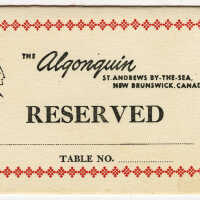
The Algonquin, St. Andrews By-The-Sea, New Brunswick, Canada - Reserved Table Card
Old Accession Number: 1048
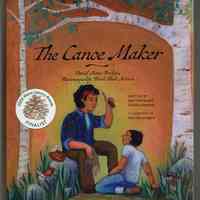
The Canoe Maker: David Moses Bridges, Passamaquoddy Birch Bark Artisan | Written by Jean Flahive and Donald Soctomah | Illustrated by Mari Dieumegard
Written by Jean Flahive and Donald Soctomah | Illustrated by Mari Dieumegard
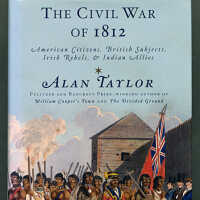

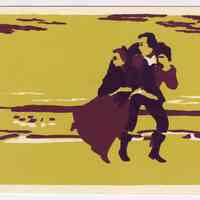
The Legend of Marguerite | Screen Printed Card | Micmac Indian (Mi'kmaq) Craftsmen, Big Cove Reserve, New Brunswick
Back of Card reads: THE LEGEND OF MARGUERITE Marguerite's father wanted her to marry an old wealthy gentleman, but she eloped with Paul, a tall, dark and handsome worker on her father's large farm. She was disowned. Today, with the moon just right you can see Marguerite's sad but beautiful face smile up at you in the border river between N.B. and N.S. that once bore her name. The river is now caled the Missaquash. Original tapestry, 47" x 62", at Travel Bureau, Aulac N. B. Designed by Marjory Donaldson and woven by Ivan H. Crowell. Screen printed by Micmac Indian Craftsmen, Big Cove, Reserve, N. B. Card No. 5 Printed in Canada
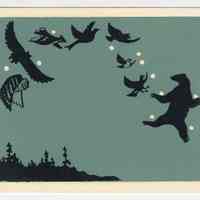
The Legend of the Big Bear | Screen Printed Card | Micmac (Mi'kmaq) Indian Craftsmen, Big Cove Reserve, New Brunswick
Back of Card reads: THE LEGEND OF THE BIG BEAR As the constellation of the Big Bear or Big Dipper moves across the heavens each spring, it is chased by seven birds. Finally, towards fall, Robin catches the Big Bear and, in killing him, becomes covered with blood. As he rests in a tree, he shakes himself. As if to recall this event, each fall many of our leaves turn red. And all robins have been marked, too, for they have had red breasts ever since. Our Indians knew many beautiful lengends of the stars, for they knew much astronomy . Original tapestry, 3' x 7', at Travel Bureau, on the Trans-Canada Highway near Moncton. Designed by Marjory Donaldson and woven by Ivan H. Crowell. Screen printed by Micmac Indian Craftsmen, Big Cove, Reserve, N. B. Card No. 6 Printed in Canada
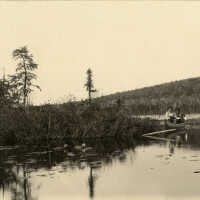
The Long Wait on Duck Lake, Maine | William Lyman Underwood
Artist: William Lyman Underwood Medium: Photograph Classification: Photographs Old Accession Number: 605 Description: 605. William Lyman Underwood. The Long Wait on Duck Lake, c. 1896. Photograph.
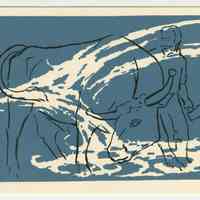
The Reversing Falls Legend | Screen Printed Card | Micmac (Mi'kmaq) Indian Craftsmen, Big Cove Reserve, New Brunswick
Back of Card reads: THE REVERSING FALLS LEGEND Part of this tapestry depicts another legend which says that the ubiquitous Paul Bunyan and his blue ox, Babe, were responsible for the now famous reversing falls. So many great feats were credited to Paul and Babe that this one seems well within the talents of the fabulous woodsman and his great blue ox. Look out the window of the Travel Bureau and there is the site of both the legends. Use your imagination and you can see Glooscap, the beaver; Pau Bunyan and Babe on the waters below you. Original tapestry, 4' x 6', at Travel Bureau, St. Stephen, N. B. Designed by Marjory Donaldson and woven by Ivan H. Crowell. Screen printed by Micmac Indian Craftsmen, Big Cove, Reserve, N. B. Card No. 8 Printed in Canada
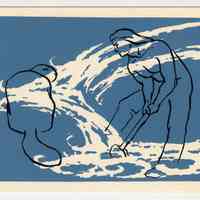
The Reversing Falls Legend | Screen Printed Card | Micmac (Mi'kmaq) Indian Craftsmen, Big Cove Reserve, New Brunswick
Back of Card reads: THE REVERSING FALLS LEGEND In the long ago beaver dammed the mouth of the Saint John river. It made a big pond for him, but it also flooded the homes of many other animals, as muskrat and duck. Glooscap was called upon to save his many animal friends from the selfish beaver. Part of the tapestry design shows Glooscap chopping away as beaver sits glumbly by. His axe is in a split rock which you can see at the base of the falls when the tide is low. Original tapestry, 4' x 6', at Travel Bureau, Reversing Falls. Designed by Marjory Donaldson and woven by Ivan H. Crowell. Screen printed by Micmac Indian Craftsmen, Big Cove, Reserve, N. B. Card No. 9 Printed in Canada
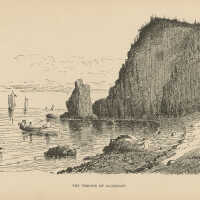
The Throne of Glooscap | Grand Manan, New Brunswick
Medium: Engraving Old Accession Number: 356
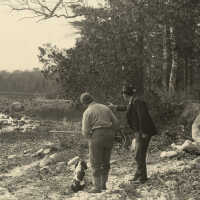
They Fly Out from There [Duck Lake, Maine] | William Lyman Underwood
Artist: William Lyman Underwood Medium: Photograph Circa: 1896 Old Accession Number: 608 Description: They Fly Out from There. Duck Lake
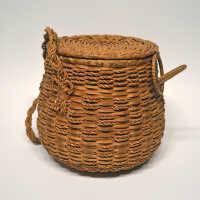
Twisted Cord and Ash Basket with Long Braided Handle [Passamaquoddy] | Unknown Artist
Artist: Unknown artist Classification: North American Basket Old Accession Number: 651 Description: ?Passamaquoddy. Twisted Cord and Ash Basket with Long Braided Handle. Middle Shelf.
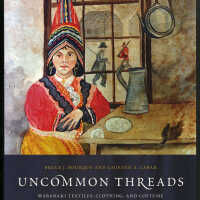
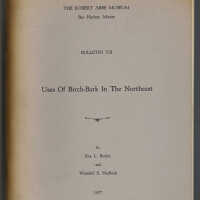
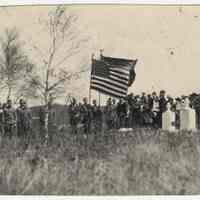
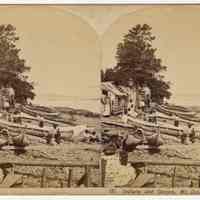
Wabanaki Canoes | Bar Harbor, Maine | Photograph by B. Bradley, Bar Harbor, Mt. Desert, Me.
Text on front of photograph: 151. Indians and Canoes, Mt. Desert, Me.
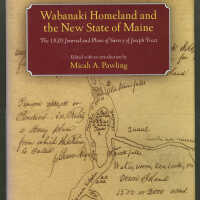
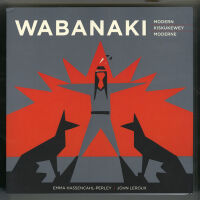
Wabanaki Modern/Kiskukewey/Moderne | Emma Hassencahl-Perley and John Leroux
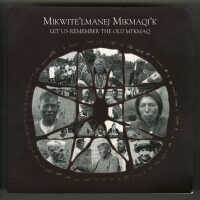
About the Micmac (Mi'kmaq) Indian Craftsmen collective in New Brunswick during the 1960s.
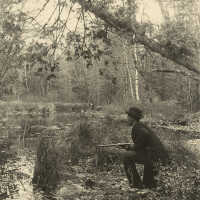
Waiting in the Bush [Duck Lake, Maine | William Lyman Underwood
Artist: William Lyman Underwood Medium: Photograph Circa: 1896 Old Accession Number: 606 Description: Waiting in the Bush. Duck Lake
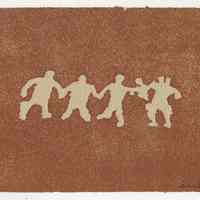
We Are Still Dancing ... | Stephanie Francis | 2008
On back of print: "We Are Still Dancing ..." The image of this print was made by Stehanie Francis and printed on hemp and sweetgrass paper made by Bernie Vinzani with help from Donald and Dakota Soctomah, Patty Vinzani, and Michelle Amato. From: https://pmportal.org/credits "Opening Portal Art Work: "We Are Still Dancing" by Stephanie Francis. The image is taken from a collection of petroglyphs—one of the oldest existing forms of graphic Peskotomuhkati communication. It was created by Stephanie Francis and printed on sweetgrass and hemp paper made by Bernie Vinzani with help from Donald and Dakota Soctomah, Patty Vinzani, and Michelle Amato."
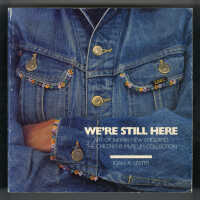
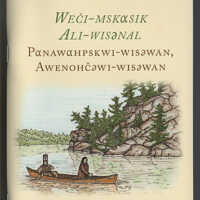
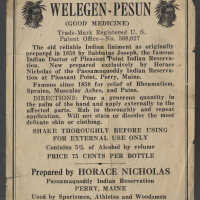
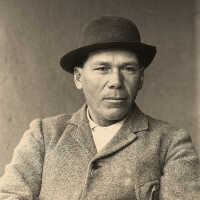
William Lyman Underwood (1864-1929) | Joe Mell, Passamaquoddy Guide at Duck Lake, Maine | c.1895
A photograph portrait by Boston based photographer, William Lyman Underwood, of the well known Passamaquoddy guide, Joe Mell. It dates to about 1895 and was taken in northern Washington County, Maine where Mell used to guide Underwood on his annual hunting and fishing trips to the area for about 30 years. This photograph of Joe Mell is one of 13 photographs in the Tides Institute’s collections taken by Underwood during his trips to northern Washington County in the early 1890s. The photographs were obtained over several years from a collector in California. Underwood was born in Belmont, Massachusetts in 1864 into the wealthy Underwood family that had founded the William Underwood Company, an American canned food company, in 1822. William Lyman Underwood and his brother Loring were at the forefront of nineteenth-century nature photography. Loring trained his camera on human designed parks and gardens, while William concentrated on the wilds of the northeastern U.S. Their work is described in the book Gentlemen Photographers: The Work of Loring Underwood and Wm. Lyman Underwood published in 1987. Joe Mell, whose mother was French and father was Passamaquoddy, became a popular guide around the wilderness forests and lakes of northern Washington County. Mell was extremely well-versed in the ways of the Passamaquoddy. In 1927, William Underwood published the book, Wilderness Adventures, that describes his experiences with Joe Mell. Underwood died in 1929. Photo caption: Portrait photograph of Passamaquoddy guide, Joe Mell, by photographer, William Lyman Underwood that dates to about 1895. Artist: William Lyman Underwood Medium: Photograph Circa: 1896 Old Accession Number: 604 Description: Joe Mell, Passamaquoddy Guide at Duck Lake
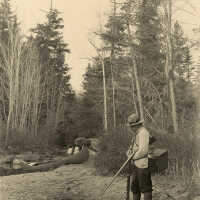
William Lyman Underwood. Self Portrait. Contemplating the Day’s Hunt. Duck Lake, Maine | William Lyman Underwood
Artist: William Lyman Underwood Medium: Photograph Circa: 1896 Old Accession Number: 603 Description: Self Portrait. Contemplating the Day’s Hunt. Duck Lake, Maine.
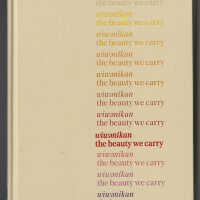
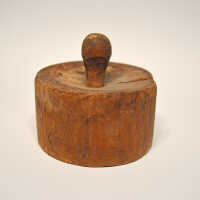
Wood Basket Mold [Passamaquoddy] | Unknown Artist
Artist: Unknown Artist Classification: North American Basket Old Accession Number: 1502 Description: Wood Basket Mold. Passamaquoddy. One of seven Passamaquoddy wood basket molds purchased from Mary Bassett, a Passamaquoddy elder, in 2008.
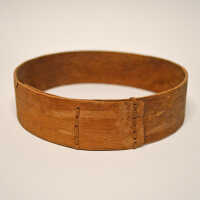
Wood Basket Mold [Passamaquoddy] | Unknown Artist
Artist: Unknown Artist Classification: North American Basket Old Accession Number: 1501 Description: Wood Basket Mold. Passamaquoddy. One of seven Passamaquoddy wood basket molds purchased from Mary Bassett, a Passamaquoddy elder, in 2008.
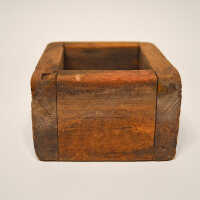
Wood Basket Mold [Passamaquoddy] | Unknown Artist
Artist: Unknown Artist Classification: North American Basket Old Accession Number: 1198 Description: Wood Basket Mold. Passamaquoddy. One of seven Passamaquoddy wood basket molds purchased from Mary Bassett, a Passamaquoddy elder, in 2008.
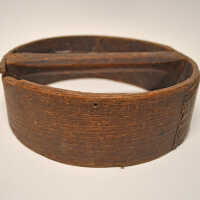
Wood Basket Mold [Passamaquoddy] | Unknown Artist
Artist: Unknown Artist Classification: North American Basket Old Accession Number: 1197 Description: Wood Basket Mold. Passamaquoddy. One of seven Passamaquoddy wood basket molds purchased from Mary Bassett, a Passamaquoddy elder, in 2008.
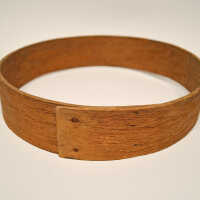
Wood Basket Mold [Passamaquoddy] | Unknown Artist
Artist: Unknown Artist Classification: North American Basket Old Accession Number: 1196 Description: Wood Basket Mold. Passamaquoddy. One of seven Passamaquoddy wood basket molds purchased from Mary Bassett, a Passamaquoddy elder, in 2008.
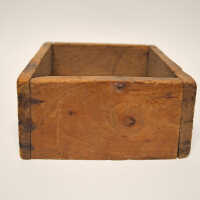
Wood Basket Mold [Passamaquoddy] | Unknown Artist
Artist: Unknown Artist Classification: North American Basket Old Accession Number: 1195 Description: Wood Basket Mold. Passamaquoddy. One of seven Passamaquoddy wood basket molds purchased from Mary Bassett, a Passamaquoddy elder, in 2008.
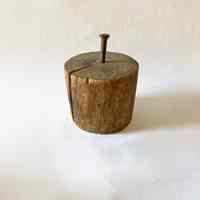
Wooden Basket Mold | Passamaquoddy | c.1900
Wood Basket Mold. Passamaquoddy. One of seven Passamaquoddy wood basket molds purchased from Mary Bassett, a Passamaquoddy elder, in 2008.