


Browse and search a portion of the collections of the Tides Institute & Museum of Art available online (now consisting of over 8,000 online records in process of completion). The Online Collections are best viewed using Google Chrome or Mozilla Firefox. Search Hints: To search by phrase or multiple word names wrap your criteria in quotes. Example: “Martin Johnson Heade” or “Grand Manan”. For an overview of the collections, see: Collections Overview.
Rotating Views, TIMA at 20
An exhibition of works held in 2022 that highlighted the Tides Institute & Museum of Art's extensive cultural collections assembled over the Museum's first 20 years. Art making activities based on these works were held during the exhibition. Several of the works in the exhibition came into the Museum's collections during 2022 and had never been exhibited before. Other works in the exhibition had not been exhibited for many years.
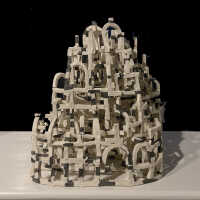
Anna Hepler (1969- ) | The Castle | Ceramic Sculpture | 2016
A black and white ceramic sculpture, The Castle, by artist, Anna Hepler. It stands about 14 1/2 inches high by 13 inches in diameter and dates to 2016. Hepler was born in Boston, Massachusetts 1969. She earned a B.A. degree from Oberlin College In Ohio in 1992 and an MFA degree from the University of Wisconsin at Madison in 1994. She moved to Portland, Maine in 2001 and soon afterwards to the opposite end of Maine’s coast to Eastport where she remained until 2018. She then moved to Greenfield, Massachusetts where she is currently based. A statement about her work includes: “At the heart of Hepler’s work is the thrill of making things and the excitement of training her mind and hand to manipulate unfamiliar materials. It is from this energetic center that her work radiates in many media, shapes and sizes. Hepler seeks forms in conflict – inflatable forms that breathe and are in constant motion, or latticed volumes that collapse perceptually in space. Quiet and intuitive, these restless sculptures are the molecular structure or alphabet with which she composes a visual vocabulary.” She has exhibited widely and held numerous artist residencies. Her solo exhibitions include Portland Museum of Art (Maine), the Roswell Museum of Art (New Mexico) and the Suyama Space (Seattle). In 2016, she created a large scale art installation called Undertow within the Tides Institute’s North Church project space. That same year she was awarded a fellowship by United States Artists. This sculpture was a gift of the artist to the Tides Institute in 2022.
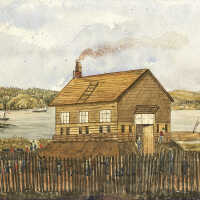
Artist unknown | School House at Indian Island | 1866
A watercolor that shows the fortification of the schoolhouse on Indian Island, New Brunswick during the Fenian border raids into Canada in 1866. The Fenian movement to aid the cause of Irish nationalism had begun 1858 and gained strength after the American Civil War with an influx of Irish veterans of the Union Army. In the spring of 1866, they congregated at various locations along the American border with British North America, what is now Canada. They hoped that by taking Canadian territory they could exchange it with Britain for Irish independence. One of the locations the Fenians came to was Eastport, Maine immediately across the border from Indian Island. The Fenians trained on a beach in Eastport in plan sight of Indian Island. On April 14, 1866 several Fenians raided Indian Island and capture the British flag that waved above the island’s British customs house. A week later, the Fenians returned and burned to the ground four warehouses and related wharves on the shores of the island. In response, New Brunswick militia were sent to Indian Island and fortified the island’s school house and this is the scene shown in the watercolor. Soon afterwards, American General Meade was dispatched to Eastport to disperse the Fenians. The Tides Institute acquired the watercolor in 2007. Initially the watercolor had come up for auction in England and the institute narrowly lost out in the bidding process. The winning bidder was an art gallery in Savannah, Georgia and the institute was then able to negotiate a purchase price with the gallery and have the watercolor become part of the institute’s collections. Photo caption: Watercolor that shows the fortification of the schoolhouse on Indian Island, New Brunswick during the Fenian border raids into Canada in 1866. Artist: Artist unkown Medium: Watercolor and graphite drawing? Classification: Paintings Old Accession Number: 96
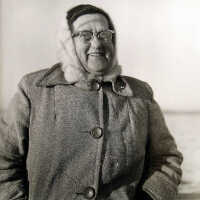
Berenice Abbott (1898-1991) | Lovina Faulkingham | c.1960
An original silver gelatin photograph print by noted American photographer, Berenice Abbott, of Lavina Faulkingham of Washington County, Maine. The photograph was taken in about 1960. Little is known about Lavina Faulkingham at this point. Berencie Abbott was one of the most important American photographers of the 20th century. Born in Springfield, Ohio in 1898, she moved to New York City in 1918. There she connected with Marcel Duchamp and Man Ray, leaders of the American avant-garde. Three years later she moved to Paris where she master the art of photography while serving as an assistant at the Man Ray Studio. In 1926, she had her first solo show of her photography in Paris. It was while at the Man Ray Studio, that Abbott first saw the photographs of Eugene Atget and after Atget’s death in 1927, she worked with Julien Levy of New York City to acquire most of Atget’s negatives and prints. She would bring these negatives and prints with her on her return to New York City in 1929, preserving them there in an archive, and promoting Atget’s work for years to come. With the onset of the Great Depression, Abbott began to document the life of New York City through her photography, an effort that resulted in 1939 in a traveling exhibition and accompanying book, Changing New York. In the early 1960s, Abbott moved to Maine that she had grown to love and settled in the small town of Monson in the Maine North Woods. She soon developed an extended series of photographs documenting life in Maine. This new body of work was published 1968 in her book, Portrait of Maine, done in collaboration with writer, Chenoweth Hall. The Tides Institute acquired Abbott’s photograph of Lavina Faulkingham from the Aucocisco Galleries of Portland, Maine in 2004. Photo caption: Original silver gelatin photograph print by noted American photographer, Berenice Abbott, of Lavina Faulkingham of Washington County, Maine. The photograph was taken in about 1960. Artist: Berenice Abbott Medium: Photograph Classification: Photographs Old Accession Number: 184
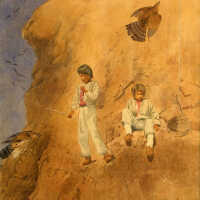
Charles Caleb Ward (1831-1896) | Cliff Climbers, Grand Manan | 1869
An 1869 watercolor (9.5 inches by 11.5 inches) by New Brunswick artist, Charles Caleb Ward of Peskotomuhkati/Passamaquoddy youths gathering gull eggs on the cliffs of nearby Grand Manan island in New Brunswick. Historically, for the Passamaquoddies, Maine’s current political boundary line was non-existent and Passamaquoddies homeland and territory extended to both sides of the border. In the nineteenth century and long before, they were frequently on Grand Manan for fishing and sealing, to collect gull eggs found on the steep island cliffs and for other activities. In 2004, the Tides Institute learned of the existence of this painting from a tip from Donald Soctomah, long time Passamaquoddy tribal historic preservation officer. The watercolor was coming up for auction at Heritage Auction in Dallas, Texas and the Tides Institute was able to mount the successful bid after raising the necessary funds to cover the bid. It is one of two paintings by Ward in the Institute’s collections. The other is an oil painting portraying a Passamaquoddy hunter in the woods of Charlotte County, New Brunswick. Charles Caleb Ward did many paintings of the Passamaquoddies during this time while living and working in St. George, New Brunswick. He was born in Saint John, New Brunswick in 1831. Later he spent time in Liverpool, England to learn about the shipping business, but also learned figure painting with the English artist, William Henry Hunt. Ward also lived in New York City for awhile where he studied landscape painting with artist, Asher B. Durand, and maintained a studio in the city. He died in 1896. Artist: Charles Caleb Ward Medium: Watercolor Classification: Watercolors Circa: 1869 Old Accession Number: 169 Purchased in 2004 from Heritage Gallery and Auctioneers, Dallas, Texas.
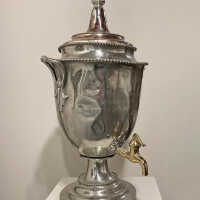
Coffee Urn | Rose Standish Steamship | c.1880
A late 19th century silver plate coffee urn that is engraved with the name “Rose Standish” on its front. The coffee urn was made for the steamship, Rose Standish, that made regularly scheduled trips in this region in the late 19th century between Calais and Eastport in Maine and St. Andrews in New Brunswick. The coffee urn stands 22 inches high and 11 inches wide. It is entirely made of silver plate with the exception of a brass spigot. There are no identifying maker’s marks on the coffee urn so it is unknown who may have made it. The Rose Standish was built in Williamsburg, New York by Lawrence and Foulks in 1863. The steamship was 154 long, 27 feet wide and 392 tons. In 1887 the steamship was sold to the Frontier Steamship Company of Calais. Thirteen years later, in 1900, the Rose Standish caught fire and sank while docked along the Calais, Maine waterfront. Nearly a century later, in the mid to late 1990s, two brothers from Calais, Darren and David Townsend, got permission from the City of Calais to explore the wreck of the Rose Standish that still lay submerged in the waters edge of the St. Croix River. Darren had a lobster boat for the salvage operation and he did the diving to the underwater Rose Standish wreck and found the still intact, though damaged, coffee urn. Several years later, Darren sold the coffee urn to a local Calais antique dealer, Kerry Pinnette. Pinnette had the coffee urn cleaned, polished and repaired by Macel Doucet of Brass ’n Things of Saint John, New Brunswick. Pinnette soon sold the restored coffee urn to another local Calais area antique dealer, Brian Smith, who contacted the Tides Institute and sold the coffee urn to the institute in 2006. Rescued from the wreck of the steamship, Rose Standish, that burned and sank in 1900 along the Calais, Maine waterfront. The Rose Standish was built in 1863. Silver-plate. 22 inches high, 11 inches wide. Reply to Facebook post in group, Old Pictures of Eastport, Maine, June 27, 2022 of photograph of steamship, Rose Standish, docked at Eastport, Maine waterfront in 1890 from Brian Smith: "Great photo, thankyou for sharing, history of the "ROSE STANDISH ",was built in Williamsburg, New York, by Lawrence &foulks in 1863,she was sold to frontier steamboat company in 1887,she was 154 feet long over all ,her beam was 27 feet, she weighed in at 392 gross tons .the ROSE STANDISH, sailed the st.cr st.croix river between Maine and New Brunswick ,from Calais to Eastport and over to st.andrews, New Brunswick and making stops to other small communities in between. She was destroyed by fire while docked at the Calais pier in 1900.,some artifacts have been recovered, one in particular, the original coffee urn that was used by the crew and passengers, is in the tides institute and museum of art,I had purchased it from Calais antiques owner, Kerry pinett [Pinnette] over a decade ago, he had purchased it from a local Calais resident and collector of marine artifacts of the local area, I decided to sell it to the tides institute and museum of art, to make sure that it forever stayed where it belonged and its history preserved for future generations of our citizens of downeast Maine and beyond, glad that an important part of our corner of downeast Maines history has gone full circle, and an historic artifact of the ROSE STANDISH is back again, to tell its memories of a time long ago in the annuals of downeast Maine." Telephone conversations with Brian Smith, July 10 and 11, 2022: Two brothers, David Townsend and Darren Townsend, of Calais, Maine were the people who recovered the coffee urn from the submerged wreck of the Rose Standish in the waters next to the Calais waterfront. This would have been in the mid to late 1990s. Darren had a lobster boat and they got permission from the City of Calais to do the salvage operation. Darren did the diving. Darren then sold the coffee urn to antique dealer, Kerry Pinnette, of Calais, Maine. Kerry had the coffee urn restored by Brass 'n Things of Saint John, New Brunswick as he knew Marcel Doucet the owner and he was having a number of things restored by Brass 'n Things at this time. Kerry only owned the coffee urn for 3-4 months and he then sold it to me (Brian Smith). Kerry must have bought the coffee urn in about 2005 as I (Brian Smith) sold the urn to the Tides Institute in 2006 after owning it for a couple months. David Townsend now works for the Calais High School as a custodian. Darren has moved to Florida. Coffee Urn was restored by Brass 'n Things of Saint John, New Brunswick: "Established in 1976, Brass "N" Things has been proudly providing antique restoration services through the Atlantic region. Locally owned and operated, we are skilled in all facets of our trade. We off our expertise for all antique lighting and repair. Door hardware, fireplace accessories. Full restoration to all Church accessories. Tabernacles, Collection Plates, Candlesticks, Chalices, etc. Dedicated to every detail in the restoration and conservation of find metalware, antiques, and collectibles. We will make your artifacts new again. We strive for outstanding customer satisfaction. We buy scrap Gold & Silver, Old Coins. Antiques bought & Sold!"
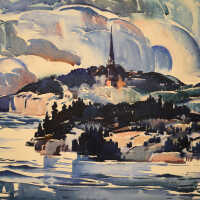
George Pearse Ennis (1884-1936) | Northern Landmark [Lubec, Maine] | c.1930
Artist: George Pearse Ennis Medium: Watercolor Classification: Watercolors Gift of Sondra and Rand Castile. Old Accession Number: 88 Dimensions: 33" w x 29 1/4" h (framed)
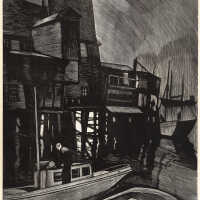
Howard Cook (1901-1980) | Fog in Eastport | 1928
A large wood engraving print (12 1/16”/30.6 cm x 10 1/8”/25.7 cm) titled “Fog in Eastport” completed in 1928 and is the work of American printmaker, Howard Norton Cook. Cook was born in 1901 in Springfield, Massachusetts and is particularly known for his wood engravings and murals. He learned printmaking from Joseph Pennell at the Art Students League in New York City in the early 1920s. From 1928 to 1935, he and his wife and fellow artist, Barbara Latham, traveled to Europe, Mexico and the American South. In 1928, Cook spent a summer on Deer Island, New Brunswick with Barbara. He did several wood engravings and and etchings while in the area and original prints of almost all are in the collections of the Tides Institute including “Fog in Eastport,” “Herring Fisherman,” “Quoddy Bay,” and “Deer Island.” Working for New Deal on art projects in the 1930s, Cook produced murals for courthouses in Pittsburgh and Springfield, Massachusetts. From the late 1920s to the early 1930s, he and Barbara lived primarily in New York City and the city’s ongoing construction was a major subject of his art. In 1938, the couple settled near Taos, New Mexico. Cook had first come to Taos, New Mexico in 1926 to complete a series of woodcuts to illustrate Death Comes for the Archbishop for the magazine Forum. Taos remained the couple’s base until 1976. Cook died in 1980. Artist: Howard Cook Medium: Wood engraving Classification: Prints Circa: 1928 Old Accession Number: 208
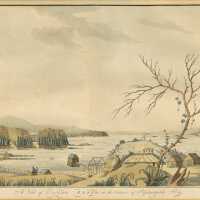
J. F. W. Des Barres (1722-1824) | A View of Campo Bello at the Entrance of Passamaquoddy Bay | Aquatint with Etching | 1780
An aquatint with etching print titled, “A View of Campo Bello at the entrance of Passamaquoddy Bay,” by Colonel Joseph Frederick Wallet Des Barres. The print dates to 1780 and shows a view of Windmill Point and Curry Cove at the village of Wilson’s Beach at Campobello Island in New Brunswick. It is part of the very large and extensive four volume, Atlantic Neptune publication, consisting of maps, charts and views created by Des Barres of the eastern Atlantic coast of North America from New York City to Newfoundland. Des Barres was born in 1721 in Switzerland. He trained as a cartographer and served in that capacity during the Seven Years' War as the aide-de-camp to General James Wolfe. Later he served as the Lieutenant-Governor of Cape Breton and as Lieutenant-Governor of Prince Edward Island. But Des Barres is best known for his Atlantic Neptune work that he spent years compiling. His cartographic survey of Nova Scotia alone took him nearly 10 years due to the province’s extensive and undulating coastline. Des Barres died in 1824 and is buried in Halifax, Nova Scotia. The Tides Institute acquired the “Campo Bello” print at auction. It joins three other late 18th century Des Barres works of the Passamaquoddy region in the Tides Institute’s collections that were acquired, also at auction several years earlier: a chart of Passamaquoddy Bay and entrances and related chart of Grand Manan and adjacent coast as well as a view of the entrance to Passamaquoddy Bay (aquatint with etching print). Photo caption: Original aquatint with etching print titled, “A View of Campo Bello at the entrance of Passamaquoddy Bay,” by Colonel Joseph Frederick Wallet Des Barres. The print dates to 1780 and shows a view of Windmill Point and Curry Cove at the village of Wilson’s Beach at Campobello Island in New Brunswick. CAMPOBELLO, 1780! Print (aquatint with etching) that recently came into our collections that shows a view of Campobello Island, New Brunswick. The print dates to 1780 and is the work of Joseph F.W. DesBarres. It’s titled, “A View of Campo Bello at the entrance of Passamaquoddy Bay.” The view is of Windmill Point and Curry Cove at the village of Wilson’s Beach.
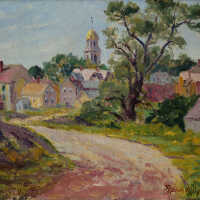
J. Redding Kelly | Eastport, Maine | 1931
Eastport Sentinel July 8, 1931 Page 1, column 5 ART SCHOOL OPENS HAS MANY STUDENTS IS ATTRACTING MUCH ATTENTION IN ART CIRCLES—LARGER REGISTRATION—PROSPECTS FOR SUCCESSFUL SEASON GOOD .... Mr. Redding Kelly, head of the Art Department of City College of New York will arrive Tuesday by the Eastern S. S.
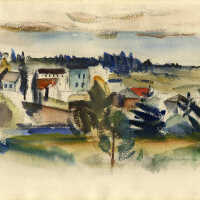
Jack Humphrey (1901-1967) | Grand Manan, New Brunswick | 1936
A watercolor of Grand Manan Island, New Brunswick by New Brunswick artist, Jack Weldon Humphrey. It dates to 1936. Grand Manan was part of the disputed coastal border territory between the U.S. and what is now Canada that was largely resolved by the Webster Ashburton Treaty of 1842. The treaty placed Grand Manan with Canada (then Great Britain). Humphrey was one of the most significant painters in eastern Canada during his day. He was born in Saint John, New Brunswick in 1901, studied at the school of the Museum of Fine Arts in Boston and at the National Academy of Design and the Art Students League in New York City. Afterwards, in 1929 and 1930 he travelled to Europe including studying in Paris, France and in Munich, Germany. Returning to Canada, he visited Vancouver, British Columbia on the Canadian Pacific coast in 1933 and then travelled south to Mexico in 1938. In 1933, Humphrey was a founding member of the Canadian Group of Painters. He taught at Queen's University in Kingston, Ontario in 1951 and that same year received an honorary doctorate degree from the University of New Brunswick. From 1952 to 1954, he painted in Paris on a Canadian Government-Royal Society Overseas Fellowship. Humphrey extensively portrayed his hometown of Saint John, the city’s streets, people and waterfront, over many years and these paintings established his importance as an artist. A retrospective exhibition of his work was organized in the mid-1960s at the Beaverbrook Art Gallery in Fredericton in New Brunswick and the exhibition toured throughout Canada. He died in Saint John, New Brunswick in 1967. This watercolor was acquired by the Tides Institute from Galley 78 in Fredericton, New Brunswick in 2009. Photo caption: Watercolor of Grand Manan Island, New Brunswick by New Brunswick artist, Jack Weldon Humphrey. The watercolor dates to 1936. Artist: Jack Humphrey Medium: Watercolor Classification: Watercolors Purchased from Gallery 78, Fredericton, New Brunswick in 2009. Old Accession Number: 19
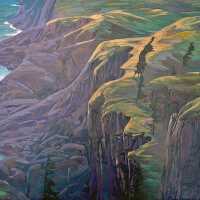
John Doyle | Grand Manan Cliffs | 1994
A large (48 x 60 inches) acrylic on canvas painting of the cliffs of Grand Manan island in New Brunswick by Canadian artist, John Doyle, that dates to 1994. It gives a dramatic view from the northeast of Grand Manan looking out along the cliffs towards Swallowtail Lighthouse. The Tides Institute discovered the painting in Toronto, Ontario in the art gallery, Gallery One, that represented Doyle at that time. The institute was able to raise the necessary funds to purchase the painting directly from the gallery. John Doyle was born in Toronto in 1950 and earned a degree in fine arts at York University in Toronto in 1974. Primarily a landscape painter, Doyle’s work has focused on the central Canadian province of Ontario, but he has, on occasion as witnessed by his painting of the cliffs of Grand Manan island, ventured to the east coast of Canada as well as western Canada and outside of Canada, too. His paintings tend to be large scale and mostly acrylic on canvas. His work has been exhibited almost exclusively in Toronto though he did have a solo exhibition at the New Brunswick Museum in Saint John, New Brunswick in 1983. Most of his paintings are less dramatic than his painting of the cliffs of Grand Manan island, but the reasons for this have more to do with choice of subject matter, more serene forested and rural scenes though some times with more vibrant colors. GRAND MANAN! Large scale (48 x 60 inches) acrylic on canvas painting in our collections of the cliffs of Grand Manan island in New Brunswick. It's the work of Toronto based artist, John Doyle, and was completed in 1994. Email from John Doyle, 2025: John Doyle Tue, Aug 19, 5:08 PM (4 days ago) to me, kmckinlay Dear Hugh and Kristin, I was very excited today and honoured to discover my painting in your collection. Upon further research into TIMA I discovered a shared philosophical outlook to what you collect, the engagement with community, the erasing of borders, all of the things that the arts can do and that are so important. To be allowed a small part in what you both have built is very rewarding. I was googling "john doyle canadian artist" in preparation for my show at Ingram Gallery opening September 6th when to my delight I discovered my painting at Tides. The painting is from the north east of Grand Manan looking outwards towards the Swallowtale Lighthouse not from the west coast. I am thinking more painting in the east coast is in order and of course a visit to Eastport. Congratulations on what you have accomplished. A big hug from over the border, John Doyle
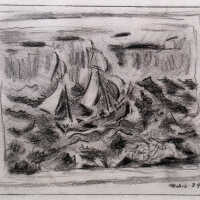
John Marin (1870-1953) | Untitled | Drawing | 1939
Artist: John Marin Medium: Pencil drawing Classification: Drawings Circa: 1939 Old Accession Number: 168
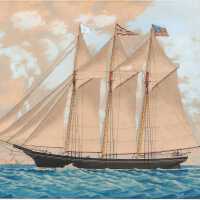
Louis Roust | Pembroke, Maine Schooner, George K. Hatch | 1876
A 19th century watercolor ship portrait painting of the Pembroke, Maine built three masted schooner, George K. Hatch. The painting dates to 1876 and is the work of artist, Louis Roust. Nothing is known about the artist. The schooner, at 285 tons, was built in Pembroke in 1874 by either S.C. Foster or Aaron or A.& G. Frost. The schooner was named for a prominent resident and merchant of Pembroke, George K. Hatch, who was born in 1836. Hatch served in the American Civil War and then returned to Pembroke where he served as postmaster in 1870. He died in 1877, three years after the schooner named for him was built. James Murphy was master of the schooner from 1874 to 1878 and James Hardenbrook was master in 1886. In 1888 the ship was wrecked in the Caribbean Sea on Turks Island and in 1892 was subsequently sold, repaired and transferred to Saint John, New Brunswick and its name change to Alianza. The painting was secured at an auction in Los Angeles in 2021. There were a great many sailing vessels of all kinds built in this region, including in Pembroke, Maine, during the 19th century and into the early 20th century. Many of them had ship portrait paintings done of them, but unfortunately very few of these portraits survive in this region. This is why the Tides Institute felt it was important to secure the ship portrait of the schooner, George K. Hatch, when it came up for auction and see it brought back to this region. Photo caption: Watercolor painting (17” x 24”) of the schooner, George K. Hatch, by artist, Louis Roust. The schooner was built in Pembroke, Maine in 1874 and the painting dates to 1876. 19th century ship portrait of the Pembroke, Maine built three masted schooner, George K. Hatch. The watercolor painting dates to 1876 and is the work of artist, Louis Roust. The schooner was built in Pembroke in 1874. In 1888 the ship was wrecked in the Caribbean Sea on Turks Island and was subsequently sold, repaired and transferred to the British flag under the name Alianza. Painting was secured at an auction in Los Angeles in 2021.
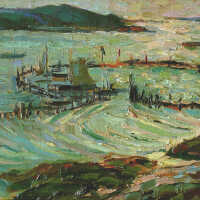
Sandor Bernath (1892-1985) | Day’s End | c.1930s
A small oil on board painting by Hungarian-American artist, Sandor Bernath (1892-1985) of a coastal scene with a central element of the seining of a herring weir. Without any notation on the painting, presumably the painting is of a scene along the eastern coast of Maine or southwestern New Brunswick as Bernath lived in Eastport, Maine for about 20 years beginning in the mid-1920s. The painting likely dates to the 1930s. Little is known about Bernath and his work along this border region as few works of his related to this region have been discovered. Bernath was born in Hungary and came to the United States when he was young and settled first in New York City. During his long career, he is perhaps best known for his watercolors of sailing yachts, but he also painted coastal scenes, including using oil, such as his painting described here. At one point, Bernath was a student of Edward Hopper. In the early 1920s, he began to paint coastal scenes of New England. In the late 1920s, he moved to Eastport, Maine, where he lived until at about 1945. While Eastport remained his primary residence, Bernath visited and painted in a number of American art colonies during this time. Where he went after Eastport is unclear, but he spent the last years of his life in South America. The painting here was located at the Cooley Gallery in Connecticut and the Tides Institute contacted the gallery about purchasing the painting. The price was $5,000 and the institute was able to raise the funds to secure the painting for its collections. Several years afterwards, a supporter of the institute donated a watercolor by Bernath of downtown Eastport, Maine. There must be many other paintings by Bernath of this region that remain to be discovered. Artist: Sandor Bernath Medium: Oil on board Classification: Paintings Old Accession Number: 97
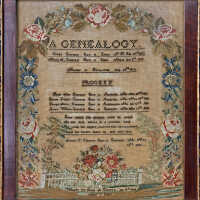
Sarah Ann Cheney | Sampler | 1846
A large (24” x 20 1/2”) mid-19th century needlework sampler by Sarah Ann Cheney of Eastport, Maine that she did when she was 11 years old. The sampler dates to 1846. The sampler is silk on Penelope weave linen and features cross and straight stitches. It is in remarkable condition for its age. Within the sampler, Sarah included information about her parents and their children, even adding her baby brother below the verse years after she had finished the piece. The sampler was part of an exhibition of early to mid-19th century federal period Maine needlework samplers held at the Saco Museum in Maine in 2013. The curator of the exhibition, Leslie Rounds, wrote in the accompanying exhibition catalogue: “Sarah Cheney's sampler is the ‘newest’ of all the samplers in the exhibition and shows many signs of the new styles of needlework that were emerging at the time. However, it also continues to demonstrate stylistic elements that clearly tie it to the earlier works in the exhibition, with its lavish rose border and family register format that appears to be a near-copy of many Portland samplers. She was mimicking the Berlin work that was quickly becoming the needle arts rage of the era. Sarah was the eldest of the five children of George Cheney and his wife, Mary. On the 1850s census, George was listed as a “trader” and the family was residing in Eastport. On July 20, 1858, Sarah married George Kilborn in Boston, Massachusetts. The Kilborns seem to have lived in Boston for the rest of their lives.” The Tides Institute acquired this sampler earlier in 2022 from a dealer in Connecticut that specialized in antique needlework samplers.
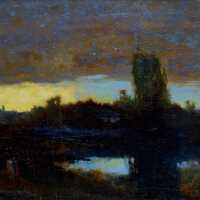
Stephen Parrish (1874-1940) | Northeast Coast | c.1920
From email from Jennifer Spencer (daughter of Lois and Ryerson Johnson), September 30, 2021: I don't know much about the Parrish painting. I seem to remember Mom got it from a friend who either was downsizing and wanted her to have it or who just wanted to give her something and she chose that painting. I don't know who the friend was, but think it was someone in New York.
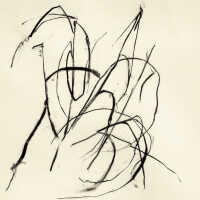
Susan Hartnett (1940- ) | February 17, 2006 #1 - Winter Grass
A large contemporary charcoal drawing, “February 17, 2006 #1 Winter Grass," by artist, Susan Hartnett. Born in 1940 in St. Louis, Missouri, for many years Hartnett has lived part of the year on the eastern coast of Maine. The rest of the year she spends in New York City where she has lived for much of her working life. But it is along the eastern coast of Maine and surrounding area that she is able to find plentiful subject matter for her expressive drawings of grasses. She has done hundreds of such drawings, each unique, each capturing subtle and larger differences in type and form of grasses that change with the weather and with the season. Her work has an immediacy as she works deliberately to capture grasses in her drawings, each stroke adding to the previous, with a minimum of strokes used, fluid yet purposeful. The use of charcoal allows her to quickly adjust her line, from thick to thin, from dense to light, from clean to smudge. Asian as well as western aesthetic traditions have influenced her work. She writes, “A lot of knowledge of Chinese and Japanese ink painting and calligraphy had to be thoroughly assimilated before the "stroke" could be applied. Large leaves need a supple brush, whereas grass or twigs could be done with strokes of different thicknesses of charcoal. I've made charcoal supple.” This particular drawing was a gift to the Tides Institute by the artist. Artist: Susan Hartnett Medium: Charcoal drawing Dimensions: 18 Classification: Drawings Circa: 2006 Old Accession Number: 112 Description: February 17, 2006 #1 Winter Grass Gift of the Artist
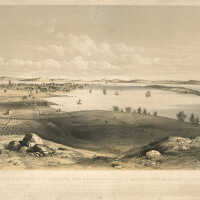
View of the Town of St. Andrews, New Brunswick, with Its Magnificent Harbour and Bay | Frederick Wells | 1840
Artist: Frederick Wells Medium: Lithograph Classification: Prints Circa: 1840 Old Accession Number: 49 Description: View of the Town of St. Andrews, New Brunswick, with Its Magnificent Harbour and Bay
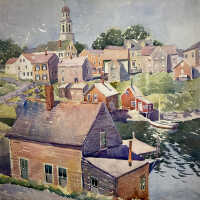
William Starkweather (1879-1969) | Eastport, Maine | c.1920
Gift of Peter and Barbara Falotico, 2020.