


Browse and search a portion of the collections of the Tides Institute & Museum of Art available online (now consisting of over 8,000 online records in process of completion). The Online Collections are best viewed using Google Chrome or Mozilla Firefox. Search Hints: To search by phrase or multiple word names wrap your criteria in quotes. Example: “Martin Johnson Heade” or “Grand Manan”. For an overview of the collections, see: Collections Overview.
Passamaquoddy Suite
Passamaquoddy Suite includes 31 prints that were produced in 2005 through a project involving the Maine College of Art (MECA), the Nova Scotia College of Art and Design (NSCAD) and the Tides Institute and Museum of Art. A hydrographic chart of the U.S./Canada Passamaquoddy Bay was divided into squares and these squares were then reinterpreted by senior printmaking students at both school along with their instructors, Alex Kahn of MECA and Mark Bovey of NSCAD.
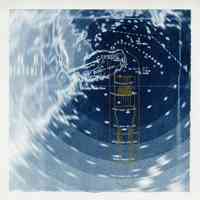
Alex Kahn
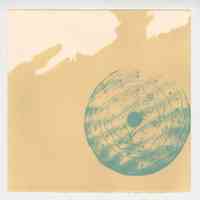
Alex Kahn (lithograph) – The tenure of Malcom Rouse, last keeper of the West Quoddy light, ended in 1988 when the lighthouse became fully automated, ending an unbroken succession of Keepers that had begun in 1808. In this image, the concentric bevels of the lamp’s Fresnel lens provide a metaphor for the incremental decay of sound, light, and memory. The fading rings echo the words of Rouse’s wife, Carol, who lamented, “It’s a whole way of life that is being put aside.”
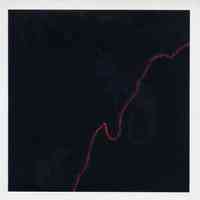
Allison Baird
Allison Baird (screenprint) – The western side of Grand Manan is treacherous to humans. With rock so hard that it cannot be drilled for water and cliff s so steep that a harbor is unimaginable, it is no wonder the Passamaquoddy never thought to give it a name. To me, this dangerous, barren land is a breeding ground for mischief.
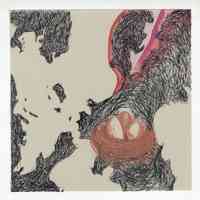
Amy Adams
Amy Adams (hand-colored screenprint) – Mother is an eco-feminist print influenced by studying the birdlife in this region, the feminine forms inherent in the shape of the land and water, and the metaphor of Mother Earth.
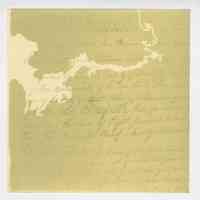
Caitlin Riordan
Caitlin Riordan (lithograph) – Around the time of the American Revolution, Irish immigrants were fleeing the United States and traveling into Canada. Many who lived in the Northeast were finding passage to Canada via the Magaguadavic River. The text included in this print is a land deed for the ownership of property in New Brunswick by an Irish immigrant.
Calvin McLeish
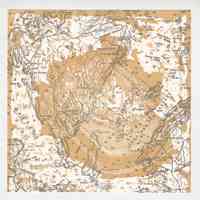
Calvin McLeish (intaglio) – Long, long ago he had defeated the beavers that tormented his people, leading to the creation of Sugar Loaf Mountain. It was this moment, however, that Kluskap faced his greatest challenge. This was the first of many struggles to come for the Passamaquoddy tribes.
Elissa Stopyra
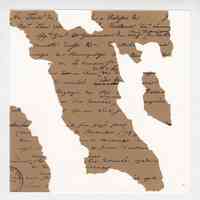
Elissa Stopyra (screenprint) – hee Wabanaki Confederacy (Abenakis, Penobscots, Passamaquoddies, Maliseets, and Micmacs) held an alliance with the French, until the Battle of Quebec in 1759, where the French were defeated. The defeat weakened the Wabanaki’s position, and in 1760 representatives from the Wabanaki Confederacy went to Halifax to sign treaties with the British.
Elizabeth Jabar
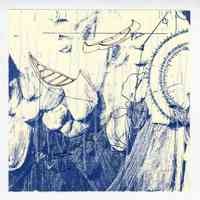
Elizabeth Jabar (intaglio) – The Passamaquoddy are believers in a power by which a song or chant in one place can be heard in another area many miles away. is power is thought to be the work of m’toulin or magic, an important part of their belief. Passamaquoddy literature is rich in illustrations of this belief system. “The Flying Canoe” is a story that contains many of the m’toulin elements central to their literature: journey, creation, transformation and power.
Ellen Cere
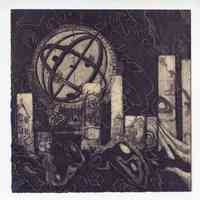
Ellen Cere (intaglio) – With my section of the map I have abstracted the history of colonization in the area, taking elements from early architecture and combining them with a stylized foreshadowing of future cultural modernization.
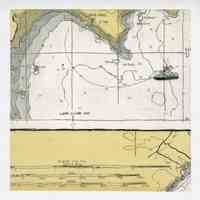
Emilie Rondeau
Emilie Rondeau (intaglio) – The Halifax ferry is a means for investigating the geography of the Passamaquoddy region. Each print is a point in time, a meeting of places with digital and traditional media along the ferry route. This is an invitation to travel. Welcome aboard!
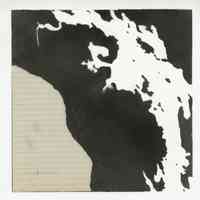
Eric Gartmayer
Eric Gartmayer (assemblage, stencil) – The easement held by the Maine Department of Inland Fisheries and Wildlife protects the farm’s significant ecological values and ensures that the public will have access to portions of the property that do not intrude on the farmstead. Hikers can enjoy more than 2.5 miles of trails up Bell’s and Crane Mountains, with outcrops that offer vantage points overlooking the Moosehorn National Wildlife Refuge and Big Meadow Pond.
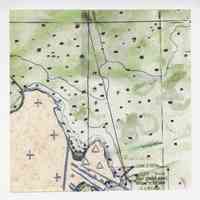
Ian Carlson
Ian Carlson (digital print, stencil, chin-collé) – The alterations to my particular quadrant were sampled from a local map of geologic formations. Each symbol represents a different composition of rock and/or mineral deposits. I have removed the terrain from the original map and replaced it with this geological information.
Jacquline Dubois
Jacquline Dubois (screenprint) – This silver Passamaquoddy brooch may have been given to James A. Purinton, Indian Agent serving at Old Town, Maine between 1860 and 1864. Many tribes in northeastern United States traded furs for handcrafted silver. The double curve design used in this brooch was popular with the Penobscots and Abenakis.
Jennifer Burke
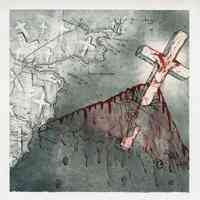
Jennifer Burke (intaglio) – What would I have felt if I had lived peacefully on my land and then new settlers had taken over? I would have felt forced – forced to do things I didn’t want to, in order to survive. I used force, the idea and the physicality of it, to create my intaglio print.
Jennifer Gingras
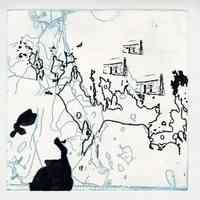
Jennifer Gingras (intaglio) – In 1779 Joel Bonny, James Sprague, and Abiel Sprague brought their families to settle on Grand Manan Island. They were not welcomed by the Merrisheete, Penobscot, and Passamaquoddy, who soon sent a complaint against them to the government. After some bargaining between Bonny and the tribes, it was decided that the settlers would be allowed to stay on the island in exchange for ten dollars and a cow.
Jenny Dougherty
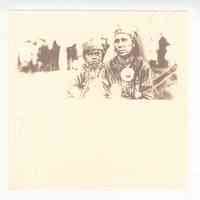
Jenny Dougherty (screenprint and perforation) – Sarah Mitchell, the wife of the last surviving tribal veteran of the American Civil War, Peter Mitchell, and her granddaughter, Mary Newell arrived in Portland on June 26, 1920 to attend the Maine Centennial.
Jessica Huff
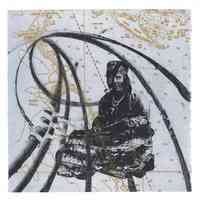
Jessica Huff (intaglio) – Ideas about hand stitching into native history, European colonization, preserving tradition and tribal cohesion.
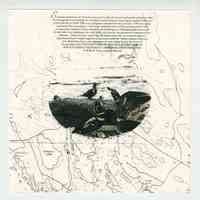
Julianna Swaney
Julianna Swaney (screenprint) – With human presence comes an inevitable change in the biodiversity of a place. The Harlequin Duck, represented here, is one species whose numbers are decreasing in this area.
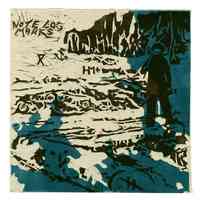
Kristen Gingras
Kristen Gingras (relief print) – In order to keep straight which logs belonged to whom, lumbermen created their own distinctive marks to carve into their logs before floating them down river to the mill. Any unmarked logs were claimed by the boom master and sold with the profits used to help maintain the mill.
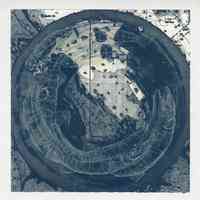
Kristina Vermeulen
Kristina Vermeulen (intaglio) – When natural stock becomes depleted, we turn to developing our own. But with solving one problem new ones develop. Whether in agriculture or aquaculture, the same question arises; can it become a reliable resource?
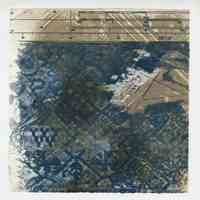
Lydia Nieuwenkamp
Lydia Nieuwenkamp (intaglio) – The two textiles I have found in my research interweave the topographical lines in the map with the patterns found in the fabrics. e worn appearance of the textiles refers to the lost and abandoned landscape of the region.
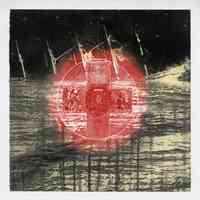
Mark Bovey
Mark Bovey (intaglio) – Integrated through visual alchemy into this mixed media etching are nine separate image fragments. The ocean suggested a metaphysical playground where time collapses and histories converse, to become an amalgam of fact and fiction, religion and science.
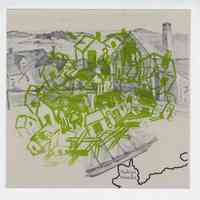
Martha Miller
Martha Miller (screenprint) – One foggy night in 1830, an experienced skipper named Bailey was making his way down the Maine coast towards Boston in a four-masted schooner filled with lumber. Due to an error in his navigation, the ship ground to a halt astride a ledge. The next morning, Bailey and his crew, reluctant to return to Boston and face the music in the home office, took the lumber off the ship, built homes and settled down.
Meghan Yates
Meghan Yates (intaglio blind embossment) – At fourteen, I spent a portion of my summer working on my father’s fishing vessel. At the break of day the boundaries between land and sea were frequently disguised by thick wafts of fog, broken up only by the white underbellies of gulls floating above. This print is intended to function as the element of fog within the larger map, a rest for the eye and a reminder about how boundaries can be blurred.
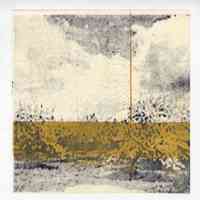
Mindy Hale
Mindy Hale (lithograph and monotype) – A contemplation of landscape, and memory, from an archival picture of trees taken by a photographer named Perry.
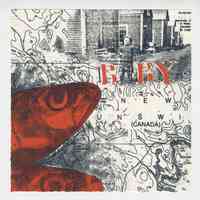
Nina Turczyn
Nina Turczyn (intaglio) – A statement on the history of child labor in the sardine industry, displaying the innocence of youth contrasted with the dominance of the fish, and the fishing industry of that time.
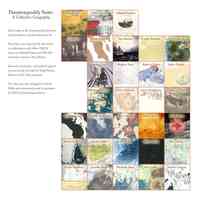
Passamaquoddy Suite: A Collective Geography, 2005
Passamaquoddy Suite: A Collective Geography Each image in the Passamaquoddy Suite was hand-printed in a limited edition of 40. The project was organized by Alex Kahn, in collaboration with fellow MECA instructor Elizabeth Jabar and NSCAD University instructor Mark Bovey. Research inspiration, and archival support was generously provided by Hugh French, Director of the Tides Institute. The folio cases were designed by David Wolfe and constructed under his guidance by MECA printmaking students.
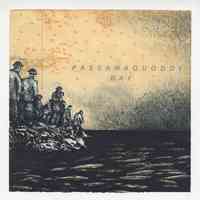
Rae Braden
Rae Braden (intaglio) – Thinking about the decline of a cultural era, I wanted to portray a narrative that conveys a sense of loss and a mood of suspended time. To achieve this I choose to use a heavily textured plate with multiple layers of embedded imagery. I am also expressing a sense of hope for the future beyond an impending darkness.
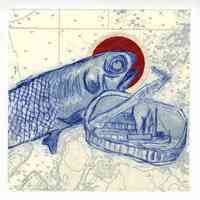
Rebecca Parker
Rebecca Parker (intaglio) – My primary interest is in the idea of community, intrinsically connected with and contained by the sardine can. I suggest that specific location and industry are irrelevant, as any small community affected by industry collapse can identify with the hardships of Passamaquoddy region.
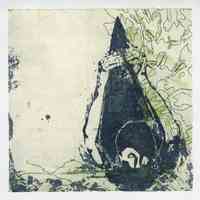
Robin Kelly
Robin Kelly (intaglio) – The original map has been reinterpreted into a drawing with the names of places forgotten or crossed out. The figure makes a gesture that further obscures the reading of the landscape to imply that all histories and their documents are inherently subjective and faulted by human influence.
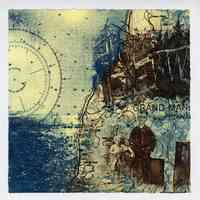
Sara Griffin
Sara Griffin (intaglio) – My contemplations for this piece were focused on concepts of origin and history. With such an enigmatic name as Dark Harbour, a clearing nestled at the base of 200-foot cliffs, there is much room for speculation of dangerous sea voyages fared by ghostly ancestors.
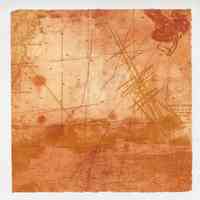
Shawn Reynar
Shawn Reynar (relief/intaglio) – Dealing with the ominous nature of the sea, beauty becomes a hangman’s noose. This beauty becomes a fleeting notion, while the permanence of history remains a fixed memory.
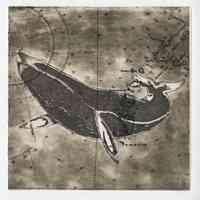
Stephanie Hopley
Stephanie Hopley (intaglio) – I wanted to honor the Minke Whale, as it is affiliated with the past, present and the future of the Passamaquoddy people. The Minke Whale is a threatened species, and is protected (since 1986) worldwide by international law. It is the world’s most heavily hunted whale.