


Browse and search a portion of the collections of the Tides Institute & Museum of Art available online (now consisting of over 8,000 online records in process of completion). The Online Collections are best viewed using Google Chrome or Mozilla Firefox. Search Hints: To search by phrase or multiple word names wrap your criteria in quotes. Example: “Martin Johnson Heade” or “Grand Manan”. For an overview of the collections, see: Collections Overview.
Highlights of the Collections
As part of Maine’s Bicentennial in 2020, the Tides Institute & Museum of Art mounted an exhibition of works from its collections ranging in date from 1820 to the present. In addition, the Tides Institute plans to publish a book featuring 100 works from its collections and the stories behind the works and how they came into the Tides Institute’s collection. This selection of works representing highlights of the collections is part of this effort.
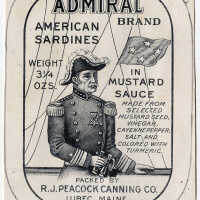
Admiral Brand | American Sardines in Cottonseed Oil | R.J. Peacock Canning Company, Lubec, Maine
An original sardine label design for the Admiral Brand of American Sardines in mustard sauce packed by the R.J. Peacock Canning Company of Lubec, Maine. The design was produced by the American Can Company in the early 20th century. It is one of several hundred such original sardine label designs in the collections of the Tides Institute that the institute acquired from Barney Rier of Lubec, Maine in 2008. The label designs represent a wide range of sardine companies operating in the area (including in New Brunswick, Canada) and an equally wide range of imaginative high quality graphic designs. Barney Rier had amassed an extraordinary collection of original equipment, artifacts and historical documents relating to the sardine industry of this region. For many years, he displayed much of his collection in a sardine museum building next to his house along Route 189 in Lubec. The American Can Company, based in New Jersey, operated can manufacturing plants across the United States beginning in the late 19th century and in the early 20th century they established two such can manufacturing plants in this region, one in Eastport, Maine and one in Lubec. Barney Rier acquired his collection of original sardine labels from the American Can Company when their operations in Eastport and Lubec went out of business. Artist: Unknown artist Sardine Can Label Old Accession Number: 733 Description: Packed by R. J. Peacock Canning Company, Lubec, Maine.
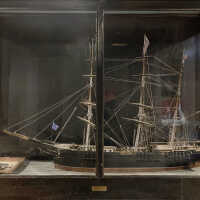
Alden Bradford (1828-1908), Eastport, Maine, Builder | R. A. Pike | Ship Model | 1857
A large historic model of a full rigged ship named the R.A. Pike that for decades resided in the reading room of the Peavey Memorial Library in Eastport. No one knew where the name of the ship came from nor what the origins of the ship were. No one could locate any record of a real ship having been named the R.A. Pike. In 2009 the Peavey Library placed the ship model with the Tides Institute. Recently, the mystery of where the name of ship came from as well as the origins of the ship model were solved. The first tip came from a 1970 article in the local Quoddy Tides newspaper that talked about several ship models then in Eastport's downtown. Two were in a downtown storefront and one, the R.A. Pike, was at the library. The article stated that the the R.A. Pike was built by Oliver Bradford and named for his soon to be wife, Ruth Ann Pike. Only there never was an Oliver Bradford in Eastport. The model builder was instead Alden Bradford (1828-1908) who married Ruth Ann Pike in 1857. This date corresponds to descriptions of the R.A. Pike when it was repaired and rerigged in 1963 by Clark Huhn. He observed that the style of rigging and gear for handling the R.A. Pike indicated the ship dated between 1840 and 1859. The scale of the model is 1/4 inch to the foot giving dimensions for the full size ship of 135 feet in length, 32 foot beam, 22 foot depth and tonnage of about 570 tons. In the 1850s, Alden Bradford ran a clothing store in Eastport's downtown. His grandfather had been a shipbuilder in Robbinston. Photo caption: Model of full rigged three masted sailing ship model, the R.A. Pike, that is part of the collections of TIMA. Artist: Artist unknown Medium: Wood Old Accession Number: 78 Description: Model of full rigged ship. Ship Model. R.A. Pike. Placed on permanent loan in 2009 by the Eastport Library Association in Eastport, Maine. Loan Agreement is on file. From one page sheet given to Tides Institute by the Eastport Library Association in 2009. One page sheet is on file. "R.A. Pike" Obviously constructed by a craftsman with the knowledge of a master mariner, the exact origin of this model of the "R.A. Pike" remains an enigma. As far as can be ascertained, it once stood in an old time Eastport store, and was eventually loaned to the Library many years ago. The record of the transaction, if any, no longer exits. The locations of its shipyard, builders, and owners are unknown. Likewise, research, still under way, has brought to light no registration records of any full-rigged ship of that name. The scale of the model has been determined to be 1/4 inch to the foot. This would establish the dimensions of the full-sized ship as 135 feet long between perpendiculars, with 32-foot beams, and a 22-foot depth of hold. Her mainmast measured 148 feet from keel to truck; her main yard was 58 feet long. Her tonnage would have been about 570. The style of rigging and gear for handling the ship indicates that she belongs to the period between 1840 and 1859. The model was completely restored and re-rigged in 1963 by Clark Huhn of Eastport. The yawl and longboat at the stern davits, on loan from his collection of ship models, are the size and type used by merchantmen in the mid-1850s; they replace the ship's boats in the nearby frame, which are too crude to have been the handiwork of the larger model's builders. Note: If anyone has any knowledge of the facts relating to the models builder, or of the original ship and its owner, the Trustees of the Library would appreciate whatever information can be supplied. From The Quoddy Tides newspaper, Eastport, Maine June 12, 1970, p.7: ”Model Boats on Display in Eastport One of the oldest model boats on display in Eastport is the “R.A. Pike” which was loaned to the Peavey Memorial Library many years ago. It is a beautifully done museum piece and was built by Oliver Bradford and named after his future wife, Ruth Ann Pike. As far as can be determined, it is not a model of any particular ship — at least it was never registered in the United States. In 1963 it was re-rigged and restored by Clark Huhn, who estimated that it was a 1/4 scale of a 135' 3 masted vessel of 32' beam and 22' depth." The article goes on to describe three other sailing boat models (two schooners and a pinky) currently on display in Eastport downtown storefronts. None of the three models are associated with Eastport or the Passamaquoddy Bay Area. Clark Foote Huhn (1900-1967) buried in Hillside Cemetery, Eastport, Maine. *********** BRADFORD, Alden Ring, Born Apr 1828 in Eastport, Washington, Maine, Died Apr 07 1908 in Boston, Suffolk, Mass BRADFORD, Alden Ring Jr., Born May 1860 in Eastport, Washington, Maine, Died AFT 1920 in Boston, Suffolk, Mass ************ From Vital Records from the Eastport Sentinel of Eastport, Maine, 1818-1900: p. 154 Vol 39 #27, 29 Apr 1857: Marriages: In Eastport, 28 Apr 1857, by Rev. S.D. Hosmer, Major Alden BRADFORD to Ruth A. d/o Humphrey PIKE all of Eastport p. 229 Vol 49 #33, 3 Jul 1867 Deaths: In Eastport, 2 Jul 1867, Mrs. Alden BRADFORD, 29 y 9 m. ************* From William Henry Kilby, Eastport and Passamaquoddy (1888): p. 286 - 287 The thirty-second representative of the town, chosen in 1868, was Honorable Alden Bradford, son of Andrew R. and Betsy (Blatchford) Bradford, born at Eastport, April 25, 1828. His grandfather was one of the early ship-builders at Robbinston; and the family is of the stock of the Pilgrim governor, William Bradford. He has been connected with the clothing house of which he is the present head from the beginning. ....
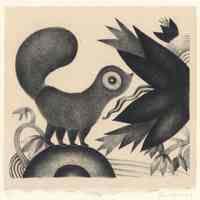
Andrea Dezsö (1968- ) | Lithograph | 2017
Signed edition 6 of 9. 2017.
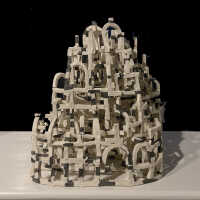
Anna Hepler (1969- ) | The Castle | Ceramic Sculpture | 2016
A black and white ceramic sculpture, The Castle, by artist, Anna Hepler. It stands about 14 1/2 inches high by 13 inches in diameter and dates to 2016. Hepler was born in Boston, Massachusetts 1969. She earned a B.A. degree from Oberlin College In Ohio in 1992 and an MFA degree from the University of Wisconsin at Madison in 1994. She moved to Portland, Maine in 2001 and soon afterwards to the opposite end of Maine’s coast to Eastport where she remained until 2018. She then moved to Greenfield, Massachusetts where she is currently based. A statement about her work includes: “At the heart of Hepler’s work is the thrill of making things and the excitement of training her mind and hand to manipulate unfamiliar materials. It is from this energetic center that her work radiates in many media, shapes and sizes. Hepler seeks forms in conflict – inflatable forms that breathe and are in constant motion, or latticed volumes that collapse perceptually in space. Quiet and intuitive, these restless sculptures are the molecular structure or alphabet with which she composes a visual vocabulary.” She has exhibited widely and held numerous artist residencies. Her solo exhibitions include Portland Museum of Art (Maine), the Roswell Museum of Art (New Mexico) and the Suyama Space (Seattle). In 2016, she created a large scale art installation called Undertow within the Tides Institute’s North Church project space. That same year she was awarded a fellowship by United States Artists. This sculpture was a gift of the artist to the Tides Institute in 2022.
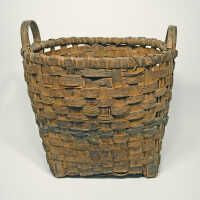
Artist Once Known | Herring Scale Basket [Passamaquoddy]
A large late 19th century herring basket made by the Passamaquoddies. It stands about 15” tall by about 19” in diameter. Made of woven strips of ash with an ash wood handle, thousands of such baskets were used in the fishing and particularly the sardine industry of the northeastern coast of Maine and southwestern coast of New Brunswick in the late 19th and early 20th centuries. Many were brought by canoes to the sardine factories from the nearby Passamaquoddy communities. The baskets were used to transport freshly caught herring from the holds of small sail powered carrier boats that brought the herring from where they had been caught in fish weirs to the sardine factory wharves. There the herrings were brought from the boats to the wharf decks one basket at a time using a simple hand pulled pulley and rope system. The baskets of fish were then dumped on tables where the heads of the herring were cut off by young laborers using large knives. The cut herring bodies were then poured back into baskets and lugged by hand to the next step in the then very labor intensive process of turning herring into canned sardines. This herring basket example is rare as few survived once the sardine industry became much more mechanized early in the 20th century and such baskets were no longer needed. Later the 20th century, such baskets were used by the thousands once again to deliver herring scales by boat to the newly developing pearl essence industry in the region that used herring scales in the production of such products as nail polish. Examples of these later herring baskets are much more common and are often marked with a large letter on the side of the basket to denote which pearl essence factory the basket belonged. The earlier late 19th century herring basket was found for sale on eBay by a seller in Quebec and purchased by the Tides Institute for its collections. When the basket arrived at the institute, it still had a few herring scales attached to the ash strips of the basket. Artist: Unknown Artist Classification: North American Basket Old Accession Number: 1516 Circa: 1920 Description: Herring Scale Basket. Passamaquoddy. Purchased on Ebay from Marc Boily of Quebec in 2003. Basket still had a few herring scales on it when first received in the mail.
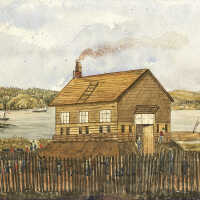
Artist unknown | School House at Indian Island | 1866
A watercolor that shows the fortification of the schoolhouse on Indian Island, New Brunswick during the Fenian border raids into Canada in 1866. The Fenian movement to aid the cause of Irish nationalism had begun 1858 and gained strength after the American Civil War with an influx of Irish veterans of the Union Army. In the spring of 1866, they congregated at various locations along the American border with British North America, what is now Canada. They hoped that by taking Canadian territory they could exchange it with Britain for Irish independence. One of the locations the Fenians came to was Eastport, Maine immediately across the border from Indian Island. The Fenians trained on a beach in Eastport in plan sight of Indian Island. On April 14, 1866 several Fenians raided Indian Island and capture the British flag that waved above the island’s British customs house. A week later, the Fenians returned and burned to the ground four warehouses and related wharves on the shores of the island. In response, New Brunswick militia were sent to Indian Island and fortified the island’s school house and this is the scene shown in the watercolor. Soon afterwards, American General Meade was dispatched to Eastport to disperse the Fenians. The Tides Institute acquired the watercolor in 2007. Initially the watercolor had come up for auction in England and the institute narrowly lost out in the bidding process. The winning bidder was an art gallery in Savannah, Georgia and the institute was then able to negotiate a purchase price with the gallery and have the watercolor become part of the institute’s collections. Photo caption: Watercolor that shows the fortification of the schoolhouse on Indian Island, New Brunswick during the Fenian border raids into Canada in 1866. Artist: Artist unkown Medium: Watercolor and graphite drawing? Classification: Paintings Old Accession Number: 96
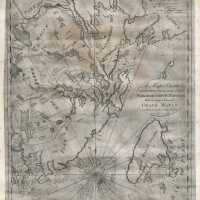
Benjamin R. Jones (1776-1859) | A map & chart of the bays harbours post roads and settlements in Passamaquoddy & Machias with the large island of Grand Manan
An early 19th century map of the Passamaquoddy Bay and Machias region by Benjamin R. Jones, surveyor. The full title of the map is: “A Map & Chart of the Bays Harbours Poft Roads and Settlements in Passamaquoddy & Machias With the large Island of Grand Manan. Compiled from Actual Survey by B.R. Jones, Surveyor.” The map was first published in 1810 with additions to the plate made in 1822 soon after Maine became a state. The engraving of the map was produced by T. Wightman of Boston, Massachusetts. Benjamin Jones was born in Milton, Massachusetts in 1776. His family moved to what is now Robbinston, Maine in 1788. As a young man with a wife and children, Jones moved to Eastport, Maine in 1803 to serve as town clerk, and then two years later, to Dennysville where he took a job teaching school. He began to work as a surveyor as well. Jones died in 1859. His map of Passamaquoddy and Machias is 20 1/2 inches (51 cm) high by slightly more than 16 inches (41 cm) wide. The map had been in the collections of Barracks Museum of the Border Historical Society of Eastport, Maine, but the Society voted to transfer its Museum collections to the Tides Institute in 2020 and the map is now in the institute’s collections. The institute also owns an original survey map by Jones of the south division of Trescott, Maine that Jones surveyed between 1806 and 1834. Artist: Benjamin R. Jones Medium: Engravings Classification: Maps Circa: 1822 Old Accession Number: 3025 Description: A rare original copy of "A map & chart of the bays harbours post roads and settlements in Passamaquoddy & Machias with the large island of Grand Manan” in our collections by map surveyor, Benjamin R. Jones. The engraved map was originally published in Boston in 1810 with plate editions on this copy of the map dating to 1822.
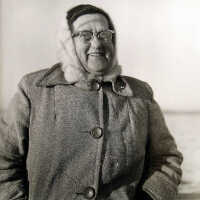
Berenice Abbott (1898-1991) | Lovina Faulkingham | c.1960
An original silver gelatin photograph print by noted American photographer, Berenice Abbott, of Lavina Faulkingham of Washington County, Maine. The photograph was taken in about 1960. Little is known about Lavina Faulkingham at this point. Berencie Abbott was one of the most important American photographers of the 20th century. Born in Springfield, Ohio in 1898, she moved to New York City in 1918. There she connected with Marcel Duchamp and Man Ray, leaders of the American avant-garde. Three years later she moved to Paris where she master the art of photography while serving as an assistant at the Man Ray Studio. In 1926, she had her first solo show of her photography in Paris. It was while at the Man Ray Studio, that Abbott first saw the photographs of Eugene Atget and after Atget’s death in 1927, she worked with Julien Levy of New York City to acquire most of Atget’s negatives and prints. She would bring these negatives and prints with her on her return to New York City in 1929, preserving them there in an archive, and promoting Atget’s work for years to come. With the onset of the Great Depression, Abbott began to document the life of New York City through her photography, an effort that resulted in 1939 in a traveling exhibition and accompanying book, Changing New York. In the early 1960s, Abbott moved to Maine that she had grown to love and settled in the small town of Monson in the Maine North Woods. She soon developed an extended series of photographs documenting life in Maine. This new body of work was published 1968 in her book, Portrait of Maine, done in collaboration with writer, Chenoweth Hall. The Tides Institute acquired Abbott’s photograph of Lavina Faulkingham from the Aucocisco Galleries of Portland, Maine in 2004. Photo caption: Original silver gelatin photograph print by noted American photographer, Berenice Abbott, of Lavina Faulkingham of Washington County, Maine. The photograph was taken in about 1960. Artist: Berenice Abbott Medium: Photograph Classification: Photographs Old Accession Number: 184
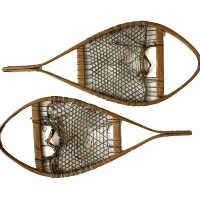
Capt. Samuel Watts | Wooden Snowshoes, c. 1810 | Roque Bluffs, Maine
A pair of handmade wooden snowshoes made over 200 years ago by Capt. Samuel Watts of Roque Bluffs, Maine for his son, Stephen Watts. They date to about 1810. Capt. Watts was born in Boston in 1745 and he died in 1816. His son was born in Jonesboro, Maine in 1803 and died in Roque Bluffs in 1876. The snowshoes are about 38 1/2” in length and 16” in width at their widest point. The hardwood used in making the frame of the snowshoes is mostly likely ash and the webbing between the frame is made from rawhide most likely from deer. Capt. Watts was a veteran of the American Revolutionary War, having taken part in the capture of the British schooner, HMS Margaretta, in nearby Machias Bay on June 11 and 12, 1775. Capt. Watts’ son in turn passed the snowshoes on to his son who wrote the following handwritten note about the snowshoes in the early 20th century: “Roque Bluffs, Maine, June 17th, 1925: These snowshoe raquetts [raquettes] were made by the Samuel Watts who took part in the taking of the Margaretta at Machias for his son Stephen J. Watts and by him given to me John N. Watts his grandson over 50 years ago and I now pass them on to my son Samuel Watts who is named for the same Samuel Watts.” A separate handwritten note by Capt. Watts’ grandson goes on to say: “These Snowshoes are over 100 years old. Presented to Samuel J. Watts by his Father, John N. Watts.” The snowshoes remained in the Watts family for nearly another 100 years and were still in Roque Bluffs when a descendant of the Watts family there decided to sell the family property and move away. The snowshoes were then acquired by the Tides Institute to keep them in the region. Photo Caption: a pair of handmade wooden snowshoes made over 200 years ago by Capt. Samuel Watts of Roque Bluffs, Maine for his son. They date to about 1810.
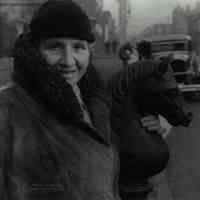
Carl Van Vechten (1880-1964) | Gertrude Stein | 1935
Carl Van Vechten. Photograph of Gertrude Stein, Richmond, Virginia with an old hitching post. Gift of John C. Fitzpatrick, 2017.
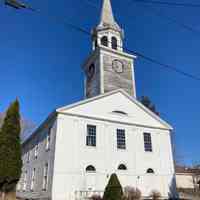
Central Meeting House | 26 Middle Street, Eastport, Maine | I7-0C3-15 | District #46 | 1828
The Central Meeting House was constructed in 1828 and dedicated in February, 1829 as The First Evangelical Congregational Meeting House. Daniel Low of Eastport served as architect and builder. He based his design for the Meeting House on a plan found in a building design book in his personal library by British-American architect, Asher Benjamin. The congregation itself had formed 10 years earlier in 1819 and in 1828 took the name of the First Evangelical Congregational Church and Society. Two years later, in 1830, the congregation’s name was changed to The Central Congregational Church and Society of Eastport. The Meeting House building employs uniquely strong construction techniques not found elsewhere in New England. The original steeple of the church blew over in the Saxby Gale of 1869 and was replaced by the current steeple of different design. The original main sanctuary space (as shown in photograph above) is very largely intact though the original balcony was enclosed and the original ceiling modified in 1892. The building is deemed “the finest example of federalist architecture in Washington County, Maine” and it has been listed on the National Register of Historic Places since 1976. The building and property were gifted to TIMA by the Central Congregational Church and Society congregation in 2016. Many of the original church records are now in the collections of TIMA. TIMA is developing the building for TIMA and other public talks, workshops, celebrations, and receptions; as exhibition space for maritime and architectural artifacts drawn from TIMA’s extensive collections; as an important feature of a walking tour of TIMA’s campus of historic buildings; and for other community events. A small contemplative park, including an historic Victorian Playhouse, is planned for the rear of the building. The main sanctuary space can host an audience of up to 150 people. Until 2024, the small remaining congregation continued to meet seasonally at the church building on Sunday mornings until they disbanded in 2025. Built:1829 Address: 26 Middle Street Eastport, Maine National Register ARCHITECTS Daniel Low ARCHITECTURAL STYLES Federal From Sunrise County Architecture (2nd revised and enlarged edition) 1996, p.24 CENTRAL CONGREGATIONAL CHURCH Built in 1829 by architect-builder Daniel Low, of Eastport, Central Congregational Churchis called "one of the finer provincial Federal style churches in the state. On a stone foundation, the wooden frame building is covered with clapboards. The front entrance has 3 doors, the center door being taller, each with arches and fan lights. Three 12-over- 12 windows, each above a door, punctuate the balcony floor. The square tower holds front and side clock faces, and above is the spire, which was added in 1831. After the 1869 Saxby Gale blew off that spire, a differently designed spire was restored. Only a few years ago this church has also survived being struck by lightning, but has been restored. A wrought iron weather vane crowns the spire. The interior is large, with an arched ceiling. The pews have been filled both for worship and for musical concerts. F AB, JCB From Eastport Walking Tour Brochure, 2010: 56) The Central Congregational Church (NR) Middle Street, Federal style. In January of 1818, a religious society was formed under the name of "First Evangelical Congregational Church and Society of Eastport," which chose Deacon Ezekiel Prince, Capt. Thomas Rogers, Nathan Bucknam, Benjamin B. Leavitt and Daniel Low as the building committee. Daniel Low, an architect and master builder, took charge and completed the church prior to its dedication February 18, 1829. Mr. Low's carpenters were said to have been mostly ship's carpenters. The original steeple was blown off during the Saxby Gale of 1869. In 1830, by an act of the State legislature, the society's name was shortened to the "Central Congregational Society of Eastport." From Kilby's Eastport and Passamaquoddy (1888): CENTRAL CONGREGATIONAL CHURCH. In the winter of 1819, Rev. Mighill Blood, of Bucksport, employed by a Massachusetts missionary society, came through to Eastport, and on the 8th of February instituted a church consisting of five persons, Ezekiel Prince, Samuel Starboard, Samuel Whitcomb, Jane N. Weston, and Sarah S. Whitney. The first Congregational meeting-house was then in process of construction; and it was the expectation of the members of the newly formed church that it would be connected with the society, worshipping in the new meeting- house when completed. But, when the time came, the proprietors voted to send to Cambridge for a Unitarian minister; and the connection was not made. The church, however, kept together, worshipping generally with the Baptists, and, though the numbers were reduced by death and removal, others were added by letter; and in 1825 Rev. Wakefield Gale, a graduate of Andover Theological Semi- nary, who had been preaching for a few Sundays for the Baptists while they were without a minister, commenced regular services in the Old South School-house, and soon gathered a congregation exceeding the capacity of that building. On the 11th of January, 1828, the society was organized under the name of the "First Evangelical Congregational Church and Society of Eastport." It was then decided to have a new house of worship; and Ezekiel Prince, Thomas Rogers, Nathan Bucknam, Benjamin B. Leavitt, and Daniel Low were chosen a building committee. The house, under the direction of Mr. Low as architect and builder, and dedicated Feb. 18, 1829, Mr. Gale preaching the sermon. This was the first church in town with a vestry under the same roof, and is the only one retaining the then prevalent style of interior finish. Its tall steeple was blown over in the great gale of 1869, and replaced by one of slightly different form. It has a clock paid for by the town. On account of the length of the name originally adopted, it was changed in 1830 by act of the State legislature to the "Central Congregational Society of Eastport." The first deacons chosen were Ezekiel Prince and Libbeus Bailey. Deacon Prince may be said to have founded the church and society, and was Its faithful friend to the end of his long life. He died July 18, 1852, aged ninety-one years. His was a marked figure in our streets, the last of the old school, clad in long stockings and knee breeches. Deacon George A. Peabody is now in the fiftieth year of his service in that capacity. Not long since, the church received a bequest of $2,000 from the estate of Miss Sarah Leavitt, and earUer in its history the sum of $400 from Mrs. Margaret Dawson. Organization for 1888. Pastor, Rev. Ora A. Lewis. Deacon, George A. Peabody. Prudential committee, George A. Peabody, John A. Lowe, Herbert Kilby. Clerk and treasurer, George A. Peabody. Superintendent Sunday-school, George A. Peabody. ( ) From Eastport Sentinel, September 21, 1892, p.5,c.2: "The Central Congregational society are having extensive repairs and alterations made to the interior of their church edifice, the work is begin done under the supervision of Mr. James H. Camplin. The society finding they no longer need the galleries which extended around two sides and one end of the building for the purpose originally intended, have partitioned them off utilizing the room thus gained, for vestry, library and dining room purposes. The ceiling of the church will be arched, while stained glass windows will admit the light from above. When completed it will be much more convenient for the society, yet its original arrangement must be greatly missed by those who have long worshiped within its old-time walls, hallowed by the sacred memories which cling to a place that has sheltered so many generations of the town's people, who have worshipped the Father within its consecrated precincts."
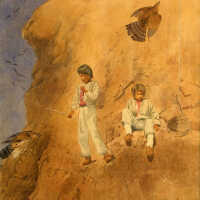
Charles Caleb Ward (1831-1896) | Cliff Climbers, Grand Manan | 1869
An 1869 watercolor (9.5 inches by 11.5 inches) by New Brunswick artist, Charles Caleb Ward of Peskotomuhkati/Passamaquoddy youths gathering gull eggs on the cliffs of nearby Grand Manan island in New Brunswick. Historically, for the Passamaquoddies, Maine’s current political boundary line was non-existent and Passamaquoddies homeland and territory extended to both sides of the border. In the nineteenth century and long before, they were frequently on Grand Manan for fishing and sealing, to collect gull eggs found on the steep island cliffs and for other activities. In 2004, the Tides Institute learned of the existence of this painting from a tip from Donald Soctomah, long time Passamaquoddy tribal historic preservation officer. The watercolor was coming up for auction at Heritage Auction in Dallas, Texas and the Tides Institute was able to mount the successful bid after raising the necessary funds to cover the bid. It is one of two paintings by Ward in the Institute’s collections. The other is an oil painting portraying a Passamaquoddy hunter in the woods of Charlotte County, New Brunswick. Charles Caleb Ward did many paintings of the Passamaquoddies during this time while living and working in St. George, New Brunswick. He was born in Saint John, New Brunswick in 1831. Later he spent time in Liverpool, England to learn about the shipping business, but also learned figure painting with the English artist, William Henry Hunt. Ward also lived in New York City for awhile where he studied landscape painting with artist, Asher B. Durand, and maintained a studio in the city. He died in 1896. Artist: Charles Caleb Ward Medium: Watercolor Classification: Watercolors Circa: 1869 Old Accession Number: 169 Purchased in 2004 from Heritage Gallery and Auctioneers, Dallas, Texas.
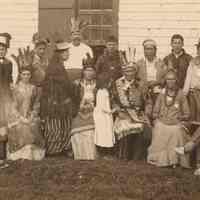
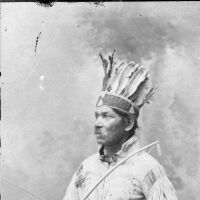
Charles E. Brown | Portrait of Members of the Peskotomuhkati/Passamaquoddy Tribe, Sipayik (Pleasant Point), Maine | c.1890
Portrait of Members of the Peskotomuhkati/Passamaquoddy Tribe, Sipayik (Pleasant Point), Maine, c.1890. Photograph by Charles E. Brown of Eastport, Maine.
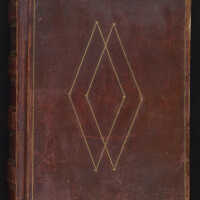
Charles T. Eldridge | Eastport, Maine American Civil War Handwritten Enlistment Book | 1871
A massive 381 page hand written oversized leather bound volume that details the participation by residents of Eastport, Maine in the Union military operations in the American Civil War. The volume was the work and labor of love of Charles T. Eldridge of Eastport, Maine who was himself a veteran of the American Civil War. He completed the work in 1871 and he was able to undertake the research for the volume while stationed in Washington, D.C. where he had access to military records regarding the War. The volume’s official title is: “Eastport: Enlistments in the Regular and Volunteer U.S. Army and Navy from 1861 to 1866, compiled from Official Records by Charles T. Eldridge.” For many years the volume resided with the Peavey Memorial Library of Eastport, Maine. But use of the volume over time led to its wear and tear to the point where the library was considering placing the volume with the Maine State Library for better preservation of the volume. Fortunately a trustee of the Peavey library approached the Tides Institute about whether the institute might be willing to take on the volume, preserve it and keep in this region. The Tides Institute agreed to do this and in 2018 the Peavey Library placed the volume with the institute. Soon afterwards the institute had the volume restored and digitized by the Northeast Document Conservation Center in Andover, Massachusetts. The institute was able to raise the necessary funds privately. Photo caption: Title page of 381 page hand written leather bound volume that details the participation by residents of Eastport, Maine in the Union military operations in the American Civil War. The volume was the work of Charles T. Eldridge of Eastport, Maine who was himself a veteran of the American Civil War. He completed the work in 1871. Placed on permanent loan in 2018 from the Eastport Library Association in Eastport, Maine. Loan agreement on file. Eastport. Enlistments in the Regular and Volunteer Service, U.S. Army and Navy. From 1861 to 1866. Compiled from Official Records by Charles T. Eldridge at Washington City, D.C., 1871. From Eastport Sentinel, December 12, 1917, p, 2: EASTPORT MAN LONG IN SERVICE Col. C.T. Eldridge Spent More Than Half Century in Service. Interment Here Wednesday Afternoon. The burial of Col. Charles T. Eldridge, who died in Washington D.C, on Sunday, Dec. 2, took place at the cemetery here at noon Wednesday immediately after the arrival of the remains on the 11:30 train. George R. Ray, Warren S. Kane, E.S. Waide, James L. Irvine, John P. Hutchison, Fred Campbell, George W. Norton and W.C. Hawkes acted as pall bearer and brief services were conducted by Rev. Dr. H.O. Millington of the Brookland Baptist church of Washington. Mrs. Eldridge and Frank Eldridge of Providence, a brother of Mr. Eldridge were present returning with Dr. Millington to their homes on the afternoon train. Col. Eldridge was born in this city about 75 years ago and was educated in the public schools. He enlisted on October 11, 1862 as a private in Co. H, 26th Maine Volunteers and saw service under Butler in the Louisiana campaign for nearly two years being mustered out in 1863. In April he was appointed commissary clark to Major B.A. Chadbourne and served with him until April, 1865, when he resigned to accept a position as clerk in a bureau of the War Department. This position he held for 52 years, in the course of which he met and developed acquaintances with many government officials. Mr. Eldridge was a penman of exceptional ability and among other samples of his work was a part of the original ritual of the Knights of Pythias, an order which was founded at Washington during the first years of his residence there. He also compiled a record of all the enlistments from Eastport during the Civil War — a beautifully executed book of 269 pages, 16 inches in width by 24 inches in length and five inches in thickness. This book was presented to the Public Library of this city by Mr. Eldridge and has for long been one of the show pieces of the library. Mr. Eldridge is survived by his wife and three brothers, William of Oregon, Frank of Providence and Mayor Fred T. Eldridge of this city.
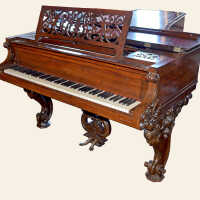
Chickering Grand Piano, 1868 | Norwood House | Eastport, Maine
A grand piano made by the Chickering and Sons piano company of Boston, Massachusetts in 1868. The piano serial number is: 32980. For many years, the piano was owned by Benjamin Whelpley, a pianist and composer of piano music, who was born in Eastport, Maine in 1864 and who had a long career in Boston. Whelpley maintained the family home, an impressive historic greek revival house, in Eastport where the piano long resided. Dennis Hooper, of Saint John, New Brunswick, recently related some of the story of Whelpley and the Chickering piano as Hooper used to spend weekends during the summer months in the Whelpley house in Eastport while Whelpley was still alive. According the Hooper, Benjamin Whelpley lived at the house when he was not performing elsewhere. The Chickering grand piano was given to Whelpley by the Chickering Piano company. The piano is hand carved and made of rosewood and copper strung. Benjamin Whelpley took the piano everywhere where he was performing. When he was at Eastport, Whelpley would give concerts at the house on Sundays and many people, including President Franklin Roosevelt and Eleanor Roosevelt when they were at their summer cottage on nearby Campobello Island, New Brunswick, would come to hear the concerts. Whelpley died in 1946 and the piano remained in the house until 2007 when new owners of the house donated it to the Tides Institute. The piano remains in relative good shape and the Tides Institute hopes to have it restored and played again. Photo Caption: Grand piano made by the Chickering and Sons piano company of Boston, Massachusetts in 1868. For many years, the piano was owned by Benjamin Whelpley, a pianist and composer of piano music, who was born in Eastport, Maine in 1864 and who had a long career in Boston. Classification: Musical instruments Circa: 1868 Old Accession Number: 3009 Description: 1869 Chickering Grand Piano, Boston, Massachusetts. From Norwood House, 15 Key Street, Eastport. Gift of Christopher and Janet Palumbo, 15 Key Street, Eastport, Maine in 2007. Piano originally belonged to composer, Benjamin Whelpley, who once owned the Norwood House, 15 Key Street, Eastport, Maine. Piano serial number is: 32980. The piano was built in about 1868. Age dated using this website: http://www.total-piano-care.com/chickering-and-sons.html.
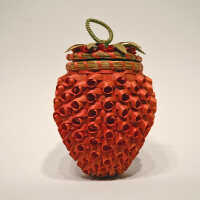
Clara Keezer (1930-2016) | Small Strawberry Basket [Passamaquoddy] |
A Passamaquoddy strawberry splint ash and sweetgrass basket by master basketmaker, Clara Neptune Keezer. The basket stands five and a half inches high and three and a half inches wide. Keezer was born in Sipayik, Maine in 1930. She came from a long line of basketmakers before her, learning how to make baskets from her grandmother and her mother. She made her first basket at age eight. At this time, basketmaking was in decline among the Passamaquoddy, Penobscot and other tribes of Maine and Keezer became involved in revitalizing this craft tradition using traditional basketmaking materials of splint brown ash and sweetgrass. One particular traditional basket form she excelled at was the strawberry basket that she took to a new more elegant form and intricate level. She also made blueberry and corn shaped baskets as well as a basket in the shape of a bell. Her baskets soon began to be exhibited elsewhere including in the influential Lost and Found Traditions: Native American Art 1965-85 exhibit that opened at the American Museum of Natural History in New York City in 1986. Ralph T. Coe, the curator of the exhibit, had spent the decade before traveling across the United States, seeking out examples of indigenous art and craft that were undergoing revival and reinvention. Of Clara Keezer, he said, she "is the finest splint craftswoman I met in the Northeast.” Sixteen years later, in 2002, Keezer was recognized as a National Heritage Fellow for her basketmaking talents by the National Endowment for the Arts. She continued basketweaving and teaching young people basketmaking techniques until her death in 2016 at the age of 86. The Tides Institute acquired the strawberry basket through eBay auction. Artist: Clara Keezer Classification: North American Basket Old Accession Number: 625 Description: Passamaquoddy. Small red color strawberry basket. Top Shelf.
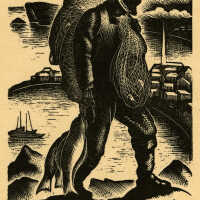
Clare Leighton (1898-1989) | Gaspe Fisherman | 1948
Artist: Clare Leighton Medium: Wood Engraving Classification: Prints Old Accession Number: 458
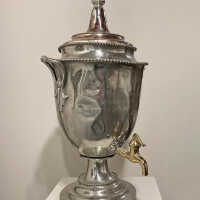
Coffee Urn | Rose Standish Steamship | c.1880
A late 19th century silver plate coffee urn that is engraved with the name “Rose Standish” on its front. The coffee urn was made for the steamship, Rose Standish, that made regularly scheduled trips in this region in the late 19th century between Calais and Eastport in Maine and St. Andrews in New Brunswick. The coffee urn stands 22 inches high and 11 inches wide. It is entirely made of silver plate with the exception of a brass spigot. There are no identifying maker’s marks on the coffee urn so it is unknown who may have made it. The Rose Standish was built in Williamsburg, New York by Lawrence and Foulks in 1863. The steamship was 154 long, 27 feet wide and 392 tons. In 1887 the steamship was sold to the Frontier Steamship Company of Calais. Thirteen years later, in 1900, the Rose Standish caught fire and sank while docked along the Calais, Maine waterfront. Nearly a century later, in the mid to late 1990s, two brothers from Calais, Darren and David Townsend, got permission from the City of Calais to explore the wreck of the Rose Standish that still lay submerged in the waters edge of the St. Croix River. Darren had a lobster boat for the salvage operation and he did the diving to the underwater Rose Standish wreck and found the still intact, though damaged, coffee urn. Several years later, Darren sold the coffee urn to a local Calais antique dealer, Kerry Pinnette. Pinnette had the coffee urn cleaned, polished and repaired by Macel Doucet of Brass ’n Things of Saint John, New Brunswick. Pinnette soon sold the restored coffee urn to another local Calais area antique dealer, Brian Smith, who contacted the Tides Institute and sold the coffee urn to the institute in 2006. Rescued from the wreck of the steamship, Rose Standish, that burned and sank in 1900 along the Calais, Maine waterfront. The Rose Standish was built in 1863. Silver-plate. 22 inches high, 11 inches wide. Reply to Facebook post in group, Old Pictures of Eastport, Maine, June 27, 2022 of photograph of steamship, Rose Standish, docked at Eastport, Maine waterfront in 1890 from Brian Smith: "Great photo, thankyou for sharing, history of the "ROSE STANDISH ",was built in Williamsburg, New York, by Lawrence &foulks in 1863,she was sold to frontier steamboat company in 1887,she was 154 feet long over all ,her beam was 27 feet, she weighed in at 392 gross tons .the ROSE STANDISH, sailed the st.cr st.croix river between Maine and New Brunswick ,from Calais to Eastport and over to st.andrews, New Brunswick and making stops to other small communities in between. She was destroyed by fire while docked at the Calais pier in 1900.,some artifacts have been recovered, one in particular, the original coffee urn that was used by the crew and passengers, is in the tides institute and museum of art,I had purchased it from Calais antiques owner, Kerry pinett [Pinnette] over a decade ago, he had purchased it from a local Calais resident and collector of marine artifacts of the local area, I decided to sell it to the tides institute and museum of art, to make sure that it forever stayed where it belonged and its history preserved for future generations of our citizens of downeast Maine and beyond, glad that an important part of our corner of downeast Maines history has gone full circle, and an historic artifact of the ROSE STANDISH is back again, to tell its memories of a time long ago in the annuals of downeast Maine." Telephone conversations with Brian Smith, July 10 and 11, 2022: Two brothers, David Townsend and Darren Townsend, of Calais, Maine were the people who recovered the coffee urn from the submerged wreck of the Rose Standish in the waters next to the Calais waterfront. This would have been in the mid to late 1990s. Darren had a lobster boat and they got permission from the City of Calais to do the salvage operation. Darren did the diving. Darren then sold the coffee urn to antique dealer, Kerry Pinnette, of Calais, Maine. Kerry had the coffee urn restored by Brass 'n Things of Saint John, New Brunswick as he knew Marcel Doucet the owner and he was having a number of things restored by Brass 'n Things at this time. Kerry only owned the coffee urn for 3-4 months and he then sold it to me (Brian Smith). Kerry must have bought the coffee urn in about 2005 as I (Brian Smith) sold the urn to the Tides Institute in 2006 after owning it for a couple months. David Townsend now works for the Calais High School as a custodian. Darren has moved to Florida. Coffee Urn was restored by Brass 'n Things of Saint John, New Brunswick: "Established in 1976, Brass "N" Things has been proudly providing antique restoration services through the Atlantic region. Locally owned and operated, we are skilled in all facets of our trade. We off our expertise for all antique lighting and repair. Door hardware, fireplace accessories. Full restoration to all Church accessories. Tabernacles, Collection Plates, Candlesticks, Chalices, etc. Dedicated to every detail in the restoration and conservation of find metalware, antiques, and collectibles. We will make your artifacts new again. We strive for outstanding customer satisfaction. We buy scrap Gold & Silver, Old Coins. Antiques bought & Sold!"
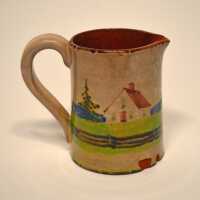
Cottage Craft CPC Pottery | St. Andrews, New Brunswick
A pottery pitcher that was created as part of the Charlotte County Cottage Craft industry initiative founded in St. Andrews, New Brunswick by Grace Helen Mowat in 1913. It dates to the 1920s. Mowat was born in St. Andrews in 1875, studied art in London (Richmond School of Art and Music )and New York City (Cooper Union) and then briefly taught art in both New England and Nova Scotia. She then returned to St. Andrews to help care for her aging parents and their farm at Beech Hill. Then and there she came up with the idea of establishing a cottage craft industry the would help give employment and income to the rural women of Charlotte County, New Brunswick. Cottage Craft initially focused on yarns naturally dyed in colors reflective of Charlotte County landscape and seascape. The yarns were then sold directly as yarn or woven into products for sale such as sweaters and cardigans as well as colorful bags and figurative dolls. With the success of the yarn and weaving industry part of Cottage Craft, in the early 1920s Mowat next attempted to expand the industry by including linen and pottery. Neither proved to have longer term success after several shorter term attempts. The pottery that was produced using local clays and ranged from small vases and candle holders to small pitchers and plates, again, decorated in colors and scenes reflective of Charlotte County. With the coming of the second World War, Mowat’s oversight of Cottage Craft began to end and successors were found to continue the industry. Mowat died at her Beech Hill farm at the age of 90 in 1964. Photo caption: Cottage Craft pottery pitcher decorated with a cottage, field fence, tree and background of blue sea. The pitcher dates to the 1920s. Old Accession Number: 1526
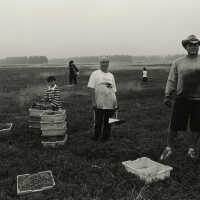
David Brooks Stess (1961- ) | Cory & Family | c.2002
A gelatin silver photographic print by photographer, David Stess, titled “Corry and Family and Crew, Northeastern Blueberry.” The photograph was taken on the wild blueberry barrens of Washington County, Maine and dates to about 2002. Stess was born in New Jersey and raised in Florida. He then attended the University of Miami where he studied history, film, and photography. He has spent more than 25 years documenting the yearly blueberry harvest in Washington County during a time when the blueberry industry was undergoing momentous change, from an over a century long entirely traditional hand raked harvesting process to an almost entirely mechanized harvesting process. A participant photographer, Stess not only has photographed the harvest and its workers annually for many year, but he has worked and lived right along side workers harvesting the blueberries on the barrens. This extended intimacy with the workers and the harvest, has allowed Stess to capture a full spectrum of life and work on the barrens, from living in the workers camps to the actual work of harvesting the blueberries by hand rakes. In 2013, fifty of his blueberry harvest photographs were exhibited at the Portland Museum of Art in Portland, Maine. This photograph was a gift to the Tides Institute by the photographer. Photo caption: David Stess, gelatin silver photographic print, “Corry and Family and Crew, Northeastern Blueberry,” 11” x 14”, c.2002. Artist: David B. Stess Medium: Selenium Toned Silver Print Classification: Photographs Old Accession Number: 919 Description: Cory & Family. Crew. Northeastern Blueberry.
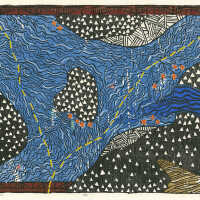
David Umholtz (1943-2014) | Webster Ashburton Treaty 1842
A large (21”/53.3cm x 33”/83.8cm) hand printed woodcut, “Webster-Ashburton Treaty,” by artist, David Umholtz. Born in 1943 in Harrisburg, Pennsylvania, Umholtz migrated to Canada in 1973 and spent much of his early years there in Manitoba where he established Moosehead Press 1977. Through his career, he taught at several universities in Canada as well as Carnegie Mellon in Pittsburgh. In the 1980s he began to summer on Deer Island, New Brunswick where he built a studio and eventually moved there full time. He created a whole body of work that had map like qualities, some with historical references like “Webster-Ashburton Treaty” and some with geographical references like “Le Grand Vortex II” (also in the collections of the Tides Institute) associated with the large “Old Sow” whirlpool off the southern tip of Deer Island. The Webster-Ashburton Treaty of 1842 between the United States and Great Britain gave final definition to the boundary line through Passamaquoddy Bay where Deer Island is located with Grand Manan Island going to Great Britain (now Canada) and Moose Island (where Eastport, Maine is located) going to the United States. In addition to his career as a printmaker, Umholtz was also an avid sailor and could often be seen traversing the waters of Passamaquoddy Bay as he slowly made his way in his small sail powered dory from Deer Island crossing the Canada/U.S. border to Eastport. Late in his career, Umholtz was awarded the two leading artist awards in New Brunswick, the Strathbutler Prize in 2009 and the Lieutenant Governor's Award for Excellence in Visual Art in 2012. Umholtz died in 2014. This particular woodcut was a gift to the Tides Institute by the artist. Artist: David Umholtz Medium: Woodcut. 4/25 Classification: Prints Old Accession Number: 95
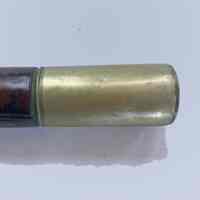
Dollond Telescope | Belonged to Leonard Tilley, Premier of New Brunswick | 1757
Dollond telescope, 1757. Belonged to Leonard Tilley (1818-1896), Premier of New Brunswick. From estate of Walter Emery, 2018. 25 1/8" in length. Note with gift of telescope: 1757, John Dollond, an English optician invented the achromatic telescope by the combination of flint and crown glass. From p. 62, Chronology of Iron and Steel, compiled by Stephen L. Goodale, edited by J. Ramsey Speer, 1st edition, published by the Pittsburgh Iron and Steel Foundries Company, Pittsburgh, Pennsylvania, 1920.
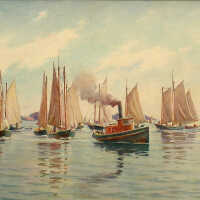
Dougal Anderson (1854-1921) | The Tow | c.1900
A large watercolor (7”/17.8 cm x 17”/43.2 cm) by American artist, Dougal Anderson (1854-1921) called “The Tow.” It dates to about 1900. At the time the painting was completed, its subject matter, “The Tow,” was a common scene along the eastern coast of Maine and southwestern New Brunswick. It portrays a steam powered tug towing a series of sail powered sardine carriers that were used to transport small herring fish freshly caught in the hundreds of weirs then active throughout this region to the numerous sardine factories located primarily in Eastport and Lubec, Maine but also elsewhere along this coastal region. The watercolor was acquired by the Tides Institute from a local Eastport historian. Born in Charlestown, Massachusetts, Anderson moved with his family to Eastport, Maine when he was two to a farm located on Kendall’s Head. At the age of 28, Anderson was awarded a scholarship to study at the Boston Museum of Fine Arts School of Drawing and Painting where he later taught. He then returned to Eastport where he spent the remainder of his life though he did travel to Europe and Mexico. A prolific painter working almost exclusively in watercolor, he is known for his hundreds of coastal scenes of the region as well as inland scenes. He is considered a local “favorite” painter of the period and his distinctive style watercolors with his trademark signature are highly sought after locally. But he is little known beyond the immediate Eastport area as his work was never shown, with the exception of a small exhibition of his work in Boston in 1978, outside this area. Artist: Dougal Anderson Medium: Watercolor Classification: Watercolors Old Accession Number: 310
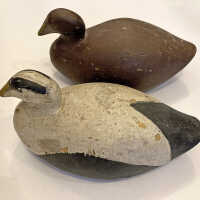
Eider Duck Decoys | Lubec, Maine | c.1930s
Two wooden male and female eider duck decoys that likely date to the 1930s. They belonged to Alger W. Pike (1899-1980) of Lubec, Maine who was an avid hunter, fisherman, and gardener as well as amateur ornithologist. He was an owner with his brothers and others of the Holmes Sardine Company and the Trident Packing Company. He also worked in New York City and Washington, D.C. The decoys are about 15 1/2 inches long and about 8 inches high. There are no maker’s marks on the decoys though one has the number 22 in red and the other has Alger Pike written on it in pencil. They were acquired by the Tides Institute from Decoys Unlimited auctions of Barnstable, Massachusetts. Alger Pike owned property along the shore in South Lubec that was located on the path of a north south fly over for migrating birds. To attract the birds, Alger had a fresh water pond created, that became known as Pike’s Pond, on the property by damming a stream that entered the sea there. The dam was created by driving boards into the ground and filling both sides with earth. He had wild rice planted in the pond to attract even more birds as the wild rice provided feed for the birds. Wild rice would not grow in salt water, but would grow in the fresh water of Pike's Puddle. In recent years, a culvert that ran under the road at Pike's Puddle was replaced and in the process modified Pike’s Puddle so that it did not hold fresh water any more. Salt water now flows into the Puddle at high tide.
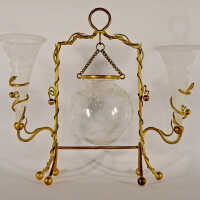
Epergne, c.1890 | Wells-Shober Cottage | Campobello, New Brunswick
A late 19th century century table piece called an epergne. It comes from the Wells-Shober Cottage on Campobello Island, New Brunswick. The Cottage is now part of the Roosevelt Campobello International Park. Merriam Webster Dictionary defines an epergne as: “an often ornate tiered centerpiece consisting typically of a frame of wrought metal (such as silver or gold) bearing dishes, vases, or candle holders or a combination of these.” In this example from the Wells-Shober Cottage, the epergne consists of a brass frame structure with a wonderful round open top etched glass bowl in the center and then two delicate etched glass vases on either side. The epergne was donated to the Tides Institute by a donor whose father was in the real estate business and once handled the sale of the Wells-Shober Cottage in the mid-20th century. Many of the original furnishings of the Cottage were still there at the time and he was able to bring many of them to his family’s home in Eastport including the epergne. The Wells-Shober Cottage was built in 1884 for Samuel Wells, a Boston lawyer and president of the Campobello Company that developed many of the hotels and surrounding land for summer cottages on Campobello at the same time. In 1912, the Cottage was purchased by the Shober family of Philadelphia. From Sunrise County Architecture (2nd revised and enlarged edition) 1996, p.119 WELLS-SHOBER COTTAGE Willard T. Sears, of Boston, designed the Wells-Shober Cottage for American lawyer Samuel Wells, once president of the Campobello Company. This building was finished in 1884, at about the same time as the building of the three Campobello hotels for which Sears drew the plans. All four buildings were Queen Anne Revival designs. With a steep hip roof, dotted with gables and dormers, this two-and-a-half story cottage was built with railings, both inside and on the facade. The roof was a bell-cast design with two chimneys. Walls of this wooden frame building are protected by clapboards, first painted brown (with white trim), but since painted all white by the Park Commission. When the living room, with fireplace, was given an addition encircling that room, the outside veranda had to be rebuilt as well. Besides dining room and kitchen, on the first floor, there are not only four second floor bathrooms but two railed verandas, while three bedrooms, each with a bath, occupy the third floor. The Park Commission remodeled the Well-:Shober Cottage for use as a guest house. This cottage is across the street (Route 774 from Lubec to Welshpool, N.B.) from the Hubbard Cottage, which is seven years younger. The Wells family sold their cottage to Mary Norris Cochrane in 1912, and her daughter Edith Shober (Mrs. Rex) inherited it in 1918. The Park Commission acquired the Wells-Shober Cottage in 1965, and it was the first cottage to be redecorated and used for Commission meetings. NHSD, JCB Classification: Furniture Old Accession Number: 2202
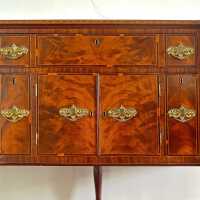
Federal Sideboard | Anna Whalen House | Eastport, Maine | c.1810
Gift from estate of Frances Whalen Strout, 2020. From Anna Whalen House, 7 Key Street, Eastport, Maine. An early 19th century mahogany sideboard that came down through one family in this region for over 200 years. It measures 74 inches long, 25 1/2 inches wide and 41 inches high. It was first owned by Seward Bucknam (1783-1868) and his wife Irene McLellan (1796-1865). Seward was born in Falmouth, Maine and then moved to Eastport, Maine at a young age. He became a well established merchant with stores and wharves on the south end of Eastport. Ellen Irene Bucknam (1826-1900) was their only child and daughter. She married Joseph Mason Livermore (1824-1872) and they eventually inherited the sideboard. They had eight children, among them Anna Bucknam Livermore (1859-1933). Anna’s first marriage to Albert Pike was short lived as he died shortly after they were married. She then married Lincoln Hamlin Newcomb (1860-1923), a lawyer. Anna inherited the sideboard from her parents. When Anna and her second husband died, the sideboard went to Anna’s younger sister, Sarah Preble Livermore Whalen Hayes (1867-1961), who married Leverett Mitchell Whalen (1850-1912) and then George Hume Hayes (1851-1935) after Leverett died. When the sideboard came to Sarah, it would have been in the large 7 Key Street house in Eastport that had been in the Whalen family for generations. It stayed in this house after Sarah’s death as the house and sideboard were inherited by Sarah’s daughter, Anna K. Whalen (1894-1986) who continued to live in the house until her death. Anna had no children and when she died, the house, sideboard and other household furnishings were inherited by Anna’s niece, Frances Whalen Strout (1933-2020). Frances sold the house and moved the sideboard and most of the household furnishings to her ranch style home with attached garage in Brewer, Maine. She converted her garage into a 19th century parlor room filled with the furnishings from her aunt’s Eastport house including the sideboard. Frances had no children and when she died the sideboard along with many with many other of the family furnishing were placed with the Tides Institute in 2020. A note found in the sideboard written by Frances reads: “Originally had black knobs. Henry Newcomb put on new brass pulls.” Federal Sideboard, c.1810. Gift from estate of Frances Whalen Strout, 2020. From Anna Whalen House, 7 Key Street, Eastport, Maine. Anna Whalen was the aunt of Frances Whalen Strout. Sideboard was first owned by Seward Bucknam of Eastport, Maine. One note from Frances Whalen Strout reads: "Seward Bucknam, born June 7, 1783, owned this sideboard." Another note from Frances Whalen Strout reads: "The Livermore sideboard - once was Aunt Nan's - at her death went to Sara P. Whalen Hayes. Originally had black knobs. Henry Newcomb put on new brass pulls." Email from Margaret Whalen, July 6, 2022: "I think I figured the history of that sideboard out. Here goes: Joseph Mason Livermore (1824-1872) married Ellen Irene Bucknam (1826-1900); the sideboard must have come to them from Ellen’s family. (Joseph and Ellen were my great-great-grandparents. It was she who must have made the crazy quilts, based on Grandpa’s letter to me.) They had eight (8!) children, among them Anna Bucknam Livermore (1859-1933). She was known in the family as Aunt Nan; her first marriage was to Albert Pike, who died pretty young. She then married Lincoln Hamlin Newcomb (1860-1923), a lawyer who was known as Linc. When they died, the sideboard went to Anna/Nan’s younger sister, Sarah Preble Livermore Whalen Hayes (1867-1961), who married Leverett Mitchell Whalen (1850-1912) and then George Hume Hayes after Leverett died. When the sideboard came to Sarah, it would have been in the 7 Key Street house, where it stayed under Anna K. Whalen’s stewardship until she died in 1986. From there it went to Dimpy’s house, where it stayed until it was given to the Tides Institute in 2020." Seward Bucknam, born in Falmouth, July 7, 1783, died Feb. 14, 1868, aged 84. His wife Anna died Nov. 22, aged 38. His wife Irene, died Oct. 19, 1865, aged 69. Ellen Irene Bucknam (1826-1900) was the daughter of Seward Bucknam (1783-1868) and Irene McLellan (1796-1865)
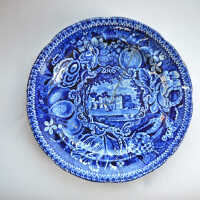
Flow Blue Plate | R. Hall's, Select Views, Warleigh House, Somersetshire, England | Stone China | c.1825
An early 19th century flow blue English stone china dish that was pieced back together from a number of shards. On the back of the dish is stamped: R. Hall's, Select Views, Warleigh House, Somersetshire, Stone China. The 8 1/2 inch wide dish was made in England and dates to about 1825. This dish was unearthed in 2018 during the excavation of a six foot deep 19th century household “dump” in this region that was filled with thousands upon thousands of beautiful, but broken early 19th century ceramic and glass shards. The “dump” was on the site of a large house built in 1824 and torn down in the early 1960s. The house underwent considerable renovation in the mid-19th century. During this renovation, the existing house pantry full of ceramic and glass ware was likely cleared out and thrown in the “dump.” Some ceramic and glass shards came into the institute’s collections during this initial excavation, but much was also taken out of the region to Portland, Maine and to North Dakota. The institute sought the return of what was removed from the area. All that went to the Portland area is now back in the institute’s collections. Nearly all (including this piece), with the exception of two pieces, that went to North Dakota is now back in the institute’s collections. In the summer of 2020, another excavation of the same household “dump” was undertaken and several hundred more ceramic and glass shards were found, some of which perfectly matched shards unearthed two years before. About 100 ceramic and glass pieces have been put back together, either entirely or nearly entirely. ( ) From Eastport Sentinel, March 29, 1882, p.2, c.5-6: Some old Eastport Houses, — AND THEIR OCCUPANTS.— A FAMILIAR RETROSPECT. — PAPER NO. 2 In the fine modern looking residence of Edward C. Pike on the same side above Elm street it would be difficult to recognize the outgrowth of one of these old hipped roof houses, but this one was built in that style in 1824 by Charles Peavey. In my earliest memory it was the home of Levi Ingols, a prominent dry goods dealer, and held of the well known firm, Ingols, & Chace and Ingols & Eustis. They kept in the brick store on Water street under the old Commercial Coffee House, and Edward H. Burgin and William P. Bucknam were boys learning the business behind the counter. Afterwards the house was occupied by Edward Ilsley, at one time in the hardware business, and the first Cashier of the Frontier Bank. Mr. & Mrs. Ilsley are still living at an advanced age in Wisconsin, and their sons have achieved marked success as business men. I well remember when immediately after one of the weddings which I attended at the Hayden house, this house was opened as the home of George W. McLellan. He had a natural turn for politics, represented the town in the State Legislature, as he afterwards did Cambridge in the General Court of Massachusetts, was Sheriff of Washington County, Deputy Collector of the Port of Boston and finally Assistant Post Master General of the United States. Among later occupants of the house were Charles H. Hayden of the family first named in this article, who was the second Cashier fo the Frontier Bank, and John W. Bass a merchant of large business when ship building was at its height in Eastern Maine. QUODDY
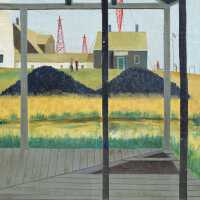
Francis Hamabe | Cutler Towers | c.1960
A painting by Francis Hamabe of the construction of the Cutler towers as part of the U.S. Navy’s very low frequency or VLF shore radio station built in Cutler, Maine in 1960. Francis Hamabe was an American artist of Japanese and Swedish heritage who was born in 1917 in Orange, New Jersey. After high school, he atttended the Newark School of Fine and Industrial Arts also began a career as an illustrator. During World War II he spent four years in the U.S. Army and afterwards, in 1946, he attended the Rhode Island School of Design under the G.I. Bill. Shortly afterwards he moved to Maine with his new wife, Sydney Gardner, of Boston, to live in her family’s summer home in Stockton Springs on Penobscot Bay. He is perhaps best known for his silk screen prints, but he also did oil paintings and ink drawings. He taught at many places in Maine, the Farnsworth Art Museum in Rockland, the Bangor Children’s Art Center and Bangor Art Society, the Blue Hill Consolidated Schoool, and for seven years at the University of Maine at Machias. He was initial art director for Down East Magazine and produced many covers for the magazine. In 1952 he co-founded the Maine Coast Artists cooperative (later the Center for Maine Contemporary Art) with Denny Winters, William and Stell Shevis, William Thon, Mildred Burrage and William Kienbusch. He died in 2002. The painting was a gift to the Tides Institute from Christopher Monkhouse, then a senior museum curator at the Art Institute of Chicago, who long summered in Machiasport, Maine. Photo caption: Painting by Francis Hamabe of the construction of the Cutler towers as part of the U.S. Navy’s very low frequency or VLF shore radio station built in Cutler, Maine in 1960. CUTLER TOWERS, FRANCIS HAMABE PAINTING, 1960! Oil on canvas painting in our collections that shows the construction of the U.S. Navy’s VLF (very low frequency) radio station towers in Cutler, Maine. Painting dates to 1960 and is the work of American artist, Francis Hamabe (1917-2002). Gift of Christopher Monkhouse.
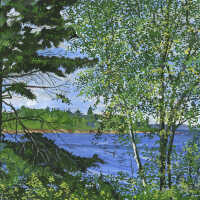
Fred Ross (1927–2014) | Looking Toward Minister’s Island, St. Andrews, New Brunswick | c.1960s
A mixed media painting by New Brunswick artist, Fred Ross, of a view looking towards Minister’s Island on the northeast back side of St. Andrews, New Brunswick. It dates to perhaps the 1990s. In the 1890s, Minister’s Island was transformed into the summer estate of William Van Horne, president of the Canadian Pacific Railroad, and is now preserved under ownership of the Province of New Brunswick and managed by a private charity. Fred Ross was born Saint John, New Brunswick in 1927. As a teenager, he began studies with Ted Campbell at the Saint John Vocational School and soon after graduating, in 1949, went to Mexico and studied with Pablo O'Higgins at Taxco. Ross returned to Saint John and then, the following year, briefly visited Mexico again and met Diego Rivera. He then began a nearly 20 year career teaching at the Saint John Vocational School as supervisor of art. In 1970, he resigned to spend full time on painting. Primarily known for his figurative and mural work, his landscape painting of Minister’s Island is less typical within his career’s work. Over his career, his paintings were exhibited nationally (the National Gallery in Ottawa), internationally (art gallery of the Canadian Embassy in Washington, D.C) and in more than 80 other exhibitions. He was the recipient of numerous honors (in 1990 he was elected to the Royal Canadian Academy of Arts; in 2002 he was made a Member of the Order of Canada; and in 2008 he was inducted into the Order of New Brunswick). Ross died in 2014 at the age of 87. His Minister’s Island painting was acquired by the Tides Institute from Tim Isaac Antiques of Saint John, New Brunswick. Photo caption: mixed media painting by New Brunswick artist, Fred Ross, of a view looking towards Minister’s Island on the northeast back side of St. Andrews, New Brunswick. It dates to the 1960s. Artist: Fred Ross Medium: Mixed Medium Classification: Paintings Old Accession Number: 220
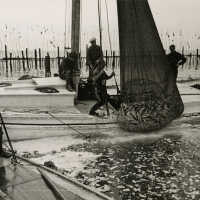
George Daniell (1911-2002) | Pulling in the Herring, 5:45 A.M. | 1938
A photograph by photographer, George Daniell, of the seining of a herring weir at Grand Manan island, New Brunswick in 1938. It is part of a large series of black and white photographs that Daniell took of the herring fisheries that year when he made an extended visit to Grand Manan. The work was published in several national magazines in the United States as well as Canada. They provide a remarkable record of the herring fisheries at this time. They are as riveting today as when they were taken. Most of Daniell’s Grand Manan photographs were acquired by the Tides Institute several years ago through a purchase/gift arrangement with the Aucocisco Gallery of Portland, Maine that was, at the time, representing the photographer's estate. George Daniell was born in Yonkers, New York in 1911. He is best known for his black and white portraits of actors, artists and writers. Also a painter, Daniell studied drawing at Yale University and New York's American People's School and Art Students League as well as at the Grand Central Art School in New York City in 1927. He began taking photographs as a teenager in his native Yonkers and, after graduating from college, became a freelance photographer in New York City and Europe. His work appeared over the years in Time and Life magazine. In 1937, he painted and photographed on his first trip to Monhegan Island on the Maine coast, a year before going to Grand Manan. He moved to mid-coast Maine in the 1960s where he continued to photograph and paint. He died in 2002. Artist: George Daniell Medium: Silver Gelatin Print Classification: Photographs Circa: 1938 Old Accession Number: 1286 Museum purchase and partial gift from Aucocisco Galleries, Portland, Maine.
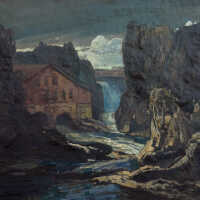
George Elmer Browne (1871-1946) | Magaguadavic Gorge and Falls, St. George, New Brunswick |
A large (25” x 30”) oil on canvas painting by American artist, George Elmer Browne, of the Magaguadavic Gorge and Falls in St. George, New Brunswick. The painting captures the dramatic setting of the falls, with its drop of nearly 70 feet, and that has long been used for power generation. A very historic New Brunswick and Canadian River, the name “Magaguadavic” is a Passamaquoddy name that means “river of eels.” The painting likely dates to about 1930.. George Elmer Browne was a well known and well regarded American Impressionist painter of the late 19th and early 20th centuries. He was born in Gloucester, Massachusetts in 1871 and studied art at the Museum School of Fine Arts and the Cowles School of Art in Boston. Soon afterwards, he went to Paris where he attended the Academie Julian and studied under Jules Lefevbre and Tony Robert-Fleury. He later returned to the United States, moving to New York City and set up his studio there. In 1895, he won a bronze medal award for his art at the Mechanics Fair in Boston. He spent many summers at Provincetown on Cape Code in Massachusetts. Browne also achieved success in France having been named Officer of Public Instruction and Fine Arts. In 1926, he was made Chevalier of the French Legion of Honor. Browne died in Provincetown in 1946. The painting was acquired by the Tides Institute from the Grogan and Company auction house of Boston, Massachusetts in 2014. Photo caption: Large oil on canvas painting (25” x 30”) by American artist, George Elmer Browne, of the Magaguadavic Gorge and Falls in St. George, New Brunswick. The painting likely dates to about 1930. Artist: George Elmer Browne Medium: Oil on Canvas Classification: Paintings Circa: 1930 Old Accession Number: 1497
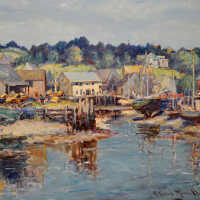
George Horne Russell (1861-1933) | Seal Cove, Grand Manan, New Brunswick | c.1910
A large early 20th century oil on canvas painting of Seal Cove on Grand Manan Island in New Brunswick by artist, George Horne Russell. Russell was born in Banff, Scotland in 1861 He expressed an interest in art early on, studying art at the local school and then at the Aberdeen Art School. Later he moved to London to study at the South Kensington Art School. In 1889, at age 28, Russell moved to Canada and took up residence and work as a portrait painter in Montreal. In 1909, the Grand Trunk Railway commissioned him to paint a series of paintings of the Canadian Rockies and the Skeena River district of British Columbia. His portrait painting business became highly successful and allowed him to afford a summer home in St. Andrews, New Brunswick where he began to spend each summer. Russell chose St. Andrews for a summer home, in all likelihood, because of the number of Montrealers who had summer homes there. He produced a large number of paintings of coastal scenes of St Andrews and the surrounding area. He would then return to Montreal in the winter to resume his portrait painting. In 1909, Russell was elected an associate member of the Royal Canadian Academy and 10 years later he was elected a full member. In 1922, he became president of the Royal Canadian Academy. Russell died in St. Stephen, New Brunswick in 1933 and is buried in St. Andrews, New Brunswick. Russell’s painting of Seal Cove was acquired by the Tides Institute from Tim Isaac Auction House in Saint John, New Brunswick. Photo caption: Early 20th century oil on canvas painting of Seal Cove on Grand Manan Island, New Brunswick by artist, George Horne Russell. Artist: George Horne Russell Medium: Oil on canvas Classification: Paintings Old Accession Number: 74
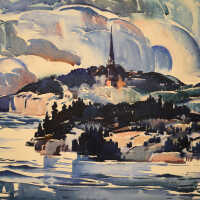
George Pearse Ennis (1884-1936) | Northern Landmark [Lubec, Maine] | c.1930
Artist: George Pearse Ennis Medium: Watercolor Classification: Watercolors Gift of Sondra and Rand Castile. Old Accession Number: 88 Dimensions: 33" w x 29 1/4" h (framed)
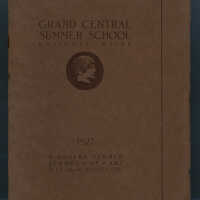
Grand Central Summer School, Eastport, Maine, 1927: A Modern Summer School of Art, July 5th to August 17th
A booklet for the first summer session for the New York City based Grand Central School of Art to be held in Eastport, Maine in 1927. Described on the front cover of the booklet as “A Modern Summer School of Art,” the first session ran from July 5th to August 17th. Instructors included New York City based artists, George Pearse Ennis and Edmund Greacen, with instruction in outdoor oil and watercolor painting. Ennis had been coming to Eastport during the summer for many years and the area was well known to him. At this time Eastport was readily accessible by both steamship and train from Boston and from Boston to New York City and to other points south and west. In selecting Eastport for the location of the summer session, the local Eastport newspaper of the time noted: “Many possible locations were discussed, but by the influence of Mr. Ennis and Mr. Greacen, Eastport was selected. No better place for an art school is to be found on the North American coastline, according to Mr. Ennis, from the standpoint of scenic values and climate, and it has the invaluable advantage of not having been ‘worked to death’ as an artists’ field.” The booklet goes on to note that at the end of summer session, an exhibition of the work of the class was to be held at the local Eastport public library. Forty students participated in the first summer session and instruction was held in the second floor auditorium of the local Boynton High School. The summer school would continue for another nine years, through the summer of 1936, under the primary directorship of Ennis. He was tragically killed in a car accident the end of August, 1936 in upstate New York and the summer school ended with his death. Photo caption: Booklet for the first summer session for the New York City based Grand Central School of Art to be held in Eastport, Maine in 1927. Described on the front cover of the booklet as “A Modern Summer School of Art,” the first session ran from July 5th to August 17th.
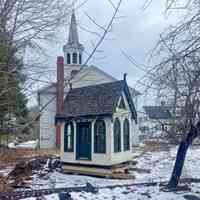
Guy Sullivan, Builder | Dorothy Waide Playhouse | 26 Middle Street | I7-0C3-15 | District #151
A late 19th century full size victorian style child’s playhouse owned by the Tides Institute & Museum of Art. It is one of nine historic buildings owned by the Tides Institute that date from 1819 to the 1940s and that help preserve and illustrate the architectural legacy of this region. This full size Gothic style children’s playhouse dates to about 1900. A then mayor of Eastport, Maine, Edward S. Waide (1867-1944), and his wife and artist, Martha “Mattie” Waide (1857-1929), had the playhouse originally built for their daughter, Dorothy Waide (1894-1974). The playhouse is appoximately 12 feet high, nine feet long and six feet wide. It has a door on each of the long sides and two Gothic arched windows at each end with a triagle shaped window above. For many years the playhouse stood on the lawn surrounding the Waide’s large historic Hayden house home in the center of Eastport at 17 Boynton Street. It stood in front of part of an attached barn to the house. In the early 1940s, the playhouse was removed to be next to a house at the outskirts of Eastport. The playhouse was gifted to TIMA in 2017 by Sheila and Ronald Sullivan (1935-2016) and family and moved to a temporary location next to TIMA’s GAR Civil War Veteran’s Hall building. Sheila grew up and lived at the house on the grounds where the playhouse had been moved to in early 1940s by her father, Leslie Grant (1907-1971). Ronald Sullivan’s grandfather, Guy Sullivan (unknown-1944), built the playhouse in the late nineteenth century for the the Waide family with help from his son, James Warren Sullivan (1895-1965), Ronald’s father. In the summer of 2025, the restored playhouse will be moved to the rear of TIMA’s Central Meeting House where TIMA is developing a small contemplative park. The playhouse will then be a half block away from where it originally stood. It is hoped, the playhouse can once again, on occasion at least, be used by children.
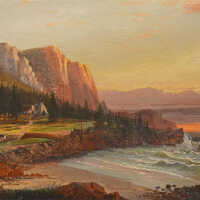
Harrison Bird Brown (1831-1915) | Grand Manan Island, New Brunswick | c.1870
An oil painting of a scene along the coast of Grand Manan Island, New Brunswick by Portland, Maine based artist, Harrison Bird Brown. The painting dates to about 1870. The Tides Institute raised the necessary funds to secure the painting at auction in Detroit. The painting shows encampments along a section of Grand Manan’s shoreline known as “Indian Beach” that was frequented by Passamaquoddies who would come there for the summer months to harvest porpoise and fish from the nearby waters. They would dry the harvest on the seawall along the beach. The camps they built to live in were used only during the summer months. They did not spend the winters there. A larger similar oil painting by Brown titled, “Camping on Grand Manan with the W.H. Pratt of Boston Offshore” shows much the same scene and is in the collections of the Portland (Maine) Museum of Art. Brown was an American painter who was born in Portland, Maine in 1831. He is best known for his marine paintings as well as his landscape paintings of the White Mountains of New Hampshire. Aid from art critic and patron, John Neal, allowed Brown to become Portland’s most successful nineteenth century artist. He and others established the Portland Society of Art in 1882 that would later become known as the Portland Museum of Art. During his life time, Brown exhibited his work at the National Academy of Design. He moved to London in 1892 to live with his daughter and he died there in 1915. Artist: Harrison Bird Brown Medium: Oil on canvas Classification: Paintings Old Accession Number: 75
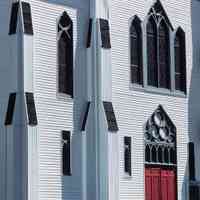
Harry Callahan (1912-1999) | Calais, Maine | 1979
Harry Callahan (American, 1912-1999) Calais, Maine, 1979 Dye transfer print 10-1/4 x 15-5/8 inches (26.0 x 39.7 cm) (image) 18 x 21-1/4 inches (sheet) Signed in pencil, lower margin recto. Photograph is of the Church of the Immaculate Conception building on Church Avenue in Calais, Maine. The building burned to the ground in 2005. CALAIS CHURCH OF THE IMMACULATE CONCEPTION! PHOTOGRAPH BY HARRY CALLAHAN, 1979! Photograph that recently came into our collections of a detail of the front facade of the original Church of the Immaculate Conception building on Church Avenue in Calais, Maine. Photograph is by the renown American photographer Harry Callahan (1912-1999) and was taken in 1979. Dye transfer print 10-1/4 x 15-5/8 inches (image) 18 x 21-1/4 inches (sheet). Signed in pencil, lower front margin. This 19th century structure burned to the ground in 2005.
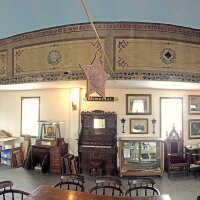
Harry Harrington | Civil War Mural | Grand Army Hall, 6 Green Street, Eastport, Maine | c.1880s
A Civil War mural running the length of the upper walls of the second floor of a former Civil War GAR (Grand Army of the Republic) Veterans Hall building in Eastport, Maine that is owned by the Tides Institute. It is the only such Civil War mural in Maine. The original two and a half story GAR Hall building dates to the 1820s and was first used as a Baptist vestry. When the Baptist Church established a new vestry space within its own separate church building in 1881, their vestry building became available to the local GAR veterans group that was organized after the American Civil War. The second floor of the building became the meeting room for the veterans group and they had the longer north and south walls decorated with a series of four panels, making a total of eight, each with a distinctive Union Army Corp badge numbering from one to eight. The shorter end east and west walls of the room were decorated with the name of the local GAR post (Meade Post No. 40) and with American flag shields and draped flag designs. The mural was very likely painted by local decorative painter, Harry Harrington, as he painted a similar mural in an adjacent Armory building at about the same time. This building and mural did not survive. A dropped ceiling, installed in the middle of the room in the early 20th century long hid the mural from view, but in 2010, after the hall building was sold to new owners, the mural was rediscovered and the dropped ceiling removed. The mural suffered considerable water damage over the years as it was painted with a distemper water soluble paint. The Tides Institute has had the mural restored by Tony Castro, an experienced restorer, of New Gloucester, Maine.
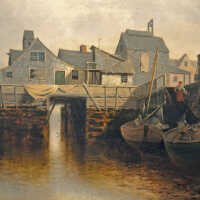
Harry Sunter (1850-1889) | Eastport Waterfront | 1886
A large nineteenth century oil painting titled “Old Relic” by artist, Harry Sunter. It portrays a scene along the waterfront of Eastport, Maine and dates to 1886 just before the Great Fire of October 14, 1886 that leveled the downtown and surrounding waterfront. The buildings in the painting were all destroyed in the fire and represent an older type of wharf construction and building style than that rebuilt after the fire. Born in England in 1850, Sunter’s paintings first gained national attention in 1876 at the United States Centennial exhibition at the Pennsylvania Academy of Fine Arts in Philadelphia, and continued to be shown at that venue for almost a quarter century after his death. Much of his work was inspired by the idyllic Finger Lakes region of central New York, where he studied with W.H. Yates, a noted artist and teacher who lived in the area. Two of Sunter's best known oils represent scenes near Auburn: "Boat Race at Skaneateles" and "Owasco Lake Reformed Church, Sand Beach". He also painted seascapes along the shores of Massachusetts and Maine. His career was relatively brief, cut short by his untimely death in 1889 at age 39. The painting “Old Relic” was acquired by the Tides Institute through an auction of James Julia of Fairfield, Maine in 2009. Artist: Harry Sunter Medium: Oil on canvas Classification: Paintings Circa: 1886 Old Accession Number: 67
Heather McHugh (1948- ) | Sound as Fundy, Fundy as Sound | Broadside/Poster printed by Andrew Steeves | 2015
A large letterpress printed broadside of a poem “Sound as Fundy, Fundy as Sound” by the American poet, Heather McHugh, that was published by the Tides Institute in 2015. The institute had asked McHugh, who lived in Eastport, Maine for several years earlier in her career, to write a poem that would be printed as a limited edition broadside. At the time, McHugh had long been based at the other side of the North American continent near Seattle, Washington, specifically Port Angeles. Port Angeles like Eastport lies directly on the U.S. / Canada coastal boundary. The poem’s title references the respective boundary waters, Puget Sound in the west, Bay of Fundy in the east. Andrew Steeves of Gaspereau Press in Kentville, Nova Scotia designed the broadside for the institute and then typeset and hand printed 250 copies. The first 50 copies of the broadside were reserved for Caregifted, an organization founded by McHugh to provide respite to long time caregivers. McHugh was born in San Diego, California in 1948 to Canadian parents, grew up in Virginia and earned a degree at Harvard College. She has led a long and highly successful career, publishing numerous books of poetry as well as works of translation and achieving numerous awards (including a “genius grant” from the MacArthur Foundation) and residency fellowships (MacDowell Colony and Yaddo among others). In 1984, she became writer in residence at the University of Washington in Seattle and in 2011 a professor of creative writing there. She continues to live in Port Angeles, Washington. Artist: Heather McHugh, Andrew Steeves Medium: Letterpress Classification: Prints Circa: 2015 Old Accession Number: 1824 This broadside was typeset & handprinted by Andrew Steeves at Gaspereau Press, Kentville, Nova Scotia, & issued in a limited edition of two hundred & fifty copies by the Tides Institute & Museum of Art, Eastport, Maine. The first fifty were reserved for CAREGIFTED, an organization which celebrates the gifts made to society by millions of unpaid lifelong caregivers to disabled family members. For Bryan & Arwen, and in honor of Dot & Harlan Gardner
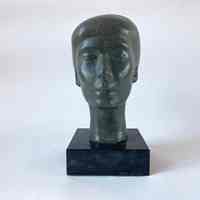
Helena Simkhovitch (1903-1993) | Bronze Head | c.1950s
A bronze cast sculpture head of a woman's head by artist Helena Simkhovitch. The sculpture dates to the 1950s. The sculpture was a gift from the artist's son. It is part of a collection of nine works of sculpture by Simkhovitch in the collections of the Tides Institute. Simkhovitch was born in New York City in 1903, attended Bryn Mawr College and lived from 1925 to 1937 in Paris where she studied art and sculpture with Charles Despiau, Aristide Maillol and at the Academie Colarossi with Marcel Gimond. From 1940 on she lived and worked in New York City and Maine. Her works have been exhibited in Paris, the American Federation of Arts, Whitney Museum of American Art, the Federation of Modern Painters and Sculptors, the Sculptors Guild, Newark Museum, Pennsylvania Academy of Fine Arts, Maine and St. Stephen, New Brunswick. In 1955, the Museum of Modern Art organized a traveling exhibition devoted to modern portraits, in which Helena Simkhovitch was the only American. Her awards include the Palmes Academiques and Officer de l’Instruction Publique. Her roots in this region go back to her childhood when she would come to Perry with her parents and grandparents in the summer. Later, she and her husband summered at the Mansion House in Robbinston with her parents, Mary and Vladimir Simkhovitch, from New York City. From the 1960s onwards, she and her husband lived year round in Maine, first at the Mansion House, then in Machias. She died in 1993. Helena Simkhovitch (1903-1993). Bronze sculpture of Woman's Head. 11" x 6 1/2". Gift by Paul Didisheim, son of the artist, in 2014 in memory of Helena Simkhovitch.
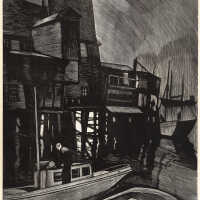
Howard Cook (1901-1980) | Fog in Eastport | 1928
A large wood engraving print (12 1/16”/30.6 cm x 10 1/8”/25.7 cm) titled “Fog in Eastport” completed in 1928 and is the work of American printmaker, Howard Norton Cook. Cook was born in 1901 in Springfield, Massachusetts and is particularly known for his wood engravings and murals. He learned printmaking from Joseph Pennell at the Art Students League in New York City in the early 1920s. From 1928 to 1935, he and his wife and fellow artist, Barbara Latham, traveled to Europe, Mexico and the American South. In 1928, Cook spent a summer on Deer Island, New Brunswick with Barbara. He did several wood engravings and and etchings while in the area and original prints of almost all are in the collections of the Tides Institute including “Fog in Eastport,” “Herring Fisherman,” “Quoddy Bay,” and “Deer Island.” Working for New Deal on art projects in the 1930s, Cook produced murals for courthouses in Pittsburgh and Springfield, Massachusetts. From the late 1920s to the early 1930s, he and Barbara lived primarily in New York City and the city’s ongoing construction was a major subject of his art. In 1938, the couple settled near Taos, New Mexico. Cook had first come to Taos, New Mexico in 1926 to complete a series of woodcuts to illustrate Death Comes for the Archbishop for the magazine Forum. Taos remained the couple’s base until 1976. Cook died in 1980. Artist: Howard Cook Medium: Wood engraving Classification: Prints Circa: 1928 Old Accession Number: 208
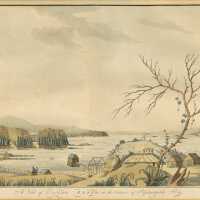
J. F. W. Des Barres (1722-1824) | A View of Campo Bello at the Entrance of Passamaquoddy Bay | Aquatint with Etching | 1780
An aquatint with etching print titled, “A View of Campo Bello at the entrance of Passamaquoddy Bay,” by Colonel Joseph Frederick Wallet Des Barres. The print dates to 1780 and shows a view of Windmill Point and Curry Cove at the village of Wilson’s Beach at Campobello Island in New Brunswick. It is part of the very large and extensive four volume, Atlantic Neptune publication, consisting of maps, charts and views created by Des Barres of the eastern Atlantic coast of North America from New York City to Newfoundland. Des Barres was born in 1721 in Switzerland. He trained as a cartographer and served in that capacity during the Seven Years' War as the aide-de-camp to General James Wolfe. Later he served as the Lieutenant-Governor of Cape Breton and as Lieutenant-Governor of Prince Edward Island. But Des Barres is best known for his Atlantic Neptune work that he spent years compiling. His cartographic survey of Nova Scotia alone took him nearly 10 years due to the province’s extensive and undulating coastline. Des Barres died in 1824 and is buried in Halifax, Nova Scotia. The Tides Institute acquired the “Campo Bello” print at auction. It joins three other late 18th century Des Barres works of the Passamaquoddy region in the Tides Institute’s collections that were acquired, also at auction several years earlier: a chart of Passamaquoddy Bay and entrances and related chart of Grand Manan and adjacent coast as well as a view of the entrance to Passamaquoddy Bay (aquatint with etching print). Photo caption: Original aquatint with etching print titled, “A View of Campo Bello at the entrance of Passamaquoddy Bay,” by Colonel Joseph Frederick Wallet Des Barres. The print dates to 1780 and shows a view of Windmill Point and Curry Cove at the village of Wilson’s Beach at Campobello Island in New Brunswick. CAMPOBELLO, 1780! Print (aquatint with etching) that recently came into our collections that shows a view of Campobello Island, New Brunswick. The print dates to 1780 and is the work of Joseph F.W. DesBarres. It’s titled, “A View of Campo Bello at the entrance of Passamaquoddy Bay.” The view is of Windmill Point and Curry Cove at the village of Wilson’s Beach.
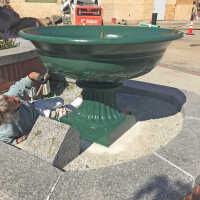
J.L. Mott | Cast Iron Water Fountain | 1889
A late 19th century cast iron water fountain that stands in front of the Tides Institute’s main building at Bank Square in downtown Eastport, Maine. In 1889, three years after a devastating fire leveled Bank Square and Eastport’s downtown and waterfront, the fountain was installed at virtually the identical spot where it now stands. A group of civic minded citizens raised the necessary $125 in funds to purchase the fountain from the J.L Mott Ironworks Company of New York City and bring it to Eastport. The fountain’s water basin is four feet four inches in diameter with a depth of 14 inches. Originally, the fountain had a tall center standard water spout (that has since been lost) and stood five feet eight inches in height. The water fountain remained at Bank Square until the early 20th century when, with the advent of the automobile, the fountain was relocated to Eastport’s Hillside Cemetery as a decorative, non-functioning fountain. In 2006, the fountain was returned to Bank Square as part of the development of a new civic space in front of the Tides Institute’s main building. A small, adaptive center water spout was installed on the fountain to make it fully functional again. Nine years later, in 2015, the fountain was donated to the Tides Institute by the then owners of the fountain, the local branch #558 of the Veterans of Foreign Wars (VFW). The local branch was disbanding and the branch felt that the Tides Institute was the best hope to preserve the fountain in the future. The Tides Instittute maintains the fountain. In 2012, the Tides Institute acquired from a Chicago antiques dealer an original copy of the J.M. Mott 1883 advertising catalogue for statuary, fountains, and more that includes the Bank Square water fountain model.
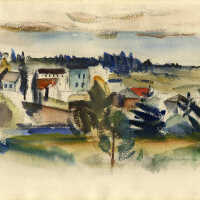
Jack Humphrey (1901-1967) | Grand Manan, New Brunswick | 1936
A watercolor of Grand Manan Island, New Brunswick by New Brunswick artist, Jack Weldon Humphrey. It dates to 1936. Grand Manan was part of the disputed coastal border territory between the U.S. and what is now Canada that was largely resolved by the Webster Ashburton Treaty of 1842. The treaty placed Grand Manan with Canada (then Great Britain). Humphrey was one of the most significant painters in eastern Canada during his day. He was born in Saint John, New Brunswick in 1901, studied at the school of the Museum of Fine Arts in Boston and at the National Academy of Design and the Art Students League in New York City. Afterwards, in 1929 and 1930 he travelled to Europe including studying in Paris, France and in Munich, Germany. Returning to Canada, he visited Vancouver, British Columbia on the Canadian Pacific coast in 1933 and then travelled south to Mexico in 1938. In 1933, Humphrey was a founding member of the Canadian Group of Painters. He taught at Queen's University in Kingston, Ontario in 1951 and that same year received an honorary doctorate degree from the University of New Brunswick. From 1952 to 1954, he painted in Paris on a Canadian Government-Royal Society Overseas Fellowship. Humphrey extensively portrayed his hometown of Saint John, the city’s streets, people and waterfront, over many years and these paintings established his importance as an artist. A retrospective exhibition of his work was organized in the mid-1960s at the Beaverbrook Art Gallery in Fredericton in New Brunswick and the exhibition toured throughout Canada. He died in Saint John, New Brunswick in 1967. This watercolor was acquired by the Tides Institute from Galley 78 in Fredericton, New Brunswick in 2009. Photo caption: Watercolor of Grand Manan Island, New Brunswick by New Brunswick artist, Jack Weldon Humphrey. The watercolor dates to 1936. Artist: Jack Humphrey Medium: Watercolor Classification: Watercolors Purchased from Gallery 78, Fredericton, New Brunswick in 2009. Old Accession Number: 19
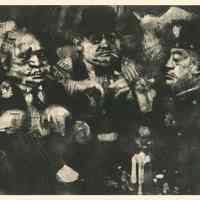
Jack Levine (1915-2010) | Feast of Pure Reason | Aquatint, Etching, Mezzotint | 1970
Aquatint, Etching, Mezzotint. Gift of Edward Leger, Moncton, New Brunswick
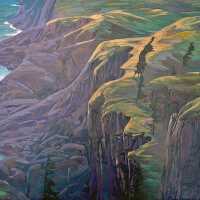
John Doyle | Grand Manan Cliffs | 1994
A large (48 x 60 inches) acrylic on canvas painting of the cliffs of Grand Manan island in New Brunswick by Canadian artist, John Doyle, that dates to 1994. It gives a dramatic view from the northeast of Grand Manan looking out along the cliffs towards Swallowtail Lighthouse. The Tides Institute discovered the painting in Toronto, Ontario in the art gallery, Gallery One, that represented Doyle at that time. The institute was able to raise the necessary funds to purchase the painting directly from the gallery. John Doyle was born in Toronto in 1950 and earned a degree in fine arts at York University in Toronto in 1974. Primarily a landscape painter, Doyle’s work has focused on the central Canadian province of Ontario, but he has, on occasion as witnessed by his painting of the cliffs of Grand Manan island, ventured to the east coast of Canada as well as western Canada and outside of Canada, too. His paintings tend to be large scale and mostly acrylic on canvas. His work has been exhibited almost exclusively in Toronto though he did have a solo exhibition at the New Brunswick Museum in Saint John, New Brunswick in 1983. Most of his paintings are less dramatic than his painting of the cliffs of Grand Manan island, but the reasons for this have more to do with choice of subject matter, more serene forested and rural scenes though some times with more vibrant colors. GRAND MANAN! Large scale (48 x 60 inches) acrylic on canvas painting in our collections of the cliffs of Grand Manan island in New Brunswick. It's the work of Toronto based artist, John Doyle, and was completed in 1994. Email from John Doyle, 2025: John Doyle Tue, Aug 19, 5:08 PM (4 days ago) to me, kmckinlay Dear Hugh and Kristin, I was very excited today and honoured to discover my painting in your collection. Upon further research into TIMA I discovered a shared philosophical outlook to what you collect, the engagement with community, the erasing of borders, all of the things that the arts can do and that are so important. To be allowed a small part in what you both have built is very rewarding. I was googling "john doyle canadian artist" in preparation for my show at Ingram Gallery opening September 6th when to my delight I discovered my painting at Tides. The painting is from the north east of Grand Manan looking outwards towards the Swallowtale Lighthouse not from the west coast. I am thinking more painting in the east coast is in order and of course a visit to Eastport. Congratulations on what you have accomplished. A big hug from over the border, John Doyle
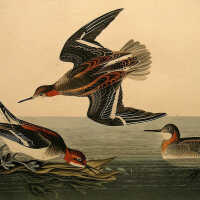
John James Audubon (1785-1851) | Hyperborean Phalarope | 1834
A large hand-colored engraving and aquatint by American artist and naturalist, John James Audubon (1785-1851), of a Hyperborean Phalarope. The print is based on a watercolor Audubon completed from a drawing he did of the bird in this border region during one of his two trips to the area in 1831 and 1833 on his way to Labrador. Audubon observed and drew several birds during his time in the area where he stayed in Dennysville and Eastport, Maine and visited Grand Manan, New Brunswick and the Fundy shore of Nova Scotia. In addition to the Hyperborean Phalarope, the other drawings included the Lincoln Sparrow (named for Audubon’s Thomas Lincoln of Dennysville), Harlequin Duck, and Thick Billed Murre. The Hyperborean Phalarope print (19 3/4”/50.2 cm x 12 1/4”/31.1 cm) is Plate CCXV of Audubon’s massive Birds of North America that contains 435 life-size watercolors by Audubon of North American birds (including the birds drawn in this area) printed between 1827 and 1838, all reproduced from hand-engraved plates by Robert Havell. The Hyperborean Phalarope was engraved and printed in 1834. The Tides Institute acquired the print at the Heritage Auction in Dallas, Texas and raised the necessary funds to secure the print. At the time of his encounters with the Hyperborean Phalaropes, Audubon wrote: “As we advanced eastward in the month of May, we saw more and more of them, and while at Eastport in Maine my son JOHN shot several out of flocks of sixty or more. At one time a flock consisting of more than a hundred was seen in the Bay of Fundy. They were exceedingly shy, and the gunners of Eastport, who knew them under the name of Sea Geese, spoke of them as very curious birds.” Artist: After John James Audubon Medium: Etching and aquatint, hand-colored Classification: Prints Old Accession Number: 58 Description: No. 43, Plate CCXV
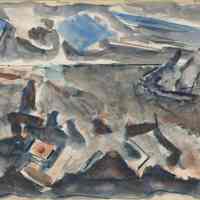
John Marin (1870-1953) | Headed Down East, Cape Split, Maine | Watercolor | 1945
Watercolor, Headed Down East, Cape Split, Maine by artist John Marin that dates to 1945. Marin was an early American modernist artist who was born in Rutherford, New Jersey in 1870. His mother died almost immediately afterwards and Marin was raised by relatives in Weehawken, New Jersey. He attended the Stevens Institute of Technology in Hoboken, New Jersey for a year, and then practiced becoming an architect before shifting to becoming an artist. From 1899 to 1901, Marin studied at the Pennsylvania Academy of the Fine Arts in Philadelphia and then also at the Art Students League in New York City. In 1905, Marin traveled to Europe where he exhibited his work in the Salon in Paris and where he also got his first exposure to modern art. In 1909, Marin held his first solo exhibition at Alfred Stieglitz's 291 gallery in midtown Manhattan in New York City. Marin's association with Stieglitz would last nearly 40 years. In 1936, Marin had a major show of his career’s work at the Museum of Modern Art in New York City. Marin first came to the Maine coast in 1914 and initially to the Small Point area of Phippsburg. In the 1920s, he shifted eastward to spending summers in Stonington. A friend of Marin’s, the writer Herbert Seligmann, then told Marin about the Cape Split area in Addison where Seligman’s wife had family. Marin first visited Cape Split in 1933 and a year later he bought a house there next to the Seligmann's. From then on, Marin would spend every summer at Cape Split, while continuing to winter in New Jersey, until he died there in 1953. This Marin watercolor was purchased at auction in 2017 in Texas by two people. In 2022, one of them promised to donate the Seligmann's cottage in Cape Split that they had purchased in the mid-1980s to TIMA. She died shortly afterwards and the cottage came into TIMA's possession. She had wished that the Marin painting would come into TIMA's collections as well. It did in 2024 when TIMA trustees and other supporters purchased it from the other person at a reduced price. John Marin (American, 1870-1953) Headed Down East, 1945 Watercolor paper 11-5/8 x 16-3/8 inches (29.5 x 41.6 cm) (sheet) Signed and dated lower right: Marin 45
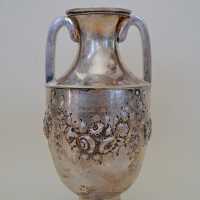
Jones, Ball & Poor, Boston | Coin Silver Presentation Vase | 1852
One of a pair of coin silver presentation pieces created and sold by the renown Boston retail jeweler firm of Jones, Ball & Poor in 1852. Jones, Ball & Poor were part of a long line of retail jeweler firms in Boston that eventually evolved into the firm of Shreve, Crump and Low that still exists today. The partnership firm of Jones, Ball & Poor existed from 1846 to 1852. The two presentation pieces consist of a 7 1/2” tall vase, with a detail shown in the accompanying photograph, and a 7” in diameter plate, each inscribed with the words ”Presented to Rev. Kendall Brooks Jr., by the Cadets of Temperance, Eastport, Me. Sep. 3d, 1852.” The presentation was made as Brooks was about to depart as minister of the Washington Street Baptist Church in Eastport, Maine where he had served from 1845 to 1852. He was a graduate of Brown University and Newton Theological Institute. After leaving Eastport, he became a professor of mathematics and natural philosophy at what is now Colby College and still later he was president of Kalamazoo College in Michigan for nearly 20 years. The Cadets of Temperance was an order founded in 1846, the year after Brooks arrived in Eastport, for young boys to promote their abstinence from alcohol. Presumably Brooks started the local branch of the order at Eastport. The inscribed vase was the first piece acquired by the Tides Institute in 2006 through a listing on Ebay by an antique silver dealer in New York City. Several years later, in 2013, the second piece, the inscribed plate, was secured through an auction house in Boston. Now the two pieces are joined together once again in the town where they were originally presented over 150 years earlier. Creator: Jones, Ball & Poor of Boston Classification: Object/Artifact Circa: 1852 Older Accession Number: 1424 Description: Presented to, Rev. Kendall Brooks Jr., by the Cadets of Temperance, Eastport, Me. Sep. 3d, 1852. Jones, Ball & Poor of Boston. Pure coin. TIMA purchase from Lauren Stanley, New York City, 2006.
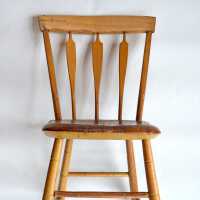
Joseph Very (1793-1831) | Thumb Arrow Back Chair, c.1822 | Eastport, Maine
A hand made wooden thumb back / arrow back chair that was made in Eastport, Maine by chair maker, Joseph Very. It dates to about 1822. Written in stencil on the underside of the chair seat are the words: “Warranted, Eastport by J. Very.” Little is known about Very. He evidently was born in Salem, Massachusetts in about 1793 and moved to Eastport some time in the early 19th century. He began making wooden chairs shortly after this and quickly became involved in a chair making war with a competing business person selling chairs in Eastport. An advertisement by Very in the Eastport Sentinel of April 13, 1822 reads: “Great Cry and Little Wool. The Subscriber observing a puffing advertisement in the last Eastport Sentinel, ‘City Chairs’ is induced to inform the public that he has taken a shop in this place … where he now carries on the Chair Making Business in its various branches. Although he cannot, with propriety, give his work the title of ‘city chairs’ (which a certain chair vender calculates a great recommendation) yet he will give them a more substantial title, that of WARRANTED CHAIRS, a name which he thinks the ‘city chairs’ are not entitled to, and will suit purchasers far better in the end.” Two years later, in 1824, Very was still advertising his Warranted Chairs along with his intentions of going into the painting business which he claimed he had 16 years of experience in. The chair was purchased by the Tides Institute from an individual in Eastport in 2018 just before the chair was to go up for auction. Very died in Eastport in 1831 at the age of 38. Photo Caption: Hand made wooden thumb back / arrow back chair that was made in Eastport, Maine by chair maker, Joseph Very. It dates to about 1822. Old Accession Number: 3019 Chair made in Eastport, Maine, c.1825. Name of maker and Eastport is on bottom of seat reads: Warranted by J.[Joseph] Very, Eastport. Advertisement from Eastport Sentinel, March 27, 1824, p. 3: House, Ship & Sign Painting. The Subscriber informs the Public, that he intends carrying on the PAINTING BUSINESS in the above branches the ensuing season, and having had sixteen years experience in the business, feels confident of getting ample satisfaction to this employers. Constantly on hand at his Shop in Boyenton-street, (one door east of Capt. Swett's Hotel) a dozen warranted CHAIRS (not city made) which will be sold low for cash or exchanged for the going currency of the place (i.e.) Pollock Fish, Herring, Oil or Lumber. Employment solicited by the public's Humble Servant, JOSEPH VERY. Eastport, March 27 ________ Eastport Sentinel, March 2, 1831: Deaths: In Eastport, 24 Feb 1831, Maj. Joseph VERY, 38y, f/o Salem, MA
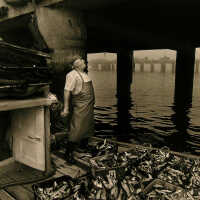
Larry Fink (1941-2023) | Portuguese Fisherman | 1995
Artist: Larry Fink Medium: Photograph Classification: Photographs Old Accession Number: 175
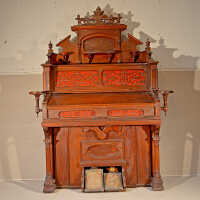
Leighton Parlor Organ, c.1885 | Pembroke, Maine
A late 19th century parlor (also known as a cabinet) organ made by William Leighton of Pembroke, Maine. Essentially a reed organ, this parlor organ has pedal-operated bellows and is mounted in a case. This parlor organ stands 76 inches tall, 46 inches wide and 23 inches deep. It is one of three different parlor organs made by Leighton and his brother, Raymond, in the collections of the Tides Institute. Two were made by William, one by Raymond. All three date to the early 1880s. Together the two brothers produced about 600 parlor organs in a five year span between 1800 to 1885. The Institute has a small sales catalogue titled “Wm. E. Leighton & Co. Cabinet Organs” in its collections that dates to 1881. The catalogue was designed and printed by J.A. Sears, printer, of Calais, Maine. The catalogue notes this particular parlor organ as Case No. 3 which came in several styles that are outlined in the catalogue. The institute acquired this organ through Ebay from a seller in California. It cost far more to have the organ shipped east to the institute’s headquarters than it cost to purchase the organ. The other two Leighton parlor organs in the institute’s collections were donated to the institute by private individuals. Before starting the organ business, William Leighton served in the American Civil War, first with the 28th Maine Infantry Company E and later with the 1st Battalion Maine Infantry Company A. He was extremely active in the founding and leadership of the Pembroke, Maine Civil War GAR. (Grand Army of the Republic) veterans organization (Isaac Campbell Post, No.1). The institute was given a large number of artifacts related to this GAR post in early 2020 and William Leighton’s name is found on many of the artifacts. In addition to parlor organs, William Leighton also made violins and the institute has four of his violins in its collections. Classification: Musical instruments Circa: 1885 Old Accession Number: 2211 Description: Purchased on Ebay from Lyle Wheeler of California in 2004.
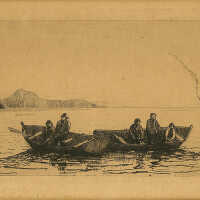
Lemuel Eldred (1848-1921) | Fishing Off Grand Manan | c.1880
An etching by American artist, Lemuel D. Eldred, of a scene along the coast of Grand Manan island in New Brunswick. It dates to about 1880. The etching measures 4 1/2” X 16” and shows fishermen in small boats pulling in a seine net full of fish. Eldred was born in Fairhaven, Massachusetts in 1848 to a wealthy family. Early in his adult life, he took part in the American Civil War, serving as a captain of a New Bedford military company of the 3rd Massachusetts Regiment. Following the Civil War, in 1868, Eldred met the well known marine painter William Bradford, of nearby New Bedford, Massachusettts, just across the harbor from Fairhaven. Eldred trained with Bradford in his studios at Fairhaven as well as New York City. In 1876 Eldred exhibited some of his work at the National Academy in New York City and in Boston. That same year he moved to Boston, beginning a long career based there as a painter and etcher. Soon afterwards, he began to travel with multiple trips made throughout Europe and North Africa as well as elsewhere along the New England coast, the Bay of Funds and the St. Lawrence River. He made several trips to Grand Manan island during this time, initially in the company of fellow New Bedford artist, Charles Gifford. Grand Manan by this time was beginning to become a destination for artists and increasingly visitors with the advent of better steamship connections by sea and better accommodations for summer visitors. Eldred did several paintings as well as etchings while on Grand Manan The Tides Institute acquired this etching by Eldred of Grand Manan in 2014 from an antique shop in Marion, Massachusetts, a short distance from Fairhaven where Eldred was born and raised. Eldred died in 1921. Artist: Lemuel Eldred Classification: Prints Old Accession Number: 1620 Description: c. 1890.
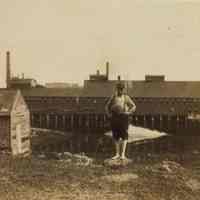
Lewis Hine (1874-1940) | Folsom McCutcheon | Eastport, Maine | 1911
Fulsom McCutcheon, 11 years old, has been working at the covering machines in Eastport canning factory, also cutting some. In the background is a typical sardine factory. Location: Eastport, Maine. Gift of Ross Y. Furman, 2023. Part of the Ross Y. Furman Advance Collection
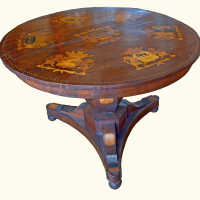
Lincoln Table | Lincoln House | Dennysville, Maine
A round wooden table with a series of coat of arms inlaid on its top. The top of the table is about 43 inches in diameter and the table stands about 29 inches tall. The table long resided in the historic Lincoln house in Dennysville, Maine, and likely dates to the early 19th century, but the actual date and origin of the table are still to be determined. The Lincoln house was built beginning in 1787 for Theodore Lincoln, son of American Revolutionary War general Benjamin Lincoln, who led a group of Massachusetts proprietors that had been granted thousands of acres in the area. Local lore claims that the table was one of four such tables presented by French general Lafayette to American general Washington’s top four generals including Benjamin Lincoln. In 1968, a photograph of the table was sent to a curator at the Metropolitan Museum of Art in New York City to see what they might suggest about the table’s history. They thought the table belonged to the style of the period around 1840, but that the inlaid coat of arms on the top of the table might have been added much later, perhaps around 1900. They had no information about any presentation of such tables by Lafayette to Washington’s generals and they could not identify the coat of arms on the table other than to say they were not associated with Lafayette. The table was purchased in about 1950 at auction from the last Lincoln family descendant to live in the Lincoln house by an individual who lived in nearby Eastport, Maine. This individual, in turn, gave it to their nephew who lived in New Jersey and there the table resided for nearly 50 years. The nephew promised the table to the Tides Institute upon his death and when he died in 2018 the table returned to the area and became part of the collections of the Tides Institute. Photo caption: Round wooden table with a series of coat of arms inlaid on its top. The table long resided in the historic Lincoln house in Dennysville, Maine, and likely dates to the early 19th century, but the actual date and origin of the table are still to be determined. Gift from estate of Walter Emery, Sea Girt, New Jersey, 2018. https://www.findagrave.com/memorial/22268818/william-morang-emery William Morang Emery BIRTH 28 Nov 1878 DEATH 30 Aug 1964 (aged 85) BURIAL Hillside Cemetery Eastport, Washington County, Maine, USA From: https://www.findagrave.com/memorial/135266620/anna-maxwell-lincoln Anna Maxwell Brown Lincoln BIRTH Jun 1857 Scotland DEATH 19 Mar 1951 (aged 93) Calais, Washington County, Maine, USA BURIAL Dennysville Cemetery Dennysville, Washington County, Maine, USA Show Map MEMORIAL ID 135266620 · View Source
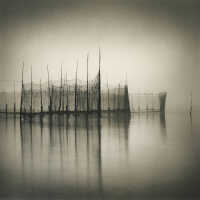
Lisa Tyson Ennis (1961- ) | Weir Study
A contemporary silver gelatin toned photographic print, “Fishing Weir, Study III," by photographer, Lisa Tyson Ennis. Hundreds of such herring weirs were once commonplace in the coves and bays of the Passamaquoddy region (and further west along the coast of Maine and further east along the coast of New Brunswick) when the sardine industry was at its height. The herring weir in this photograph stood on Deer Island, New Brunswick. While weirs had a very practical basis for their existence, to capture small herring that could be then used in the sardine canning industry, the weirs were also majestic almost other worldly structures not readily forgotten when first seen. They have a deep history in the region as simpler weir forms were used by the Passamaquoddies before the rise of the sardine industry began in the 1870s. Early herring weirs were made using brush before they converted over to twine. Now it is a rarity to see a herring weir in the region, let alone to see one that is still used for its original purpose. Lisa Tyson Ennis documented many of these weirs in their last years of use both in Maine and New Brunswick. She used a large format camera to capture the detail of the weir structures. Originally from Pennsylvania, Ennis took the photograph while she was living in Lubec, Maine. Ennis has also begun taking tintype photographs of weirs. This particular print was a gift to the Tides Institute by a supporter who long summered in Machiasport, Maine. Artist: Lisa Tyson Ennis Medium: Silver Gelatin Toned Print Classification: Photographs Old Accession Number: 1498
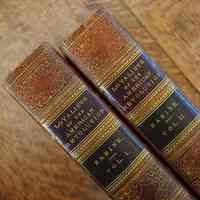
Lorenzo Sabine | Biographical Sketches of Loyalists of the American Revolution [2nd Edition] | 1864
A two volume one of a kind special leather bound second edition of Biographical Sketches of Loyalists of the American Revolution with An Historical Essay by American historian Lorenzo Sabine and published by Little, Brown and Company of Boston in 1864. The volumes are inscribed by Sabine to "Mary" who he describes as "almost like one of my own daughters." The two volumes represent a significant expansion on Sabine’s earlier single volume first edition on the same subject published by Charles C. Little and James Brown of Boston in 1847. The first edition ran 733 pages, the second edition over 1,200 pages. Born in New Hampshire, Sabine moved to Boston, Massachusetts, with his parents in 1811 and to Hampden, Maine, in 1814. At the age of eighteen, he moved to Eastport, Maine. From early on, Sabine, was, in his words, "revolution-mad." But it wasn’t until he moved to the eastern coast of Maine with its border with the American Loyalist founded province of New Brunswick that he was able to pursue his research interests and have the necessary research resources readily available. Here he could engage in his belief that "there was more than one side to the Revolution." The attitude in the United States up to this was that every Loyalist must be bad and every Patriot must be good. When the first edition of his work on the Loyalists appeared in 1847, it created great controversy. Jared Sparks, the Harvard College historian, was one of the few people and scholars to commend the book. Sabine died in Roxbury, Massachusetts in 1877 and he is buried in Hillside Cemetery in Eastport. 3 copies. Artist: Lorenzo Sabine Circa: 1864 Old Accession Number: 1593 Description: Two volumes, specially bound, of the 2nd edition of the book, Biographical Sketches of Loyalists of the American Revolution, by Lorenzo Sabine and published by Little, Brown of Boston in 1864. They are inscribed to the author's daughters. Sabine lived for about 20 years in Eastport.
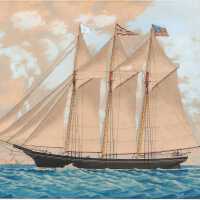
Louis Roust | Pembroke, Maine Schooner, George K. Hatch | 1876
A 19th century watercolor ship portrait painting of the Pembroke, Maine built three masted schooner, George K. Hatch. The painting dates to 1876 and is the work of artist, Louis Roust. Nothing is known about the artist. The schooner, at 285 tons, was built in Pembroke in 1874 by either S.C. Foster or Aaron or A.& G. Frost. The schooner was named for a prominent resident and merchant of Pembroke, George K. Hatch, who was born in 1836. Hatch served in the American Civil War and then returned to Pembroke where he served as postmaster in 1870. He died in 1877, three years after the schooner named for him was built. James Murphy was master of the schooner from 1874 to 1878 and James Hardenbrook was master in 1886. In 1888 the ship was wrecked in the Caribbean Sea on Turks Island and in 1892 was subsequently sold, repaired and transferred to Saint John, New Brunswick and its name change to Alianza. The painting was secured at an auction in Los Angeles in 2021. There were a great many sailing vessels of all kinds built in this region, including in Pembroke, Maine, during the 19th century and into the early 20th century. Many of them had ship portrait paintings done of them, but unfortunately very few of these portraits survive in this region. This is why the Tides Institute felt it was important to secure the ship portrait of the schooner, George K. Hatch, when it came up for auction and see it brought back to this region. Photo caption: Watercolor painting (17” x 24”) of the schooner, George K. Hatch, by artist, Louis Roust. The schooner was built in Pembroke, Maine in 1874 and the painting dates to 1876. 19th century ship portrait of the Pembroke, Maine built three masted schooner, George K. Hatch. The watercolor painting dates to 1876 and is the work of artist, Louis Roust. The schooner was built in Pembroke in 1874. In 1888 the ship was wrecked in the Caribbean Sea on Turks Island and was subsequently sold, repaired and transferred to the British flag under the name Alianza. Painting was secured at an auction in Los Angeles in 2021.
Martin Johnson Heade (1819-1904) | St. George, Passamaquoddy Bay, New Brunswick | c.1860s
One of two mid-19th century drawings by American artist Martin Johnson Heade of the Passamaquoddy Bay area in the collections of the Tides Institute. Both came from the Spanierman Gallery in New York City, one directly from the gallery and one after the gallery had closed. The drawing shown here shows a shoreline scene near St. George, New Brunswick. It dates to the early 1860s. Heade was born in Lumberville, Pennsylvania in 1819 and developed an interest in art at an early age. His early works from the 1840s were mostly portraits. But soon afterwards, he began to travel to Europe as well as travel within the United States. Some of his early work was exhibited in Philadelphia in 1841 and New York in 1843. Around this time, he became acquainted with the Hudson River School of artists and that led to his interest in landscape painting, an interest that stayed with him through the rest of his life. He became attracted to the Maine coast and it was fairly easy to come to this coast even more remote parts of it like Eastport and Passamaquoddy Bay by way of existing regularly scheduled steamship service from Boston. In addition to several drawings that he did while in the Passamaquoddy Bay region, Heade also did at least one large painting. Heade is best known for his landscape paintings of New England salt marshes and coastal views as well as detailed scenes of tropical birds and flower blossoms. In 1883, Heade married and moved to St. Augustine, Florida. Henceforth this paintings focused on Florida landscapes and flowers, particularly magnolias. He died in 1904. His paintings are now found in the collections of major art museums throughout the United States. Artist: Martin Johnson Heade Medium: Drawing Dimensions: 8-3/4" x 11-1/2" Classification: Drawings Circa: 1860 Old Accession Number: 191 Drawing. Martin Johnson Heade. St. George, Passamaquoddy Bay, New Brunswick, c.1860. Purchased from Spanierman Gallery, New York City in 2005 for $7,500.00
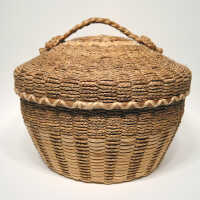
Mary Mitchell Gabriel (1908-2004) | Large Fancy Basket [Passamaquoddy]
A large Passamaquoddy brown ash splint and sweetgrass fancy basket by Mary Mitchell Gabriel. It measures 11 1/4 inches wide and 9 inches high. The basket cover is topped by Gabriel’s trademark braided frog handle that she invented. The basket has a particularly tight weave, another characteristic that her baskets are known for. The bottom of the basket is signed “Mary Gabriel.” Gabriel was the first Maine indigenous American to receive the prestigious National Heritage Fellowship from the American National Endowment for the Arts in 1994. Eleven such fellowships were presented that year and Gabriel was the only recipient from New England. Gabriel was born in 1908 in Motahkomikuk/Indian Township in northern Washington County, Maine. Her mother and grandmother were basket makers, and her father built birch-bark canoes, paddles, and snowshoes. She learned basketmaking from her grandmother and made her first basket when she was about seven years old. Later as an adult and a single mother with seven children, Gabriel moved to Bangor, Maine and earned a living working at the Emple Knitting Mill for 25 years. She continued to make baskets when she could. After the Maine Indian Land Claims Settlement of 1980, Gabriel returned to Motahkomikuk and greatly expanded her basketmaking. She bought the sweetgrass and brown ash splints from other members of the Passamaquoddy tribe. Gabriel died in 2004. The Tides Institute purchased this basket from a collector of Gabriel’s baskets one year before Gabriel passed away. Artist: Mary Mitchell Gabriel Classification: North American Basket Old Accession Number: 1194 Description. Passamaquoddy. Large fancy basket.
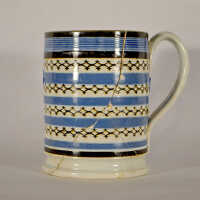
Mochaware Mug | c.1820
An early 19th century mochaware mug that was pieced back together from a number of shards.The mug dates to about 1820. This mug was unearthed in 2018 during the excavation of a six foot deep 19th century household “dump” in this region that was filled with thousands upon thousands of beautiful, but broken early 19th century ceramic and glass shards. The “dump” was on the site of a large house built in 1824 and torn down in the early 1960s. The house underwent considerable renovation in the mid-19th century. During this renovation, the existing house pantry full of ceramic and glass ware was likely cleared out and thrown in the “dump.” Some ceramic and glass shards came into the institute’s collections during this initial excavation, but much was also taken out of the region to Portland, Maine and to North Dakota. The institute sought the return of what was removed from the area. All that went to the Portland area is now back in the institute’s collections. Nearly all (including this piece), with the exception of two pieces, that went to North Dakota is now back in the institute’s collections. In 2020, another excavation of the same household “dump” was undertaken and several hundred more ceramic and glass shards were found, some of which perfectly matched shards unearthed two years before. About 100 ceramic and glass pieces have been put back together, either entirely or nearly entirely. Photo caption: An early 19th century mochaware mug that was pieced back together from a number of shards.The mug dates to about 1820. ( ) From Eastport Sentinel, March 29, 1882, p.2, c.5-6: Some old Eastport Houses, — AND THEIR OCCUPANTS.— A FAMILIAR RETROSPECT. — PAPER NO. 2 In the fine modern looking residence of Edward C. Pike on the same side above Elm street it would be difficult to recognize the outgrowth of one of these old hipped roof houses, but this one was built in that style in 1824 by Charles Peavey. In my earliest memory it wis the home of Levi Ingols, a prominent dry goods dealer, and held of the well known firm, Ingols, & Chace and Ingols & Eustis. They kept in the brick store on Water street under the old Commercial Coffee House, and Edward H. Burgin and William P. Bucknam were boys learning the business behind the counter. Afterwards the house was occupied by Edward Ilsley, at one time in the hardware business, and the first Cashier of the Frontier Bank. Mr. & Mrs. Ilsley are still living at an advanced age in Wisconsin, and their sons have achieved marked success as business men. I well remember when immediately after one of the weddings which I attended at the Hayden house, this house was opened as the home of George W. McLellan. He had a natural turn for politics, represented the town in the State Legislature, as he afterwards did Cambridge in the General Court of Massachusetts, was Sheriff of Washington County, Deputy Collector of the Port of Boston and finally Assistant Post Master General of the United States. Among later occupants of the house were Charles H. Hayden of the family first named in this article, who was the second Cashier fo the Frontier Bank, and John W. Bass a merchant of large business when ship building was at its height in Eastern Maine. QUODDY
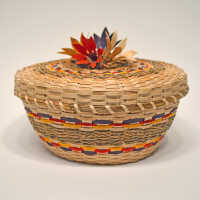
Molly Neptune Parker (1939-2020) | Medium Size Fancy Basket [Passamaquoddy]
A colorful Passamaquoddy fancy basket (7 1/2” wide x 5 1/2 high”) made by Passamaquoddy master basketmaker, Molly Neptune Parker. She wove the basket together using thin strips of split ash and strands of braided sweetgrass adding a series of carved flowers to the top that was a signature characteristic of her baskets as its was her mother’s who was also a basketmaker. This basket is one of three baskets, including an acorn shaped basket, made by Parker in the collections of the Tides Institute. Parker specialized in making fancy baskets, a style of decorative basket developed by the Passamaquoddies and other Native Americans in the latter part of the 19th century to sell to European-American tourists who begin to visit the area in increasing numbers at the same time. Parker was born in 1939 in Motahkomikuk/Indian Township in northern Washington County, Maine. She made a great many baskets over her life, among other forms some were in the shape of strawberries, others in the shape of acorns that she was particularly known for. To make a fancy basket might take five days from start to finish. In 2012, the National Endowment for the Arts named Parker a National Heritage Fellow. She was also a founder and president of the Maine Indian Basketmakers Alliance that sought to preserve, revive and extend the basketmaking craft. She taught basketmaking workshops in the area and sold her work locally as well as across the United States. She died in 2020. Artist: Molly Neptune Parker Classification: North American Basket Circa: 2008 Old Accession Number: 1518 Description: Passamaquoddy. Medium size fancy basket.
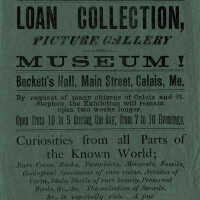
Museum Hand Bill - Beckett's Hall, Calais, Maine | c.1860s
A hand bill for perhaps the earliest “museum” in this region located in Beckett’s Hall on Main Street in downtown Calais, Maine. It likely dates to the 1860s. This early short lived museum and exhibition space, a version of a cabinet of curiosities, featured all sorts of exotic artifacts and displays that were popular at the time: rare coins, books and pamphlets; rare minerals, fossils, geological specimens and shells; and preserved birds along with collections of swords and paintings. Admission to the museum and exhibition space was 25 cents with children charged half price. The museum was the brainchild of John Gregg Beckett, better known as J.G. Beckett, a businessman and entrepreneur, who was born in Scotland in 1828, the son of a confectioner. In the mid-1840s, J.G. Beckett moved to Boston and then a few years later in 1850 to Eastport, Maine where he started a bakery. A year later, he relocated again, this time to nearby Calais, Maine where he resumed a bakery and added a confectionary in downtown Calais. There he remained for several years until late 1858, when he abruptly shut down his business and returned to Scotland to recruit emigrants to Canada. Three years later, in 1861, he was back in Calais and resumed his bakery and confectionary business. It was during this time following his return that J.G Beckett opened his short lived museum and exhibition space. In 1870, a great fire in Calais burned down the wooden building he had named “Beckett’s Hall” in his museum and exhibition hand bill. He died in 1889. Photo caption: A hand bill for perhaps the earliest “museum” in this region located in Beckett’s Hall on Main Street in downtown Calais, Maine. It likely dates to the 1860s. Classification: Prints Circa: 1860 Old Accession Number: 1604
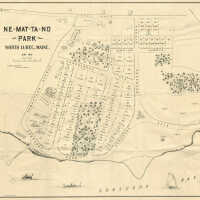
Ne-Mat-Ta-No Park Hotel and Park Map, North Lubec, Maine | 1897
A large original plan for the Ne-mat-ta-no hotel and resort development in North Lubec, Maine. that dates to June, 1897. The plan is the work of C.E.C. Beck, landscape engineer, of Boston, Massachusetts. The 500-acre facility was built by the North Lubec Improvement Company, a Young Men’s Christian Association (YMCA) company, organized in 1889 for developing a permanent New England Summer Encampment for the organization. North Lubec was chosen for the site. The map shows the Ne-mat-ta-no hotel that was built in 1890 along with the surrounding resort plan. The plan shows dozens of housing lots; streets with names of St. Croix, Kenduskeg, Cobscook, Ne-mat-ta-no, Macwahoc, Lamoine, and Mattawamkeag; tennis courts; a casino, camping ground; ice house; picnic grove; bowling alley and steamship and boat landing wharves. The hotel was a substantial four story wooden structure with a large covered porch that wrapped around all four sides of the hotel on the ground level. The hotel could accommodate 125 guests withe room rates of $2,00 to 2.50 a day or $9.00 to $12.00 a week. The hotel burned down in 1921. The Tides Institute acquired this original map from a collector in Lubec, Maine along with an original brass stencil dating to the same time period with the Ne-mat-ta-no name. The institute also has historical photographs of the hotel as well as the steamship wharf. Photo caption: Original plan for Ne-mat-ta-no retort hotel development in North Lubec, Maine that dates to 1897. Classification: Maps Circa: 1897 Old Accession Number: 231 Description: Ne-Mat-Ta-No Hotel and Park Map, North Lubec, Maine, 1897.
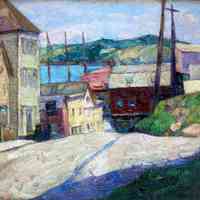
Nellie Augusta Knopf (1875-1962) | Street Scene, Eastport, Maine | Oil on Canvas | 1928
Street Scene, 1928 Oil on canvas, framed Signed and dated l.r., 16" x 18" actual, 24 1/4" x 26 3/8" framed
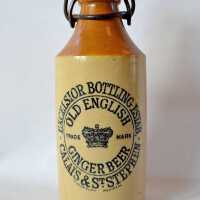
Old English Ginger Beer | Excelsior Bottling Establishment | Calais, Maine and St. Stephen, New Brunswick
A late 19th century stoneware bottle for the Old English brand of ginger beer produced by the Excelsior Bottling Establishment of the neighboring border communities of Calais, Maine and St. Stephen, New Brunswick located on opposite sides of the St. Croix River. The bottle stands about seven inches tall and two and a half inches wide and likely dates to the 1880s. Excelsior was run by two Irish Canadians, F.H. Tyrill and W. J. Cummings. Ginger beer was popular during the 19th and the early 20th centuries. It is not truly a beer as beer involves the fermentation of a grain while ginger beer involves the fermentation of ginger and added sugar. Today's ginger beers are not alcoholic, but 19th century ginger beers were, particularly moreso before the mid-19th century. After brewing, ginger beer was poured into stoneware bottles that were wired and corked shut to maintain carbonation. Stoneware bottles were used instead of glass bottles as ginger beer was usually cloudy and unattractive in appearance. Before 1880, the stoneware bottles were plain, but beginning in the 1880s the bottles became sleeker with colorful shoulder slips and transfer printed designs. This bottle was made by Munderloh & Company of Montreal, Quebec. The bottle was part of a lot of six stoneware ginger beer bottles (the other five were Old Homestead ginger beer also of Calais and St. Stephen) acquired at Ebay auction. Photo caption: Stoneware bottle for the Old English brand of ginger beer produced by the Excelsior Bottling Establishment of Calais, Maine and St. Stephen, New Brunswick. Bottle dates to the 1880s.
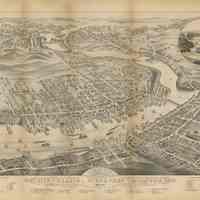
Panoramic View of the City of Calais, St. Stephen and Milltown, Washington Co. Maine, Charlotte Co. New Brunswick, 1879 | J.J. Stoner
A bird’s eye view map of Calais, Maine and St. Stephen and Milltown, New Brunswick. It dates to 1879 and was produced by the J.J. Stoner company of Madison, Wisconsin. A larger view of the map can be seen elsewhere on the institute’s website: Bird’s Eye View Map. Such maps were extremely popular in the late nineteen century throughout North America and many towns and cities had such maps created of their communities. J.J. Stoner also did another bird’s eye view map at the same time of Eastport, Maine. A copy of this map is also in the institute’s collections. Ten years later, another bird’s eye view map was created for Calais and St. Stephen and this time the map was produced by a Canadian firm, L.W. McAnn & Company, of Moncton, New Brunswick. The institute has a copy of this map as well. Other bird’s eye view maps of this region include Lubec (1896), Machias (1896), Cherryfield (1896) all by George Norris, and St. Andrews (1890) by Bert Poole. A copy of the 1896 Lubec bird’s eye view is in the institute’s collections. The institute’s 1879 bird’s eye view map of Calais, St. Stephen and Milltown was donated by Paul Hachey, former assistant curator of the Beaverbrook Art Gallery in Fredericton, New Brunswick, who at the time was living in Montreal, Quebec. He was concerned about mailing the map across the U.S. / Canada border so the Tides Institute had him mail it to the librarian at the St. Croix Public Library in St. Stephen. From there, the institute picked up the map and brought it safely across the border by car at the Ferry Point Bridge in downtown Calais and St. Stephen and successfully through U.S. Customs on the Maine side of the bridge. Artist: J.J. Stoner Medium: Lithograph Classification: Maps Circa: 1879 Old Accession Number: 55 Description: Panoramic View of the City of Calais, St. Stephen and Milltown, Washington Co. Maine, Charlotte Co. New Brunswick, 1879. Mills, Factories, Shops & Wharves. Pub. By J.J. Stoner, Madison, Wisconsin
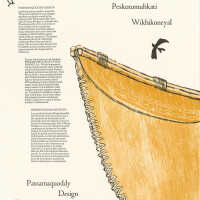
Passamaquoddy Design | David Wolfe / David Moses Bridges | 2010
A letterpress printed poster, “Peskotomuhkati Wikhikoneyal,” produced by the Tides Institute in 2010 in collaboration with letterpress printer and designer, David Wolfe, of Wolfe Editions of Portland, Maine and Passamaquoddy artist, David Moses Bridges. In English, the title of the poster is “Passamaquoddy Design” and in French, “Dessin Passamaquoddy.” Two hundred and fifty copies of the 15 7/8” (width) x 22 3/8” (height) tri-language poster were printed as part of a limited edition. The poster image was carved by David on birch bark, reinforced with a wood backing and then inked and printed directly on to the surface of the poster paper. Passamaquoddy design motifs have been used for centuries. There are hundreds of such designs and they are deeply rooted in the culture of the Passamaquoddy. David Moses Bridges was a contemporary Passamaquoddy artist and he used many many of these design motifs - sometimes traditional ones, sometimes adaptations, sometimes new ones of his own creation - in his birchbark canoes and birchbark containers. This poster reproduces one of the traditional motifs that David used in his work. The two tone color between the birchbark surface and the motif carving accentuates the design and its simplicity. David died in 2017. The Passamaquoddy text was written and translated by Joan Dana, Brenda Dana Lozada and Wayne Newell with assistance of Donald Soctomah. The French text was written and translated by Ross Paradis with assistance of Sheila Jans. Photo caption: Letterpress printed poster, “Peskotomuhkati Wikhikoneyal,,” 15 7/8” (width) x 22 3/8” (height), 250 copies, 2010. Letterpress printed poster produced by the Tides Institute in collaboration with letterpress printer, David Wolfe, of Wolfe Editions of Portland, Maine and Passamaquoddy artist, David Moses Bridges. Artist: David Wolfe / David Moses Bridges Medium: Letterpress Dimensions: 15 7/8”w x 22 3/8”h Classification: Prints Circa: 2010 Old Accession Number: 895 Description: Poster designed and printed by David Wolfe. Part of the Hand Line Press series of posters produced by the Tides Institute & Museum of Art. A limited edition of 250 copies produced in 2010. Partial funding for this poster and related workshops comes from the Maine Arts Commission. Image printed directly from birch bark and wood. Passamaquoddy text written and translated by Joan Dana, Brenda Dana Lozada and Wayne Newell with assistance of Donald Soctomah. French text written and translated by Ross Paradis with assistance of Sheila Jans.
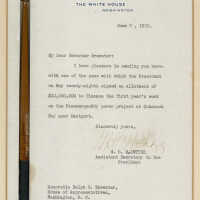
Passamaquoddy Tidal Power Project | Pen Used to Sign Initial Allotment of Funds | 1935
One of the pens used by American President Franklin Delano Roosevelt on May 28, 1935 to sign an allotment of $10 million towards the first year of work on the Passamaquoddy tidal power project in this region. The idea of harnessing the 20 plus foot tides of Passamaquoddy Bay was first thought of by hydroelectric engineer Dexter P. Cooper in 1920. The idea behind the tidal power project was to harness the power of the Bay’s tremendous tides to generate electricity. More than 70 billion cubic feet of water flow in and out of Passamaquoddy Bay with each changing tide, making the Bay an excellent candidate for a prototype tidal power project. But there were other factors at play for the selection of Passamaquoddy Bay as a site for tidal power. Dexter Cooper, the engineer behind the tidal power idea, had a summer home on Campobello Island so he was very familiar with the tides of Passamaquoddy Bay. President Roosevelt also owned a summer home on Campobello Island and he had been coming to Campobello since he was a child after his parents had bought a place there. He became a major proponent of the tidal power project. Funded by the New Deal Era Public Works Administration, the tidal power project began with great fanfare with large scale construction during the first year. Despite the support of President Roosevelt and the promise of inexpensive, sustainable energy, the U.S. Congress soon stopped the funding of the power project and all work ended in August,1936.
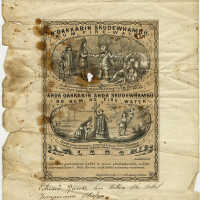
Passamaquoddy/English Temperance Pledge | 1870
A large Passamaquoddy/English language temperance pledge broadside that dates to 1870. The pledge is signed by Edward Quick of Eastport, Maine and by Catholic Jesuit priest, Eugene Vetromile, who served the Catholic churches at both Eastport and the nearby Passamaquoddy community at Sipayik, Maine in the mid-19th century. During his time as a Jesuit priest, he wrote several books on Wabanaki history and worked on a Wabanakii language dictionary as well. The Tides Institute acquired the broadside from a descendant of the Quirk family who wanted to see the broadside preserved and accessible in an institution in the region where the broadside originatted. Thanks to Donald Soctomah, historic preservation officer for the Passamaquoddy Tribe, the broadside was recently translated by Robert Leavitt and Margarett Apt. Their line by line translation is as follows: N'dakkabin = Rum Skudewhambu = firewater Peseku wonismuhinoh, nanquitchidahamal matchi Niweskum, anda kegus kepkuattasseu, metchinabi, te alihkle Alamkik If I lose track and drink, I will try to think of God, and not drink anything, otherwise I would die and go to Hell. Anda Dakkabin = no rum Anda Skudewhambu = no firewater Peseku esma wonismiu, nanguitchdahamal ketchi Niweskum, If I lose track and drink, I will try to think of God, n’messeli messinemon, sipkauso, tehetch ulitahaso lannihahali. I publicly show it, he will live a long life, he will be happy, Amen. Nia … niak’dihlel ndamina gatosmiwon hokbe te messi skudewhambu; I am going to swear that I will not drink any kind of liquor; wibitte acquamalsiane, lhite Doctol, niakdihlel ndamina wonsmiu. as soon as I feel better, I will go to the doctor, and I will not forget. Pledge No Drinking - Father Vetromile 1870 Translations by Margaret Apt & Robert Leavitt (2021) N'dakkabin = Rum This looks more like ntahkopim “my cold drink” (the word does not appear in the text below) Skudewhambu = firewater Sqotewop (literally, “fire-water”) anda dakkabin = no rum Ma-te ntahkopim (originally may have been ntama ntahkopim) anda skudewhambu = no firewater Ma-te sqotewop (originally may have been ntama sqotewop) Peseku wonismuhinoh, nanquitchidahamal matchi Niweskum, anda kegus kepkuattasseu, metchinabi, te alihkle Alamkik Pseqossomiyan, ntoqecitahama kci-Niweskum, ma-te keqoss nkotuwossomiw, nmehcin-op naka ntoli Lamkik. If I lose track and drink, I will try to think of God, and not drink anything, otherwise I would die and go to Hell. Peseku esma wonismiu, nanguitchdahamal ketchi Niweskum, Pseqossomiyan, ntoqecitahama kci-Niweskum, If I lose track and drink, I will try to think of God, n’messeli messinemon, sipkauso, tehetch ulitahaso lannihahali. nmessuwi-messunomon, sipkawsu-tehc, wolitahasu, niyalic. ??? I publicly show it, he will live a long life, he will be happy, ???Amen. Nia … niak’dihlel ndamina gatosmiwon hokbe te messi skudewhambu; Nila … Nila nkoti-wolaman, ntama-na nkotuhsomiwon psiw sqotewop; I am going to swear that I will not drink any kind of liquor; wibitte acquamalsiane, lhite Doctol, niakdihlel ndamina wonsmiu. woli-te aqamolsiyan, ihik taktalk nkoti-li, ntama-na nunitahasiw. as soon as I feel better, I will go to the doctor, and I will not forget. Temperance Pledge. Edward Quirk has taken the total Temperance Pledge. Eastport [Maine], January 8, 1870. Signed by Edward Quirk and Eugene Vetromile, Pastor. Purchased from Roger Quirk of Lubec, Maine in 2012. Old Accession Number: 1062
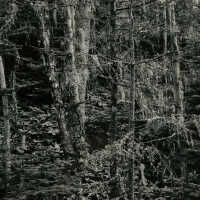
Paul Caponigro (1932-2024) | Woods, Lubec, Maine | c.1960
A photograph of woods in Lubec, Maine by photographer, Paul Caponigro. The photograph dates to about 1960. The Tides Institute acquired the photograph at auction in Boston after being tipped off about the photograph and auction by one of the institute’s trustees. Caponigro was part of a group of Boston based artists who visited Lubec for many years and particularly during the 1950s and 1960s. They were led there by artist, Nina Bohlen, whose family had deep ties to Lubec and had houses and land there. In addition to Caponigro and Bohlen, other Boston based artist who were part of the annual artist migration to Lubec included Hyman Bloom, Steven Trefonides, Nicholas Dean and Marie Cosindas. Caponigro was born in Boston in 1932 and studied with photographer, Minor White, and then taught photography part-time at Boston University in the 1960s. Later, for 20 years, Caponigro lived in New Mexico where he explored the landscape of the American Southwest. He is considered one of the leading landscape photographers in the United States. Caponigro’s photograph of woods in Lubec, Maine is one of two photographs by him of Lubec in the collections of the Tides Institute. The other is a landscape photograph of Raven’s Gulch that dates to 1960. The institute also has a photograph of Caponigro taken at Lubec during this same time by fellow Boston photographer and Lubec visitor, Nicholas Dean. Artist: Paul Caponigro Medium: Photograph Classification: Photographs Old Accession Number: 186
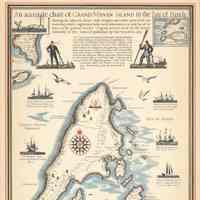
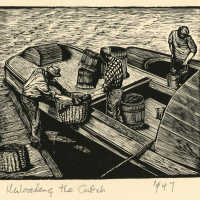
Pauline Winchester Inman (1904–1990) | Unloading the Catch | Wood Engraving | 1947
A wood engraving (3 1/2” x 3”) titled “Unloading the catch” by artist and printmaker, Pauline Inman. Dating to 1947, the engraving shows the unloading of a day’s catch of fishing from the stern of a boat tied unto a wharf along the eastern coast of Maine. Inman was born in Chicago in 1904 and graduated from Smith College in 1926. She studied wood engraving at Parson School of Design and Columbia University, both in New York City. “Unloading the catch” is part of a large collection of Inman’s wood engravings donated to the Tides Institute over a decade ago. An equally large collection of Inman’s original engraved wood block from which the prints were made from were placed with the Tides Institute as well. She and her husband first visited South Addison, Maine in 1929 and they continued to spend summers there for the next 30 to 40 years. From this summer base at South Addison, Inman was able to explore the surrounding eastern coast of Maine and all provided rich subject matter for her engravings. She would sketch and photograph during the summer and engrave the wood blocks in the winter at her home in Connecticut. She died in 1990. Artist: Pauline Inman Medium: Wood engraving Old Accession Number: 670 Description Pencil Signed. 1947. Unloading the Catch, 1947 Wood Engraving Fishermen unload fish from the stern of a wooden boat tied to a wharf with a single rope cutting across the shadow of the water. The heavy basket full of the day’s catch balances on the boat’s gunwale. An example of Inman’s interest in the activities of the wharf, this wood engraving captures the slumped, tired bodies of fishermen who have spent the day on the water and are now transporting their catches from the boat to the wharf decks one basket at a time with the desire to end the day with transactions. While the personal connection between the three figures might seem clear at first glance, this print has also been referred to as Selling the Catch, a title that sparks a reevaluation of the figures’ relationship.
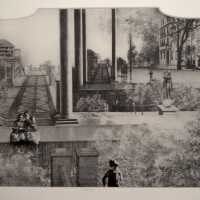
Peter Milton (1930- ) | The First Gate | Etching and Engraving | 1974
Artist: Peter Milton Medium: Etching and Engraving Dimensions: 20 x 30 inches (50.8 x 76.2 cm) Classification: Prints Circa: 1974 Old Accession Number: 1032
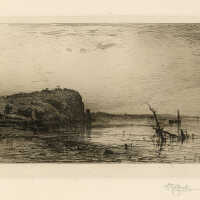
Prosper Senat (1852-1925) | Friar Head, Campobello, New Brunswick | Etching | 1886
An etching of Friar’s Head on Campobello Island, New Brunswick by American artist, Prosper Louis Senat. It dates to 1886. Sent was born in Philadelphia in 1852 to a wealthy family. His early art training included studies at the National Academy of Design in New York at the Brooklyn Art Associaton. Later studies included the Ecole des Beaux Arts in Paris and the South Kensington School in London. He married in 1887 and began to divide his time between Philadelphia in the winter and Kennebunkport, Maine in the summers. Much of his time was also spent travelling and painting to many parts of the world: Southern Italy, Egypt, Mexico, Jamaica, Bermuda, Belgium, England, France, Holland, Nova Scotia, and the coastlines of Cornwall and Brittany. He also did a number of etchings including at least four (all in the collections of the Tides Institute) in the Passamaquoddy Bay region. Senat exhibited widely throughout his life and belonged to a number of artist clubs, both in Philadelphia and New York City. He died in 1925. The description accompanying Senat’s etching of Frair’s Head is as follows: “Friar Head, Campobello, N.B. Campobello, like its larger companion, Grand Menan, just escaped being an American subject. It has become well known in late years, however, to most Americans, as a very delightful summer resort, with the additional attraction that its scenery is yet sufficiently new to give it the charm once (though no longer, with all its beauty) attached to Mt. Desert. Friar Head is a prominent landmark of Passamaquoddy Bay, and the most imposing headland on the island.” Photo caption: Etching of Friar’s Head on Campobello Island, New Brunswick by American artist, Prosper Louis Senat. It dates to 1886. Artist: Prosper Senat Medium: Etching Classification: Prints Circa: 1886 Old Accession Number: 1674 Description: Friar Head, Campobello, N.B. Campobello, like its larger companion, Grand Menan, just escaped being an American subject. It has become well known in late years, however, to most Americans, as a very delightful summer resort, with the additional attraction that its scenery is yet sufficiently new to give it the charm once (though no longer, with all its beauty) attached to Mt. Desert. Friar Head is a prominent landmark of Passamaquoddy Bay, and the most imposing headland on the island.
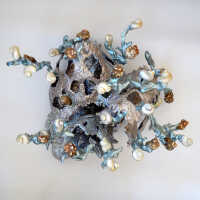
Richard Van Buren (1937- ) | Mist Dance | 2009
A sculpture titled “Mist Dance” by artist and sculptor, Richard Van Buren. Created in 2009 and made of thermoplastic, acrylic paint and shells, the 24” x 24” x 20” piece was a gift to the Tides Institute by the artist. Van Buren was born in Syracuse, New York in 1937 and studied painting and sculpture at San Francisco State University and the National University of Mexico. In 1964, he moved to New York City. Over the next 35 years he taught sculpture there, first at the School of Visual Arts (1967-1988) and then at the Parsons School of Design (1988-2001). During the 1960s and 1970s, Van Buren had solo exhibitions at numerous important galleries, particularly in New York City, including the Bykert Gallery, 112 Greene Street and Paula Cooper Gallery. During this same time, his work was also included in many ground breaking museum exhibitions. Working primarily with a very pliable polyester resin material, Van Buren has been able to explore and push sculptural work in new ways, often adding completely different materials to the polyester resin form. His work can be found in the collections of such major museums as the Art Institute of Chicago, the Museum of Fine Arts (Boston), the Museum of Modern Art (New York City), the National Gallery (Washington, D.C.), and the Walker Art Center (Minneapolis). He began coming to Perry, Maine during the summers beginning in the 1970s and since 2001 he has lived and worked there year round. Sculpture titled “Mist Dance” by artist and sculptor, Richard Van Buren, thermoplastic, acrylic paint and shells, 24” x 24” x 20”, 2009. Gift of the artist.
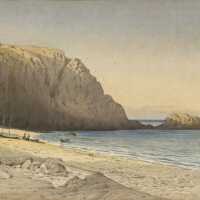
Samuel Peter Rolt Triscott (1846-1925) | Grand Manan | c.1890
A watercolor painting by American artist, Samuel Peter Rolt Triscott, of Eel Brook Beach and Ashburton Head on Grand Manan Island, New Brunswick. It dates to about 1890. Triscott was born in Gosport, England in 1846, one of five children, to a relatively well off family. His early art studies in painting were at the Royal Institute of Painters in Water Colors in London. But he was also trained in civil engineering. In 1871 Triscott moved to Worcester, Massachusetts and became a partner in a civil engineering firm there. Three years later he began selling his painting out of his engineering office and in 1881 he had he had a one person exhibition at the Boston Art Club in Boston. He continued to show regularly at this Club as well as the American Watercolor Society in New York, the Pennsylvania Academy of Fine Arts in Philadelphia and the Gallery of J. Eastman Chase in Boston. Triscott taught painting during this time and his students included Winslow Homer, Sears Gallagher, William J. Bixbee, and Robert Henri. In 1885, he helped found, along with others, the Boston Society of Water Color Painters. Triscott first began to visit Monhegan Island in mid-coast Maine in the early 1890s. There he bought a large tract of land, parts of which he later sell off as cottage lots as Monhegan became more popular as a summer destination. As time went on, Triscott spend more of each year on Monhegan and eventually began staying there year round. It was during his Monhegan years that Triscott visited Grand Manan. He died on Monhegan in 1925. This watercolor was acquired by the Tides Institute at auction in 2014. Photo caption: Watercolor of Eel Brook Beach and Ashburnton Head on Grand Manan Island, New Brunswick by American artist,. Samuel Peter Rolt Triscott. The watercolor dates to about 1900. Artist: S. P. R. Triscott Medium: Watercolor Classification: Paintings Circa: 1890 Description: Eel Brook Beach and Ashburton Head, Grand Manan. Old Accession Number: 1438
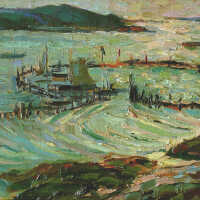
Sandor Bernath (1892-1985) | Day’s End | c.1930s
A small oil on board painting by Hungarian-American artist, Sandor Bernath (1892-1985) of a coastal scene with a central element of the seining of a herring weir. Without any notation on the painting, presumably the painting is of a scene along the eastern coast of Maine or southwestern New Brunswick as Bernath lived in Eastport, Maine for about 20 years beginning in the mid-1920s. The painting likely dates to the 1930s. Little is known about Bernath and his work along this border region as few works of his related to this region have been discovered. Bernath was born in Hungary and came to the United States when he was young and settled first in New York City. During his long career, he is perhaps best known for his watercolors of sailing yachts, but he also painted coastal scenes, including using oil, such as his painting described here. At one point, Bernath was a student of Edward Hopper. In the early 1920s, he began to paint coastal scenes of New England. In the late 1920s, he moved to Eastport, Maine, where he lived until at about 1945. While Eastport remained his primary residence, Bernath visited and painted in a number of American art colonies during this time. Where he went after Eastport is unclear, but he spent the last years of his life in South America. The painting here was located at the Cooley Gallery in Connecticut and the Tides Institute contacted the gallery about purchasing the painting. The price was $5,000 and the institute was able to raise the funds to secure the painting for its collections. Several years afterwards, a supporter of the institute donated a watercolor by Bernath of downtown Eastport, Maine. There must be many other paintings by Bernath of this region that remain to be discovered. Artist: Sandor Bernath Medium: Oil on board Classification: Paintings Old Accession Number: 97
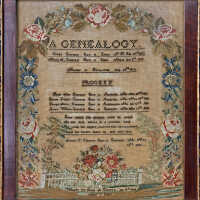
Sarah Ann Cheney | Sampler | 1846
A large (24” x 20 1/2”) mid-19th century needlework sampler by Sarah Ann Cheney of Eastport, Maine that she did when she was 11 years old. The sampler dates to 1846. The sampler is silk on Penelope weave linen and features cross and straight stitches. It is in remarkable condition for its age. Within the sampler, Sarah included information about her parents and their children, even adding her baby brother below the verse years after she had finished the piece. The sampler was part of an exhibition of early to mid-19th century federal period Maine needlework samplers held at the Saco Museum in Maine in 2013. The curator of the exhibition, Leslie Rounds, wrote in the accompanying exhibition catalogue: “Sarah Cheney's sampler is the ‘newest’ of all the samplers in the exhibition and shows many signs of the new styles of needlework that were emerging at the time. However, it also continues to demonstrate stylistic elements that clearly tie it to the earlier works in the exhibition, with its lavish rose border and family register format that appears to be a near-copy of many Portland samplers. She was mimicking the Berlin work that was quickly becoming the needle arts rage of the era. Sarah was the eldest of the five children of George Cheney and his wife, Mary. On the 1850s census, George was listed as a “trader” and the family was residing in Eastport. On July 20, 1858, Sarah married George Kilborn in Boston, Massachusetts. The Kilborns seem to have lived in Boston for the rest of their lives.” The Tides Institute acquired this sampler earlier in 2022 from a dealer in Connecticut that specialized in antique needlework samplers.
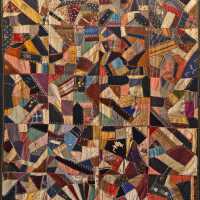
Sarah Preble Livermore (1867-1961) | Crazy Quilt | Eastport, Maine | c.1890s
Gift from estate of Frances Whalen Strout, 2020. From Anna Whalen House, 7 Key Street, Eastport, Maine. A late 19th century “crazy quilt” from this region that came into our collections in 2020.. It dates to the 1890s and had come down through the Livermore and Whalen families of Eastport, Maine before it was donated to us by descendants of the family. The quilt measures 63” high and 51” inches wide and includes a piece that has a large cursive “L” with the numbers 84 and 94 on either side of the letter as well as a piece that is a ribbon for the 13th reunion of the 1st Maine Cavalry of the American Civil War. Crazy quilts hit their heyday in the 1880s to early 1890s, putting this quilt in the middle of the craze. They were usually dated, as were needle point samplers, with the dates of their completion so this quilt may have been a 10 year project, begun in 1884 and finished in 1894. The quilt most likely was made by Sarah Preble Livermore who was born in 1867 and would have been 17 when she started the quilt. The large cursive “L’ stands for Livermore and Sarah’s last name would have still been Livermore until 1892 when she married Leveret Whalen and took the Whalen last name. In addition, Sarah’s mother, Ellen Bucknam Livermore, wrote poems to Sarah about gifts she was giving her, including sewing needles. Sarah clearly took an interest in the crafts of the time as she also did some china painting as well. As for the 1st Maine Cavalry ribbon, one of Sarah’s uncles was Brevet Brigadier General Charles H. Smith, who had married Mary Livermore, and was an honored veteran of the American Civil War, having been awarded the Medal of Honor for his heroism. He entered the Civil War as a captain in the 1st Maine Cavalry regiment and later took command of the regiment. Sarah Preble Livermore Whalen Hayes (1867-1961) married Leverett Mitchell Whalen (1850-1912) in 1892 and then George Hume Hayes (1851-1935) after Leverett died. At the time the quilt was made, Sarah would have been living in the large 7 Key Street house in Eastport that had been in the Whalen family for generations. It stayed in this house after Sarah’s death as the house and quilt were inherited by Sarah’s daughter, Anna K. Whalen (1894-1986) who continued to live in the house until her death. Anna had no children and when she died, the house, quilt and other household furnishings were inherited by Anna’s niece, Frances Whalen Strout (1933-2020). Frances sold the house and moved the quilt and most of the household furnishings to her ranch style home with attached garage in Brewer, Maine. She converted her garage into a 19th century parlor room filled with the furnishings from her aunt’s Eastport house including the quilt. Frances had no children and when she died the quilt along with many with many other of the family furnishing were placed with the Tides Institute in 2020.
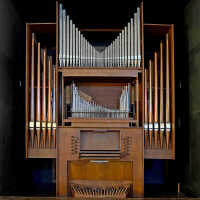
Schlicker Organ Company, Buffalo, New York | Chamber Organ | 1961
A modern chamber organ that was constructed in 1961 by the Schlicker Organ Company of Buffalo, New York. It was built for noted American sculptor, Richard Lippold, of Locust Valley, New York and designed for solo and ensemble Renaissance and Baroque music. It is not a church organ, but is intended for chamber music. Hermann Schlicker was among the immigrant pioneers in the United States of the Baroque revival. He was active from the 1940’s to the 1970’s. The instrument is entirely mechanical, except for the electric blower which supplies wind. Mechanical linkage from keyboards and pedals opens valves beneath the pipes. The design is rendered in oak and mahogany, and brass and steel fittings. The pipes are copper, oak and tin. After the death of the chamber organ’s original owner in 2002, the organ was disassembled and stored in a warehouse in Brooklyn, New York. The Tides Institute learned of the organ’s existence in 2016 from someone who knew the institute’s North Church space in Eastport, Maine and its exceptional acoustics. They thought the organ and North Church space would be a perfect match. The institute was able to purchase the disassembled organ and had the pieces transported to Eastport. In spring of 2018, the organ was reassembled and installed in the North Church space. That summer, an early music concert was performed in the space with Ensemble Abendmusik based in Boston with one of the world’s leading organists, James David Christie, giving inaugural performances with the organ. Photo caption: Modern chamber organ reinstalled in the Tides Institute’s North Church space. The organ was constructed in 1961 by the Schlicker Organ Company of Buffalo, New York. Flentrop organ pipes: https://www.flentrop.nl/ukflentroporgan.html.
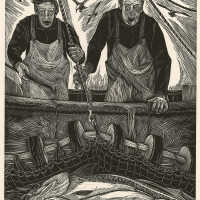
Siri Beckman (1942- ) | Tale of The Machias Cod | 1996
Artist: Siri Beckman Medium: Wood Engraving Classification: Prints Old Accession Number: 362 Description: Artist's Proof, #6.
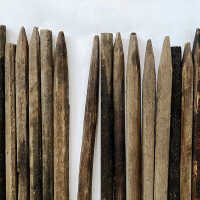
Smoked Herring Sticks | McCurdy Smokehouse | Lubec, Maine
A collection of twenty-nine 20th century wooden smoked herring sticks from the McCurdy herring smoke house complex in Lubec, Maine. During the 19th and for much of the 20th centuries, there were dozens of herring smoke houses throughout the coastal border region between Maine and New Brunswick. Lubec had at least 13 herring smoke houses and Seal Cove on neighboring Grand Manan, New Brunswick had even more. The process of smoking the plentiful herring caught in the surrounding waters and bays was a centuries old process brought to North America from Europe. The half inch in diameter smoked herring sticks, some round, some square, average about 40 inches in length and are sharpened on one end. To this day they retain a pungent smell of smoked herring. The McCurdy complex operated between about 1906 and 1991 on the Lubec waterfront. It is last nearly intact early 20th-century herring smoke house complex in Maine and has been listed on the National Register of Historic Places since 1993. Others still exist in New Brunswick. Once the herring were brought to a herring smoke house operation by boat, they were soaked in a salt brine and then strung on the wooden herring sticks. Sticks full of strung herring were then brought inside nearby smoke houses and suspended in a series of vertical bays above smoldering fires on the building floor. In 1995, four years after the McCurdy herring smoke house operations closed, it was sold to Lubec Landmarks, an organization dedicated to preserving the McCurdy complex and history.
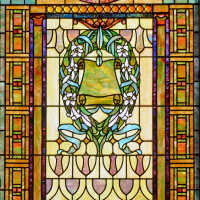
Spence, Bell & Company, Boston | Stained Glass Window, North Church, Eastport Maine | 1916-1917
One of eight large stained glass windows in the former sanctuary space of the Tides Institute & Museum of Art’s North Church building in Eastport, Maine. The North Church building was built in 1819 for the Free Will Baptist Society, organized three years before, and known as the North Baptist Church. In 1881 the building was raised upwards and a ground level vestry space added beneath. Thirty-five years later, in 1916, during the 100th anniversary of the organization of the church, the eight stained glass windows in the sanctuary space were installed including this one. The windows had been created by the Boston studio glass firm of Spence, Bell & Company. Several other much simpler stained glass windows were installed in the church balcony as well as in the 11 foot high front doors. Little is known about Spence, Bell & Company other than they were considered very good and they did work throughout the northeast. The new sanctuary windows in the North Church were memorial windows meant to honor individuals or groups by those providing the funds to cover the cost of the windows. This window reads near the bottom, “In Loving Remembrance, Alexander W. Beckett, Emma S. Beckett.” The sanctuary windows are not overly religious in appearance, but all have religious elements. Leslie Smith, a retired Episcopal priest, provided an interpretation of the elements within this stained glass window: “Many more lilies form the border of central lozenge, which is centered by a Scroll, the Word of God. The upper arc has at center an Open Bible, symbolic of Protestant emphasis on Scripture as the heart of Christian Faith, i.e. Sola Scriptura. The Bible is surmounted by a Crown, meaning the primacy of Scripture or indicating heavenly reward.” These stained glass windows were nearly lost as soon after 2000, the building became abandoned after the congregation had dwindled and the building badly deteriorated. In 2014, the building was gifted to the Tides Institute by the then successor church owners to insure the building’s preservation.
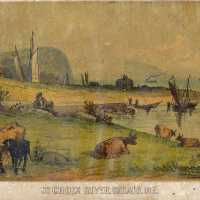
St. Croix River, Calais, Me. | J. H. Bufford's Sons, Lithographers, Boston | c.1860
A small late 19th century lithographic print titled “St. Croix River, Calais, Me.” The print is about 4 1/4 inches high and 6 1/2 inches wide. It shows a bucolic scene along the shores of the river separating Maine and New Brunswick with cows, a farm house and farm, sailing vessels, and what appears to be an outcrop of the Devil’s Head landmark in the background. The print is the work of J. H. Bufford's Sons Lithographers of Boston and dates to about 1860. The lithographic form of printing was invented at the end of the 18th century and became a prevalent form of reproducing a wide range of “art” scenes in the first half of the 19th century. John Henry Bufford was part of these greatly expanding lithographic endeavors. Bufford was born in Portsmouth, New Hampshire in 1810. He studied and worked under the well known Pendleton lithography shop in Boston for a few years between 1829 and 1831 while also working on his own. Later he moved to New York City to work as a pictorial artist with the even better known Endicott and Nathaniel Currier lithography shop while continuing, again, to work on his own. He returned to Boston in 1840 and worked for various printing and publishing firms, sometimes in partnership with his brother-in-law, sometimes alone. His businesses thrived until the late 1860s, when photolithography became a widely available, less expensive alternative to the more traditional lithography. Bufford died in Roxbury, Massachusetts in 1870. We located his “St. Croix River, Calais, Me.” print in Pennsylvania. It is the only print of his that we know of set in Washington County, Maine. Photo caption: Late 19th century lithographic print titled “St. Croix River, Calais, Me.” The print is the work of J. H. Bufford's Sons Lithographers of Boston and dates to about 1870. ST. CROIX RIVER, CALAIS, MAINE! Small 19th century lithographic print (about 4.25" high x 6.5" wide) of the St. Croix River at Calais, Maine that recently came into our collections. We located the print in Pennsylvania. It's the work of J. H. Bufford's Sons Lithographers of Boston and dates to about 1870. See: http://www.artoftheprint.com/artistpages/trade_card_j_h_bufford_and_sons_thefloralbabies.htm
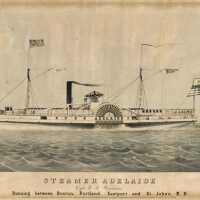
Steamer Adelaide | [No Artist Defined]
A large lithograph of the side wheel steamer Adelaide. For a couple of years in the mid to late 1850s, the Adelaide made regularly scheduled trips between Boston, Portland, and Eastport in Maine and Saint John in New Brunswick under Captain E.B. Winchester. The print dates to this time and was produced by Endicott & Company, lithographers, of New York City. Endicott was a well established firm and producer of lithographs of maps, ships, buildings, landscape scenes and portraits. At this time, the Adelaide was owned and operated by the Calais Steamboat Company. The Tides Institute located the print in Virginia a little over three years ago and was able to secure the print for its collections. The Adelaide was built in 1854 at Greenpoint, Long Island, New York by Lupton and McDermott for Cornelius Vanderbilt. Vanderbilt intended to use the Adelaine as a steamer along the California coast during the Gold Rush era. A change in business conditions resulted in this plan being shelved and the Adelaide was sold while still under construction to the Calais Steamboat Company. The Baltimore Steam Packet Company purchased the vessel in 1859 for its Norfolk to Baltimore run. In 1880, the Adelaide began operating out of Long Branch, New Jersey and shortly afterwards was rammed by the excursion boat Grand Republic where it sank in New York City harbor. Classification: Prints Circa: 1855 Old Accession Number: 2306 Description: https://www.history.navy.mil/research/histories/ship-histories/danfs/a/adelaide.html Saint John, Eastport, Portland, Boston
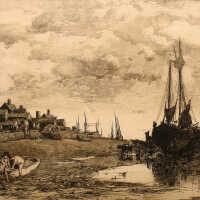
Stephen Parrish (1874-1940) | Low Tide, Bay of Fundy | 1882
A large etching (11 3/4”/29.9 cm x 18 3/4”/47.6 cm) by American artist, Stephen Parrish (1846-1938) called “Low Tide, Bay of Fundy.” It dates to 1882. In his 1886 book Etching in America, J.R.W. Hitchcock wrote, "Nothing that Mr. Parrish has done, however, seems to be more vigorous than his 'Low Tide, Bay of Fundy.' With the strong lines of stranded vessels outstanding against a brilliant sky, balanced by quaint houses on the shore, and with another touch added in the expressive figures on the beach.” Parrish was born in Philadelphia into a wealthy Quaker family. In his early 20s he spent several months travelling through Europe and it was during these travels that he discovered his love for art. Until then, Parrish’s primary work was in the coal industry and later he owned a stationary store. In 1878 he attended the Pennsylvania Academy in Philadelphia and the following year the National Academy in New York City. He soon turned his attention to etching. In the summer of 1881, Parrish and fellow American etcher, Charles Platt, traveled through New Brunswick and Nova Scotia sketching the coastal and interior scenes along the way. The two artists were much taken by what they saw. Parrish created a number of preliminary sketches that he later turned into a series of etchings. Parish was the father of Maxfield Parrish. “Low Tide, Bay of Fundy" is one of several etchings of the Bay of Fundy and Annapolis Valley by Parrish in the collections of the Tides Institute along with a painting by Parrish of a northeastern landsacpe. The institute also has several etchings by Charles Platt of the Bay of Fundy and Annapolis Valley area. Artist: Stephen Parrish Medium: Etching Classification: Prints Circa: 1881 Old Accession Number: 126
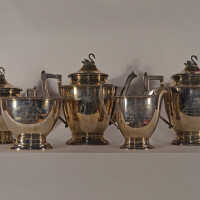
Sterling Silver Presentation Coffee Pot & Service Set | Shreve, Stanwood & Company | 1867 | Boston
A five piece coin silver tea service set dating to 1867. Each piece is inscribed: "Boston Board of Trade to Hon. Lorenzo Sabine as a testimonial for his able and faithful service as secretary for a period of ten years. 1867." The set was made by Shreve, Stanwood & Co. of Boston, one of Boston’s leading silversmiths at the time. Sabine lived in Eastport, Maine for many years in the early 19th century and then moved to Boston. He died in 1877 and is buried in Hillside Cemetery in Eastport. An historian, he is best known for one of the earliest works by an American historian on the history of the American Loyalists who moved to what is now Canada after the American Revolution. The tea service set came down through his family in Eastport. The last descendants in Eastport moved in the 1960s and put the service set up for sale. There was a local effort to raise funds to keep the set in Eastport, but the effort was unsuccessful. Nearly 50 years later, the president of the Tides Institute’s board learned that the set was up for auction in Rockland, Maine. By the time inquiries were made, the auction had already taken place. The auctioneer, though, was asked by the Tides Institute about having the winning buyer contacted. The auctioneer obliged and the buyer, a dealer, was willing to sell the set to the Tides Institute for a price: $5,000. The Tides Institute was able to raise the funds in two days and the set is now back in Eastport as part of the Tides Institute’s collections. Classification: Silver Circa: 1867 Old Accession Number: 2276 Description: Coin silver presentation coffee pot. Part of a five piece sterling silver coffee and tea service set. Inscribed: "Boston Board of Trade to Hon. Lorenzo Sabine as a testimonial for his able and faithful serves[sic] as secretary for a period of ten years. 1867." Shreve, Standwood & Co. of Boston.
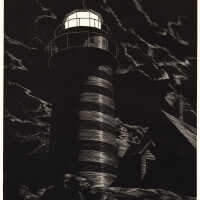
Stevan Dohanos (1907-1994) | West Quoddy Light, Lubec, Maine | 1933
A large wood engraving (10” x 7 15/16’’) of West Quoddy Head Lighthouse in Lubec, Maine by artist, Steven Dohanos. It dates to 1933. It was one of the earliest pieces to come into the collections of the Tides Institute, having been purchased by the Institute in 2003, a year after the Institute’s founding. An artist and illustrator, Dohanos was born in Lorain, Ohio in 1907 and attended the Cleveland School of Art. He was one of several artists from Ohio and the midwest (such as Walter Dubois Richards from Ohio and Edmund Schildknecht and Robert Craig, both from Indiana) who attended the summer art school (Grand Central School of Art that later became the Eastport Summer School of Art) in Eastport, Maine during the 1920s and early 1930s. Dohanos is perhaps best known for his Saturday Evening Post covers including a later illustration of the same West Quoddy Head Lighthouse. He considered Grand Wood and Edward Hopper as having the largest influences on his painting style. He was a member of the National Society of Mural Painters and the Society of Illustrators and a founding faculty member of the Famous Artists School of Westport, Connecticut where he moved to in early 1940s. He worked for the U.S. Treasury Department painting several post office murals across the U.S. He did his first magazine illustration for McCall's in 1938 and sold his first cover painting to The Saturday Evening Post in 1942. In total, he painted over 125 covers for The Saturday Evening Post during the 1940s and 1950s. He also illustrated for Esquire and other magazines. He died in 1994. Artist: Stevan Dohanos Medium: Wood engraving Classification: Prints Circa: 1933 Old Accession Number: 187 Description: Stevan Dohanos (American 1907-1994)- ''West Quoddy Light''- wood engraving, 1933, signed in pencil, edition of 250, published for the Print-A-Month club Cleveland, very good condition. 10 x 7 15/16''
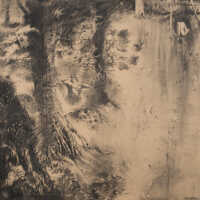
Steven Trefonides (1926-2021) | Nude in Hammock | Charcoal Drawing
A large scale charcoal drawing by artist Steven Trefonides titled “Nude in a Hammock.” The drawing was a gift to the Tides Institute by the artist in 2016 and is the first large work that Trefonides did after he began to visit Lubec, Maine in the 1960s. Trefonides is a well known Boston artist who was part of a significant group artists from this city who visited Lubec for many years and particularly during the 1950s and 1960s. Artist, Nina Bohlen, whose family had deep ties to Lubec and had houses and land there, led the Boston artists to this downeast coastal town. In addition to Trefonides and Bohlen, other Boston based artist who were part of the annual artist migration to Lubec included Hyman Bloom, Paul Caponigro, Nicholas Dean and Marie Cosindas, Harold Tovish, Kahlil George Gibran, Marianna Pineda and Iso Papo. Trefonides and his wife, Phyllis, bought a house in Lubec and summered in Lubec for more than 50 years, until very recently. Trefonides was born in New Bedford, Massachusetts in 1926. He studied at the Swain School of Design in New Bedford, the Vesper George School of Art in Boston, and the School of the Museum of Fine Arts in Boston where he majored in painting from 1950 to 1954. The recipient of Tiffany and Fulbright grants, Trefonides' work may be found in the Metropolitan Museum of Art, the de Cordova Museum and the Wadsworth Athenaeum. The Tides Institute mounted a retrospective exhibition of Trefonides’ work, with accompanying catalogue, in 2016. Trefonides died in 2021. Photo caption: Charcoal drawing (48” x 48”) by Steven Trefonides and titled “Nude in a Hammock.” The drawing dates to 1966. Artist: Steven Trefonides Medium: Charcoal Drawing Classification: Drawings Circa: 1967 Old Accession Number: 2988
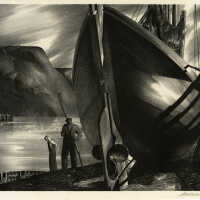
Stow Wengenroth (1906-1978) | Dark Harbor | 1932
An original lithograph print, “Dark Harbor," by American artist and printmaker, Stow Wengenroth. It dates to 1932 and is likely of a scene on Grand Manan Island in New Brunswick. The print is one of 20 lithographs by Wengenroth of scenes of the Passamaquoddy region that the Tides Institute & Museum of Art has acquired for its collections over the past 18 years. Born in New York City in 1906, Wengenroth learned lithography in the later 1920s, early 1930s while a student at the summer art school based out of New York City that operated at Eastport from 1922 to 1936. He later taught at the summer school. From 1931 to 1933, he created 33 lithographs of scenes in the Passamaquoddy region, many are clearly Eastport, others, like “Dark Harbor,” look like Grand Manan. Wengenroth went on to have a long and successful career as an artist and printmaker. He died in 1978. In his early work in the area, Wengenroth produced some of his most imaginative and dramatic work. After his early period as an artist, he sort of settled down while continuing to produce a great many excellent and technically flawless works. Building a collection of Wengenroth’s works from the area has been part of the Tides Institute’s long term effort to rebuild some of the cultural legacy of this region, so much of which has been hidden, dispersed or seemingly lost. The Tides Institute’s current Wengenroth lithographs can be viewed online through the institute’s web based collections resource: http://www.tidesinstitute.org/place/browseArt.php?collection=22. The Tides Institute hopes to secure the remaining 13 Wengenroth prints of the region for its collections over the next decade and to mount an exhibition of its Wengenroth lithographs. Artist: Stow Wengenroth Medium: Lithograph Classification: Prints Circa: October, 1932 9 1/8" x 12 13/16" Edition of 50 Old Accession Number: 295
Susan Hartnett (1940- ) | February 17, 2006 #1 - Winter Grass
A large contemporary charcoal drawing, “February 17, 2006 #1 Winter Grass," by artist, Susan Hartnett. Born in 1940 in St. Louis, Missouri, for many years Hartnett has lived part of the year on the eastern coast of Maine. The rest of the year she spends in New York City where she has lived for much of her working life. But it is along the eastern coast of Maine and surrounding area that she is able to find plentiful subject matter for her expressive drawings of grasses. She has done hundreds of such drawings, each unique, each capturing subtle and larger differences in type and form of grasses that change with the weather and with the season. Her work has an immediacy as she works deliberately to capture grasses in her drawings, each stroke adding to the previous, with a minimum of strokes used, fluid yet purposeful. The use of charcoal allows her to quickly adjust her line, from thick to thin, from dense to light, from clean to smudge. Asian as well as western aesthetic traditions have influenced her work. She writes, “A lot of knowledge of Chinese and Japanese ink painting and calligraphy had to be thoroughly assimilated before the "stroke" could be applied. Large leaves need a supple brush, whereas grass or twigs could be done with strokes of different thicknesses of charcoal. I've made charcoal supple.” This particular drawing was a gift to the Tides Institute by the artist. Artist: Susan Hartnett Medium: Charcoal drawing Dimensions: 18 Classification: Drawings Circa: 2006 Old Accession Number: 112 Description: February 17, 2006 #1 Winter Grass Gift of the Artist
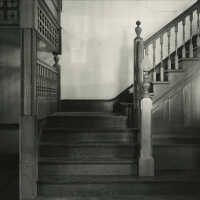
Thaddeus Holownia (1949- ) | Staircase, Capen House, 16 Key Street, Eastport, Maine | 2015
A gelatin silver photographic print, “Staircase, Capen House, 16 Key Street, Eastport, Maine,” by photographer, Thaddeus Holownia, taken in 2015. The photograph was part of a large scale nine year effort by Holownia to photograph the architecture, landscape and community of Eastport, Maine from 2009 to 2017. Using large format cameras and film photography, Holownia took nearly 1,000 photographs of building exteriors and interiors, architectural details and wider streetscapes and landscapes of Eastport. Nearly 200 of the photographs were incorporated into the 218 page hardbound book, Eastport, with accompanying thematic essays by New Brunswick architect, John Leroux, co-published by Holownia’s Anchorage Press and the Tides Institute & Museum of Art (TIMA) in 2018. Holownia was born in England in 1949 and immigrated to Canada in 1954. For 41 years he taught photography at Mount Allison University in Sackville New Brunswick. Holownia’s exquisite large format photographs of the forests, rivers and architecture of Atlantic Canada and other selective parts of the world have been exhibited and published extensively including a major retrospective exhibition of his work, The Nature of Nature, The Photographs of Thaddeus Holownia 1976–2016, at the Art Gallery of Nova Scotia in 2017. Holownia is a Fellow of the Royal Society of Canada and he received the Lieutenant Governor’s Award for High Achievement in the Visual Arts from artsNB as well as the Order of New Brunswick. The Eastport photograph was a gift to TIMA by the photographer.
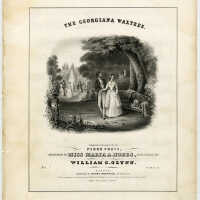
The Georgiana Waltzes | William C. Glynn | 1844
Artist: William C. Glynn Classification: Musical scores Circa: 1844 Old Accession Number: 995 Description: The Georgiana Waltzes. Composed & arranged for the Piano Forte, Dedicated to Miss Maria A. Hobbs, Eastport, Me by William C. Glynn. No. 1. Pr. 25 cts nett. Boston. Published by Henry Prentiss, 33 Court St., Entered according to act of Congress in the year 1844 by H. Prentiss in the Clerk's office of the District Court of Massachusetts. Thayer & Co.' Lithog'y. Boston. A mid-19th century published sheet music score, “The Georgiana Waltzes,” composed and arranged for the piano forte by William C. Glynn. It dates to 1844 and was dedicated to Miss Maria Archibald Hobbs of Eastport, Maine. Maria Hobbs was born in 1821, the daughter of George and Salome Hobbs. The piano forte was an early small piano that was popular in homes at the time. The sheet music was published by Henry Prentiss of Boston and printed by Thayer and Company, lithographers, also of Boston. Whether Maria’s parents paid to have the music score composed in their daughter’s honor is unclear, but her parents were originally from the Boston area. The institute has another slightly earlier dedicated piece of published sheet music in its collections, “Le Victoria, A New Set of Quadrilles,” dating to 1835, composed by James Hooton of Boston and inscribed to Miss Margaret Strang of St. Andrews, New Brunswick. In 1847, three years after “The Georgiana Waltzes” was published, Maria Hobbs married Peter Asley Scott, a lieutenant in the British Royal Navy, who at the time was serving on the Columbia steamship that was engaged iin surveying the coast of North America under the command of Capt. William Fitzwilliam Owen of nearby Campobello Island in New Brunswick. They were married in the Washington Street Baptist Church in Eastport by the Reverend Kendall Brooks. She died in 1895. The Tides Institute acquired the “The Georgiana Waltzes” sheet music through ebay auction.
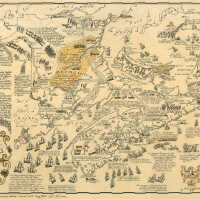
The Maritime Provinces of Canada | Peter Furse | 1963
Artist: Peter Furse Classification: Maps Circa: 1963 Old Accession Number: 256 Title: The Maritime Provinces of Canada 1963 First hand coloured edition. Limited to 50. Copy number 19. From (2024): https://www.davidrumsey.com/luna/servlet/detail/RUMSEY~8~1~346063~90113522:The-Maritime-Provinces-of-Canada?qvq=w4s:/who%2FPeter%2BFurse;lc:RUMSEY~8~1&mi=2&trs=13 David Rumsey Historical Map Collection Record Author: Furse, Peter R. Date: 1963 Short Title: The Maritime Provinces of Canada Publisher: Peter Furse Publisher Location: Hampton, New Brunswick Type: Separate Map Obj Height cm: 38 Obj Width cm: 60 Note: Copy No. 39 in 1st colored limited edition of 50. Lithograph on watermarked Superfine Linen Record 100% Canadian Rag produced by Rolland Paper Co., St. Jerome, Quebec. Hand-coloring applied by artist Kathy Hooper, a daughter of the artist. Lingley Printing Co. Ltd., Saint John, New Brunswick State/Province: New Brunswick State/Province: Nova Scotia State/Province: Prince Edward Island Subject: Pictorial map Subject: Historical Full Title: The Maritime Provinces of Canada List No: 15278.000 Publication Author: Furse, Peter R. Pub Date: 1963 Pub Title: The Maritime Provinces of Canada Pub Note: "Peter Reynolds Furse was born October 29th, 1901, in Farnham, Hampshire, Surrey, England. He was a son of Dame Katherine (Symonds) Furse, GBE, and the English artist Charles Wellington Furse. He entered the Royal Navy during WWI at age 17. He was a cartographer and graduated Emmanuel College, University of Cambridge in 1922. He was married in England on June 25th, 1931, to Barbara Elizabeth Ross of Saskatchewan, Canada. The couple moved to Africa, living in Nairobi, Kenya, and then Cape Town, South Africa where he served in the Royal Navy during WWII. He rose to the rank of Lt. Commander, Royal Navy. The couple had 2 daughters, Kathy and Elizabeth, both born in Kenya. Following the War, he bought Houw Hoek farm in Grabouw, Western Cape. While still in Africa, Furse developed an interest in making pictorial maps. Eventually, Furse and his wife moved to North America where Furse continued to draw. For a time, the couple lived in Laguna Beach, California, USA. Then, in 1962, they moved to the village of Hampton, New Brunswick, Canada, where Furse and his wife, their daughter Kathy, and her husband sculptor John Hooper, were members of the 'Hampton Group’ artists’ community. Peter’s only sibling was a brother, Rear Admiral John Paul Wellington Furse, C.B., O.B.E.. Peter Furse died in New Brunswick in 1970." (Gallery 18 Ltd., 2022) Pub List No: 15278.000 Pub Type: Separate Map Pub Height cm: 38 Pub Width cm:
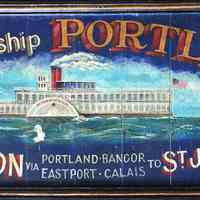
The Steamship Portland | Sign
Sign A large late 19th century painted wooden advertising sign for the Steamship Portland that made regularly scheduled runs between Boston, Massachusetts and Saint John, New Brunswick with stops in between to Portland, Bangor, Calais and Eastport, Maine. The sign measures 47 inches in length by 15 inches in width and is constructed of vertical tongue and groove wood boards with an outer edge frame wood moulding. The Steamship Portland was built in 1889 as a wooden-hulled side-wheel steamship by the New England Shipbuilding Company of Bath, Maine for the Portland Steam Packet Company of Portland. The steamship was 291 feet in length by 42 feet in breadth. It had a passenger capacity of up to 800 with a crew of 65. On November 27, 1898, the steamship was lost some 40 miles off of Boston on the Stellwagen Bank in a storm-of-the-century. All lives were lost including 63 crew members and 129 or 130 passengers. This storm become known as the Portland Gale in honor of the steamship. The steamship is often called "The Titanic of New England" due to its long-unknown location, the large loss of life, and its luxurious design. Not until over a century later, in 2002, was the wreck of the steamship located. Since then, numerous underwater explorations have been undertaken to document the well preserved steamship and the steamship is now protected as part of the Stellwegan Bank National Marine Sanctuary and is listed on the National Register of Historic Places. The Tides Institute acquired the sign at auction in Boston. There is a similar sign for the Steamship Portland in the collections of the Maine Historical Society.
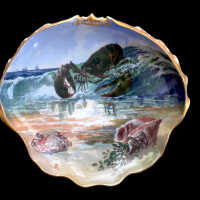
Theodore Russell Davis (1840–1894) | Seafood plate, from the Rutherford B. Hayes Presidential Service | 1880 | | View of Front Side
A Seafood Plate from the Rutherford B. Hayes Presidential Service, 1879–1880, with a design on the front that could well be a Maine coastal scene complete with lobster and crab. The plate was a gift to the Tides Institute. The plate is made of porcelain with enamels and gilding. It is part of very large and remarkable specially commissioned porcelain state dinner service set that was made for the White House by Haviland Company of New York City and Limoges of France. Originally, the First Lady and wife of President Hayes had intended to have floral patterns, drawn from plants in the White House conservatory, serve as designs on the porcelain service pieces. But a chance meeting in the conservatory between her and Theodore Davis, an illustrator and journalist for Harper’s Weekly, changed matters. Davis suggested that the First Lady use depictions of flora and fauna native to North America, thus celebrating the naturalistic bounty of the country. The First Lady agreed. She commissioned Davis as the designer and he produced 130 distinct decorations for the 562 pieces made for nine courses. Each decoration was drawn by hand, etchings were made to transfer the outlines, basic colors were applied via chromolithographic and decalcomania processes, and lastly enamel details and gilding were added by hand. Theodore Russell Davis Seafood plate, from the Rutherford B. Hayes Presidential Service, 1880 Porcelain with enamels and gilding 3 4/5 × 22 9/10 in | 9.7 × 58.2 cm Old Accession Number: 1626 Credit / Gift Of: Christopher Monkhouse Classification: Ceramics Description: Seafood Plate and Ice Cream Dish from the Rutherford B. Hayes Presidential Service, 1879–1880 Porcelain with enamels and gilding Gift of Christopher Monkhouse 2003.111; Gift of Daphne Farago 82.022 A chance meeting between the wife of President Rutherford B. Hayes and Theodore Davis, an illustrator and journalist for Harper’s Weekly, in the White House conservatory produced one of the most extraordinary dinner services. The First Lady was selecting botanical samples to be used for the decoration of the presidential service, which had already been contracted with Haviland. On the spot, Davis suggested that Mrs. Hayes use depictions of flora and fauna native to North America, thus celebrating the naturalistic bounty of the country. Mrs. Hayes was in favor of the idea and Davis became the designer of the service, producing 130 distinct decorations for the 562 pieces made for nine courses. Each decoration was drawn by hand, etchings were made to transfer the outlines, basic colors were applied via chromolithographic and decalcomania processes, and finally enamel details and gilding were added by hand.
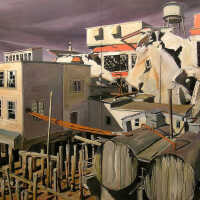
Tim Gaydos (1941- ) | American Can Plant, Lubec, Maine | c.1990
A very large (60” x 96”) acrylic on board painting of the American Can plant in Lubec, Maine by artist Tim Gaydos. It is one of a number of paintings that Gaydos did of this can plant, but this one is by far his largest and most dramatic one. The can plant was established in Lubec in 1908 by the American Can Company of New Jersey. It was one of two can plants that the company established in this region that year to provide manufactured cans for the thriving sardine industry here. The other was in Eastport, Maine. Prior to 1908, cans were made in the individual sardine factories in the region. The can plant in Lubec operated until 1972 and was torn down in 1995. This painting dates to just before the can plant was torn down. The institute, on first seeing the painting, felt that it was not only a great painting, but was emblematic of the rise and decline of the sardine industry in this region. There is now very little physical evidence here of this once large industry. The institute felt that the painting was too important to not be in the institute’s collection and institute was able to reach an agreement with the artist to secure the painting. Born and raised in New York City, Gaydos long lived in Patterson, New Jersey and summered for many years in Lubec where he maintained a home. While he painted many landscape and streetscape scenes throughout this region, Gaydos also did a number of paintings of remaining industrial buildings and he is one of the very few artists who have done this. The institute also has a painting by Gaydos of Jackson’s Wharf at Wilson’s Beach on Campobello Island, New Brunswick done before this landmark wharf complex was torn down. Artist: Tim Gaydos Medium: Acrylic on board Classification: Paintings Old Accession Number: 62
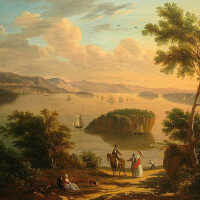
Victor De Grailly (1804-1887) | View of Passamaquoddy Bay | c.1845
An oil painting, “Eastport and Passamaquoddy Bay,” by Victor de Grailly. It dates to about 1845. De Grailly was a French landscape artist who studied under Jean-Victor Bertin and exhibited in Paris. The painting was based on an engraving of a very similar scene in the book, American Scenery, published in London in 1840 by George Virtue, and that contains a large number of engravings of scenes across the United States based on drawings by William Henry Bartlett. It is doubtful that de Grailly ever came to the United States to paint the scene first hand. The painting captures a view of the U.S. / Canada coastal border country of Passamaquoddy Bay as seen from Lubec, Maine looking north to Pope’s Folly island with the then town of Eastport, Maine in the distance. Several well-dressed people are shown along the shore in the foreground of the painting with numerous ships under sailing in the bay beyond. This was one of the first works of art acquired by the Tides Institute and the institute did so, in part, to make a statement of its aims and ambitions. It was purchased from C.L. Prickett of Yardley, Pennsylvania in 2003. De Grailly evidently had success with the painting that he made several copies, one of which was acquired by the White House in Washington, D.C. during the administration of President Gerald Ford. Artist: Victor De Grailly Medium: Oil on canvas Classification: Paintings Circa: 1840 Old Accession Number: 72
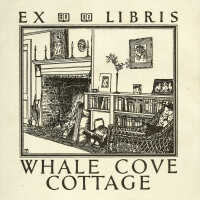
Willa Cather (1873-1947) | Ex Libris, Whale Cove Cottage | Bookplate |
An original “Ex Libris” bookplate for Whale Cove Cottage on Grand Manan Island in New Brunswick. This was the cottage that noted American writer, Willa Cather, and her companion, Edith Lewis, had built for themselves in 1927 by local carpenters. The bookplate contains an interior view of their comfortable and cozy looking cottage complete with fireplace, shelf clock sitting above on the fireplace mantle, a low bookcase to one side of the fireplace full of books and a comfortable wicker chair beside the fireplace and bookcase for sitting in. The bookplate is adhered to the inside cover of a book in the collections of the Tides Institute and it may have come from the personal library of Willa Cather and perhaps was one of the books in the bookcase shown in the bookplate scene of the cottage. Willa Cather first came to Grand Manan with Edith Lewis in 1922 and rented “Orchardside,” one of the Whale Cove Cottages that still exist today, as does their own cottage that they later had built nearby. Cather was working on her novel, “A Lost Lady,” when she spent that first summer on Grand Manan. She and Lewis would return to Grand Manan each of the following summers for nearly 20 years. Cather wrote only one story clearly set on Grand Manan. This is the story, “Before Breakfast,” found within a book collection of her stories, “The Old Beauty and Others,” published after her death in 1948 in which she describes in detail her Whale Cove Cottage and surrounding trails. But clearly Whale Cove Cottage and Grand Manan provided Cather with the time and space to work and write on her other novels over those nearly 20 years. She spent her last summer on Grand Manan in 1940 as she was finishing up her last novel, “Sapphira and the Slave Girl,” published in the fall of that year. She died in 1947. Photo Caption: An original “Ex Libris” bookplate for Whale Cove Cottage on Grand Manan Island in New Brunswick. This was the cottage that American writer, Willa Cather, and her companion, Edith Lewis, had built for themselves in 1927. Inside front cover of the book, Admirals All and Other Verses by Henry Newbolt (London: Elkin Mathews, 1907) Willa Cather Cottage on Grand Manan, New Brunswick. Old Accession Number: 1621
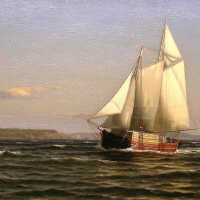
William Edward Norton (1843-1916) | Lumber ship off West Quoddy Head, Lubec, Maine | 1875
A large oil on canvas painting of a lumber ship off West Quoddy Head Lighthouse in Lubec, Maine that dates to 1875. It is the work of American artist, William Edward Norton (1843-1916) of Boston. As a young artist, Norton studied with George Inness. The 1870s marked an increase in the number of tourists as well as artists visiting this region and Norton was a part of this influx. It may well be that the scene in this painting is one Norton saw while arriving to this area by steamship from Boston. Norton also painted on neighboring Grand Manan island in New Brunswick. Soon after this time, Norton went to Europe to continue his career. On his return to the United States in 1901, he settled in New York City where he lived for the rest of his life. Norton's lumber ship off West Quoddy Head Lighthouse painting became part of the collections of the Tides Institute in an unexpected way. The institute received a call from one of its supporters about 15 years ago and the supporter said he was standing in front of a painting at the Roger King art gallery in Newport, Rhode Island. He went on to describe the lumber ship off West Quoddy Head Lighthouse painting and asked whether it would be of interest to the institute. The institute told the supporter that the painting would very much be of interest to the institute. The supporter then said that the painting was for sale for $15,000. In response, the institute told the supporter that it could not afford this price given its very limited acquisition budget. That was the end of the telephone conversation. Several weeks later a crate arrived at the front door of the Tides Institute and when the crate was opened up, there was the painting, a gift from the supporter to the institute. It has been in the institute's collections ever since. Artist: William Edward Norton Medium: Oil on canvas Classification: Paintings Circa: 1875 Gift of Markley Boyer, Sr. Old Accession Number: 71
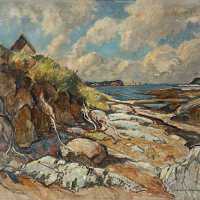
William Lester Stevens (1888-1969) | North Head, Grand Manan, New Brunswick | c.1960
A large oil on board painting (32” high x 35.75” wide) of North Head, Grand Manan, New Brunswick by American painter, William Lester Stevens. It dates to about 1960. The Tides Institute raised the necessary funds to acquire the painting in 2014 from the Altermann Galleries of Santa Fe, New Mexico. Stevens was born in Rockport, Massachusetts in 1888 and first studied painting with the marine painter, Parker Perkins, of Rockport. Later he studied at the School of the Museum of Fine Arts in Boston. During the First World War, Stevens joined the U.S. Army and was sent to Europe where after the war he was able to study master works of art in the museums of Europe. Returning to the U.S., Stevens had a one man show of his works at the Boston Art Club and had one of his paintings selected for the Corcoran Gallery’s annual exhibition of contemporary American art. Stevens then returned to Rockport and in 1921 helped found, along with many other artists, the Rockport Art Association. During the summers he taught at Rockport and also at Boston University and Princeton. In 1934, he left Rockport and moved to Springfield, and then to Conway, Massachusetts where he lived and painted for the rest of his life. During the summer months he made trips to Vinalhaven and then to Lubec in Maine as well as Campobello Island and Grand Manan Island in New Brunswick. Stevens ran an art school for awhile on Grand Manan. He died in 1969. William Lester Stevens, "North Head" oil on board. Signed lower right "W. Lester Stevens N.A. A.W.S". Inscribed en verso "North Head Grand Manan W Lester Stevens N.A.". Board: 32"H x 35.75"W; Frame: 41.25"H x 45.5"W. Purchased in 2014 from Altermann Galleries of Santa Fe, New Mexico.
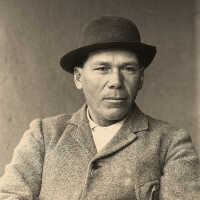
William Lyman Underwood (1864-1929) | Joe Mell, Passamaquoddy Guide at Duck Lake, Maine | c.1895
A photograph portrait by Boston based photographer, William Lyman Underwood, of the well known Passamaquoddy guide, Joe Mell. It dates to about 1895 and was taken in northern Washington County, Maine where Mell used to guide Underwood on his annual hunting and fishing trips to the area for about 30 years. This photograph of Joe Mell is one of 13 photographs in the Tides Institute’s collections taken by Underwood during his trips to northern Washington County in the early 1890s. The photographs were obtained over several years from a collector in California. Underwood was born in Belmont, Massachusetts in 1864 into the wealthy Underwood family that had founded the William Underwood Company, an American canned food company, in 1822. William Lyman Underwood and his brother Loring were at the forefront of nineteenth-century nature photography. Loring trained his camera on human designed parks and gardens, while William concentrated on the wilds of the northeastern U.S. Their work is described in the book Gentlemen Photographers: The Work of Loring Underwood and Wm. Lyman Underwood published in 1987. Joe Mell, whose mother was French and father was Passamaquoddy, became a popular guide around the wilderness forests and lakes of northern Washington County. Mell was extremely well-versed in the ways of the Passamaquoddy. In 1927, William Underwood published the book, Wilderness Adventures, that describes his experiences with Joe Mell. Underwood died in 1929. Photo caption: Portrait photograph of Passamaquoddy guide, Joe Mell, by photographer, William Lyman Underwood that dates to about 1895. Artist: William Lyman Underwood Medium: Photograph Circa: 1896 Old Accession Number: 604 Description: Joe Mell, Passamaquoddy Guide at Duck Lake
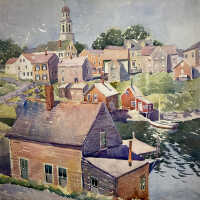
William Starkweather (1879-1969) | Eastport, Maine | c.1920
Gift of Peter and Barbara Falotico, 2020.
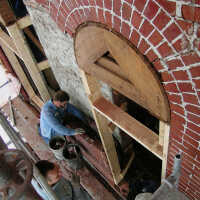
Wooden Window Arch Form | Eastport Savings Bank Building, Eastport, Maine 1887
One of a series of six original late 19th century wooden window arch forms used in the construction of theTides Institute’s main building in downtown Eastport, Maine. The were used when the building was built in 1887 as the Eastport Savings Bank. The six forms were discovered in the fourth floor attic space of the building shortly after the Tides Institute purchased the building in 2002. The building was designed by architect, Henry N. Black, of Boston and Saint John, New Brunswick and was constructed by B. Mooney & Sons, brick masons, of Saint John, New Brunswick. It is very unusual to have such 19th century window arch forms survive as typically they are thrown away as soon as a building has been built using them. Earle Shettleworth, Jr., long the director of the Maine Historic Preservation Commission, when told about the forms, reported that he he had never seen such 19th century window arch forms survive anywhere else in Maine. These original forms were reused during the reconstruction of the Tides Institute’s main building in 2005 by G. Drake Masonry of Dixmont, Maine The Tides Institute main building is part of a 30 building Eastport downtown National Register Historic District established in 1982. Most of the buildings in the district date to 1887 following a devastating great fire of October 14, 1886 that leveled the Eastport downtown and waterfront. Two thirds of the buildings in the district were designed by architect, Henry Black. Photo caption: Two of the six original wooden window arch forms used in the construction of theTides Institute’s main building in downtown Eastport, Maine in 1887. The forms were reused during the reconstruction of the building in 2005 by G. Drake Masonry. The forms were discovered in the attic of the Tides Institute's main building with the building was purchased in 2002.