


Browse and search a portion of the collections of the Tides Institute & Museum of Art available online (now consisting of over 8,000 online records in process of completion). The Online Collections are best viewed using Google Chrome or Mozilla Firefox. Search Hints: To search by phrase or multiple word names wrap your criteria in quotes. Example: “Martin Johnson Heade” or “Grand Manan”. For an overview of the collections, see: Collections Overview.
Exhibition, 2026—Generations of Tradition: Recent Acquisitions of Work by Women Artists
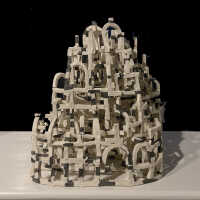
Anna Hepler (1969- ) | The Castle | Ceramic Sculpture | 2016
A black and white ceramic sculpture, The Castle, by artist, Anna Hepler. It stands about 14 1/2 inches high by 13 inches in diameter and dates to 2016. Hepler was born in Boston, Massachusetts 1969. She earned a B.A. degree from Oberlin College In Ohio in 1992 and an MFA degree from the University of Wisconsin at Madison in 1994. She moved to Portland, Maine in 2001 and soon afterwards to the opposite end of Maine’s coast to Eastport where she remained until 2018. She then moved to Greenfield, Massachusetts where she is currently based. A statement about her work includes: “At the heart of Hepler’s work is the thrill of making things and the excitement of training her mind and hand to manipulate unfamiliar materials. It is from this energetic center that her work radiates in many media, shapes and sizes. Hepler seeks forms in conflict – inflatable forms that breathe and are in constant motion, or latticed volumes that collapse perceptually in space. Quiet and intuitive, these restless sculptures are the molecular structure or alphabet with which she composes a visual vocabulary.” She has exhibited widely and held numerous artist residencies. Her solo exhibitions include Portland Museum of Art (Maine), the Roswell Museum of Art (New Mexico) and the Suyama Space (Seattle). In 2016, she created a large scale art installation called Undertow within the Tides Institute’s North Church project space. That same year she was awarded a fellowship by United States Artists. This sculpture was a gift of the artist to the Tides Institute in 2022.
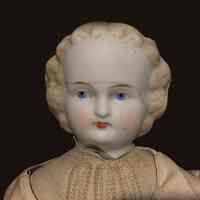
Bisque Porcelain Doll | c.1880s
THREE GENERATIONS PORCELAIN DOLL, 1880s! A family handed down bisque porcelain doll, likely made in Germany or France, that recently came into our collections. It was a childhood doll that belonged to the donor's grandmother, Helen Prince Wadsworth Raye (1880-1968), of Eastport, Maine and dates to the early 1880s. The doll's current dress was made from the grandmother's wedding dress and was likely made by the grandmother later in her life. When her grand-daughter, the donor, was a young child, the grandmother gave her the doll. The donor's first name is the same as her grandmother's and she was likely named for her. Gift of Helen Raye of Buffalo, New York, 2024.
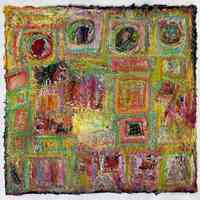
Charlotte "Baychar" Morris (1949-2024) | Baychar 2 |
30" x 30 1/2" Gift from the Estate of Charlotte "Baychar" Morris (1949-2024), 2025.
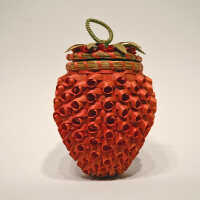
Clara Keezer (1930-2016) | Small Strawberry Basket [Passamaquoddy] |
A Passamaquoddy strawberry splint ash and sweetgrass basket by master basketmaker, Clara Neptune Keezer. The basket stands five and a half inches high and three and a half inches wide. Keezer was born in Sipayik, Maine in 1930. She came from a long line of basketmakers before her, learning how to make baskets from her grandmother and her mother. She made her first basket at age eight. At this time, basketmaking was in decline among the Passamaquoddy, Penobscot and other tribes of Maine and Keezer became involved in revitalizing this craft tradition using traditional basketmaking materials of splint brown ash and sweetgrass. One particular traditional basket form she excelled at was the strawberry basket that she took to a new more elegant form and intricate level. She also made blueberry and corn shaped baskets as well as a basket in the shape of a bell. Her baskets soon began to be exhibited elsewhere including in the influential Lost and Found Traditions: Native American Art 1965-85 exhibit that opened at the American Museum of Natural History in New York City in 1986. Ralph T. Coe, the curator of the exhibit, had spent the decade before traveling across the United States, seeking out examples of indigenous art and craft that were undergoing revival and reinvention. Of Clara Keezer, he said, she "is the finest splint craftswoman I met in the Northeast.” Sixteen years later, in 2002, Keezer was recognized as a National Heritage Fellow for her basketmaking talents by the National Endowment for the Arts. She continued basketweaving and teaching young people basketmaking techniques until her death in 2016 at the age of 86. The Tides Institute acquired the strawberry basket through eBay auction. Artist: Clara Keezer Classification: North American Basket Old Accession Number: 625 Description: Passamaquoddy. Small red color strawberry basket. Top Shelf.
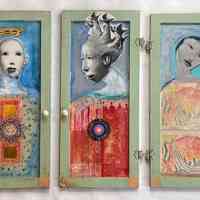
Elizabeth Ostrander (1943?- ) | Painted Kitchen Cabinet Doors | Eastport, Maine
Gift of the Family of Elizabeth Ostrander, 2025. The kitchen cabinet doors were painted by artist, Elizabeth Ostrander, and are from from the house where she lived until 2024 on outer Clark Street in Eastport, Maine.
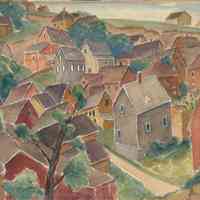
Josephine Reichmann (1864-1938) | East Port, Maine [Eastport, Maine] | c.1920
Watercolor. 17" x 18".
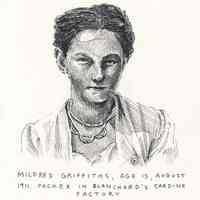
Maeve McCool | Mildred Griffiths, Age 13, August, 1911, Packer in Blanchard's Sardine Factory | Drawing, 2023
Drawing by artist Maeve McCool. McCool was a StudioWorks Artist-in-Residence at the Tides Institute & Museum of Art in 2023. McCool Scan 11
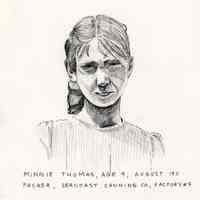
Maeve McCool | Minnie Thomas, Age 9, August, 1911, Packer, Seacoast Canning Co., Factory #7 | Drawing, 2023
Drawing by artist Maeve McCool. McCool was a StudioWorks Artist-in-Residence at the Tides Institute & Museum of Art in 2023. McCool Scan 17
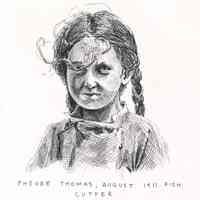
Maeve McCool | Phoebe Thomas, August, 1911, Fish Cutter | Drawing, 2023
Drawing by artist Maeve McCool. McCool was a StudioWorks Artist-in-Residence at the Tides Institute & Museum of Art in 2023. McCool Scan 18
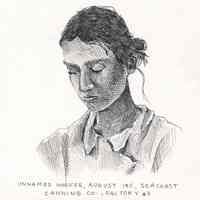
Maeve McCool | Unnamed Worker, August, 1911, Seacoast Canning Co., Factory #7 | Drawing, 2023
Drawing by artist Maeve McCool. McCool was a StudioWorks Artist-in-Residence at the Tides Institute & Museum of Art in 2023. McCool Scan 9
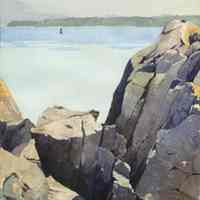
Margaret La Farge | Grand Manan Channel | Watercolor | 2007
Watercolor. 2007. 10 1/4" x 10 5/8". Gift of estate of Christopher Monkhouse of Brunswick, Maine, 2021.
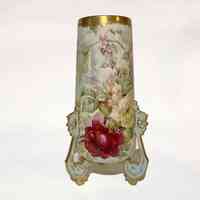
Martha "Mattie" Waide (1857-1929) | Hand Painted China Vase | Eastport, Maine
Martha "Mattie" Waide (1857-1929) Gift of Eleanor Norton, Eastport, Maine.
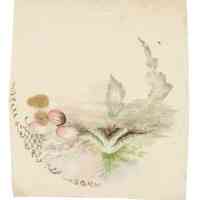
Martha "Mattie" Waide (1857-1929) | Watercolor for Hand Painted China Covered Sardine Box with Tray | Eastport, Maine
Gift of Ken Schiano and Paula Beall
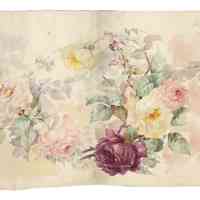
Martha "Mattie" Waide (1857-1929) | Watercolor for Hand Painted China Vase | Eastport, Maine
Gift of Ken Schiano and Paula Beall
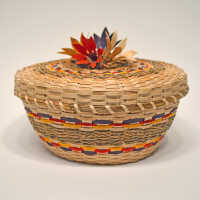
Molly Neptune Parker (1939-2020) | Medium Size Fancy Basket [Passamaquoddy]
A colorful Passamaquoddy fancy basket (7 1/2” wide x 5 1/2 high”) made by Passamaquoddy master basketmaker, Molly Neptune Parker. She wove the basket together using thin strips of split ash and strands of braided sweetgrass adding a series of carved flowers to the top that was a signature characteristic of her baskets as its was her mother’s who was also a basketmaker. This basket is one of three baskets, including an acorn shaped basket, made by Parker in the collections of the Tides Institute. Parker specialized in making fancy baskets, a style of decorative basket developed by the Passamaquoddies and other Native Americans in the latter part of the 19th century to sell to European-American tourists who begin to visit the area in increasing numbers at the same time. Parker was born in 1939 in Motahkomikuk/Indian Township in northern Washington County, Maine. She made a great many baskets over her life, among other forms some were in the shape of strawberries, others in the shape of acorns that she was particularly known for. To make a fancy basket might take five days from start to finish. In 2012, the National Endowment for the Arts named Parker a National Heritage Fellow. She was also a founder and president of the Maine Indian Basketmakers Alliance that sought to preserve, revive and extend the basketmaking craft. She taught basketmaking workshops in the area and sold her work locally as well as across the United States. She died in 2020. Artist: Molly Neptune Parker Classification: North American Basket Circa: 2008 Old Accession Number: 1518 Description: Passamaquoddy. Medium size fancy basket.
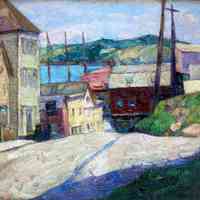
Nellie Augusta Knopf (1875-1962) | Street Scene, Eastport, Maine | Oil on Canvas | 1928
Street Scene, 1928 Oil on canvas, framed Signed and dated l.r., 16" x 18" actual, 24 1/4" x 26 3/8" framed
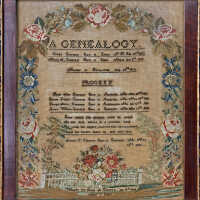
Sarah Ann Cheney | Sampler | 1846
A large (24” x 20 1/2”) mid-19th century needlework sampler by Sarah Ann Cheney of Eastport, Maine that she did when she was 11 years old. The sampler dates to 1846. The sampler is silk on Penelope weave linen and features cross and straight stitches. It is in remarkable condition for its age. Within the sampler, Sarah included information about her parents and their children, even adding her baby brother below the verse years after she had finished the piece. The sampler was part of an exhibition of early to mid-19th century federal period Maine needlework samplers held at the Saco Museum in Maine in 2013. The curator of the exhibition, Leslie Rounds, wrote in the accompanying exhibition catalogue: “Sarah Cheney's sampler is the ‘newest’ of all the samplers in the exhibition and shows many signs of the new styles of needlework that were emerging at the time. However, it also continues to demonstrate stylistic elements that clearly tie it to the earlier works in the exhibition, with its lavish rose border and family register format that appears to be a near-copy of many Portland samplers. She was mimicking the Berlin work that was quickly becoming the needle arts rage of the era. Sarah was the eldest of the five children of George Cheney and his wife, Mary. On the 1850s census, George was listed as a “trader” and the family was residing in Eastport. On July 20, 1858, Sarah married George Kilborn in Boston, Massachusetts. The Kilborns seem to have lived in Boston for the rest of their lives.” The Tides Institute acquired this sampler earlier in 2022 from a dealer in Connecticut that specialized in antique needlework samplers.
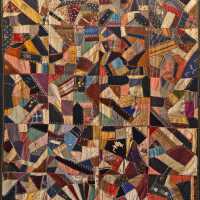
Sarah Preble Livermore (1867-1961) | Crazy Quilt | Eastport, Maine | c.1890s
Gift from estate of Frances Whalen Strout, 2020. From Anna Whalen House, 7 Key Street, Eastport, Maine. A late 19th century “crazy quilt” from this region that came into our collections in 2020.. It dates to the 1890s and had come down through the Livermore and Whalen families of Eastport, Maine before it was donated to us by descendants of the family. The quilt measures 63” high and 51” inches wide and includes a piece that has a large cursive “L” with the numbers 84 and 94 on either side of the letter as well as a piece that is a ribbon for the 13th reunion of the 1st Maine Cavalry of the American Civil War. Crazy quilts hit their heyday in the 1880s to early 1890s, putting this quilt in the middle of the craze. They were usually dated, as were needle point samplers, with the dates of their completion so this quilt may have been a 10 year project, begun in 1884 and finished in 1894. The quilt most likely was made by Sarah Preble Livermore who was born in 1867 and would have been 17 when she started the quilt. The large cursive “L’ stands for Livermore and Sarah’s last name would have still been Livermore until 1892 when she married Leveret Whalen and took the Whalen last name. In addition, Sarah’s mother, Ellen Bucknam Livermore, wrote poems to Sarah about gifts she was giving her, including sewing needles. Sarah clearly took an interest in the crafts of the time as she also did some china painting as well. As for the 1st Maine Cavalry ribbon, one of Sarah’s uncles was Brevet Brigadier General Charles H. Smith, who had married Mary Livermore, and was an honored veteran of the American Civil War, having been awarded the Medal of Honor for his heroism. He entered the Civil War as a captain in the 1st Maine Cavalry regiment and later took command of the regiment. Sarah Preble Livermore Whalen Hayes (1867-1961) married Leverett Mitchell Whalen (1850-1912) in 1892 and then George Hume Hayes (1851-1935) after Leverett died. At the time the quilt was made, Sarah would have been living in the large 7 Key Street house in Eastport that had been in the Whalen family for generations. It stayed in this house after Sarah’s death as the house and quilt were inherited by Sarah’s daughter, Anna K. Whalen (1894-1986) who continued to live in the house until her death. Anna had no children and when she died, the house, quilt and other household furnishings were inherited by Anna’s niece, Frances Whalen Strout (1933-2020). Frances sold the house and moved the quilt and most of the household furnishings to her ranch style home with attached garage in Brewer, Maine. She converted her garage into a 19th century parlor room filled with the furnishings from her aunt’s Eastport house including the quilt. Frances had no children and when she died the quilt along with many with many other of the family furnishing were placed with the Tides Institute in 2020.
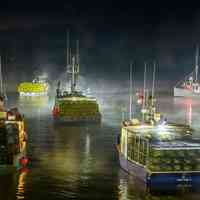
Susan Lapides | Setting Day | Back Bay, New Brunswick
Gift of the artist, 2025. From an email from Susan Lapides Mon, Aug 4, 2025, 1:46 PM Here’s what I wrote about my photograph “Setting Day” — Setting Day was photographed at the Back Bay, New Brunswick wharf on the opening day of lobster season. In New Brunswick, there are two lobster fishing seasons, and this image captures the start of the spring season, when boats set out at 6 AM after a horn blast, racing to drop their traps in waters they know by heart. Each boat is loaded in advance with carefully rigged traps, ropes, and buoys. In the predawn darkness, families gather on the wharf to say goodbye—sharing hugs and quiet prayers. Lobstering can be dangerous work, especially on Setting Day, and this moment is filled with both tradition and tension as the crews head out to sea. From an email from Susan Lapides Wed, Oct 8, 2025, 7:17 PM Setting Day 2021 6 a.m. on a chilly November morning. The horn sounds—the biannual lobster season begins. Boats surge from the Back Bay wharf in St. George, New Brunswick, racing into the Bay of Fundy, where the tides rise and fall 26 feet. Fishermen drop their traps, each outfitted with ropes of measured length and an identification buoy, noting the spot by GPS before moving to the next. Hours earlier, the wharf was alive with grandparents, parents, and children—laughing, talking, and gathering for one last hug and prayer for safety and a successful season. Setting Day carries both tradition and tension, marking the start of another season, like generations before them.
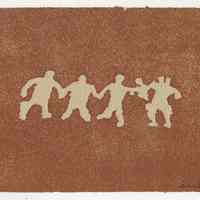
We Are Still Dancing ... | Stephanie Francis | 2008
On back of print: "We Are Still Dancing ..." The image of this print was made by Stehanie Francis and printed on hemp and sweetgrass paper made by Bernie Vinzani with help from Donald and Dakota Soctomah, Patty Vinzani, and Michelle Amato. From: https://pmportal.org/credits "Opening Portal Art Work: "We Are Still Dancing" by Stephanie Francis. The image is taken from a collection of petroglyphs—one of the oldest existing forms of graphic Peskotomuhkati communication. It was created by Stephanie Francis and printed on sweetgrass and hemp paper made by Bernie Vinzani with help from Donald and Dakota Soctomah, Patty Vinzani, and Michelle Amato."