


Browse and search a portion of the collections of the Tides Institute & Museum of Art available online (now consisting of over 8,000 online records in process of completion). The Online Collections are best viewed using Google Chrome or Mozilla Firefox. Search Hints: To search by phrase or multiple word names wrap your criteria in quotes. Example: “Martin Johnson Heade” or “Grand Manan”. For an overview of the collections, see: Collections Overview.
Early 19th Century
This folder attempts to pull together items in the collections of the Tides Institute & Museum of Art that relate to the first half of the 19th century along the eastern coast of Maine and into neighboring Canada.
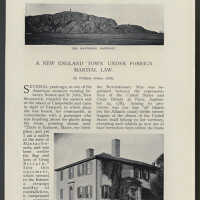
"A New England Town Under Foreign Martial Law" | William Henry Kilby | The New England Magazine, New Series, Vol. XIV, No. 6, August, 1896, pp. 685 - 698.
The New England Magazine, New Series, Vol. XIV, No. 6, August, 1896, pp. 685 - 698.
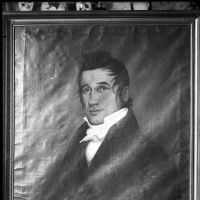
036-CEB-03~7.TIF | Capt. John Swett (1780-1832), Eastport, Maine | Charles E. Brown (1863-1945), Photographer, Glass Plate Negative
From webpage, September 17, 20026: https://www.genealogy.com/ftm/s/w/e/Donald-K-Swett/GENE1-0045.html 248.CAPTAIN JOHN7 SWETT (ENOCH6, ENOCH5, BENJAMIN4, JOHN3, STEPHEN2, JOHN1) was born August 21, 1781 in Newburyport, Massachusetts, and died September 10, 1832 in Eastport, Maine.He married MARY PERKINS WOOD February 05, 1805 in Eastport, Maine.She was born 1786, and died 1833. Notes for CAPTAIN JOHN SWETT: Lt. John was in the Washington Artillery Company in the War of 1812. Later he made Captain and was a selectman and town clerk More About CAPTAIN JOHN SWETT: Christening: August 26, 1781, Newburyport, Massachusetts Notes for MARY PERKINS WOOD: Mary was the descendant of Thomas Wood of Rowley, MA (1654) and Isaac Perkins of Hampton, NH (1640). More About JOHN SWETT and MARY WOOD: Marriage: February 05, 1805, Eastport, Maine Children of JOHN SWETT and MARY WOOD are: i. JOHN LEAVITT8 SWETT, b. August 14, 1806, Eastport, Maine; d. October 02, 1834. ii. FREDERICH WILLIAM SWETT, b. April 19, 1808, Eastport, Maine; d. August 09, 1816. iii. JAMES ALBERT SWETT, b. December 28, 1809, Eastport, Maine; d. Unknown. iv. LEMUEL TRESCOTT SWETT, b. Abt. 1811, Newburyport, Massachusetts; d. October 19, 1870, Eastport, Maine. v. ANDREW JACKSON SWETT, b. October 14, 1814, Eastport, Maine; d. September 18, 1834, Baltimore, Maryland. 427. vi. FREDERICK AUGUSTUS SWETT, b. October 16, 1816, Eastport, Maine; d. Unknown. 428. vii. MARY JANE SWETT, b. November 01, 1818, Eastport, Maine; d. Unknown. 429. viii. ELIZABETH W. SWETT, b. May 13, 1820, Richmond, Sagadahoc, Maine; d. Unknown. 430. ix. NATHANIEL FOSDICK SWETT, b. April 02, 1822, Eastport, Maine; d. April 25, 1866, Alton, Illinois. x. ABIGAIL PUTNAM SWETT, b. January 11, 1825, Eastport, Maine; d. Unknown.
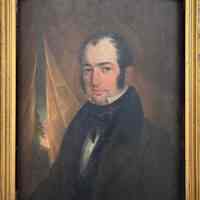
Artist Unknown | Portrait of Dr. Cyrus Hamlin (1802-1839) | Dennysville and Calais, Maine | c.1830
PORTRAIT OF CALAIS & DENNYSVILLE DOCTOR, C.1830! Framed portrait of Dr Cyrus Hamlin that recently came into our collections. The oil on board portrait measures 27 1/2” x 33 1/2” including frame. Cyrus Hamlin was the brother of Lincoln’s vice president, Hannibal Hamlin. Born in Livermore, Maine in 1802, Cyrus Hamlin graduated from Bowdoin College’ medical school in 1828. He then moved to Dennysville, Maine where he practiced medicine for three years. Transferring next to Calais, Maine, he set up his practice on Main Street in the house that now serves as the St. Croix Historical Society’s museum. Cyrus Hamlin died in 1839. https://www.ebay.com/itm/334631946250: Calais ME C1830 Doctor Painting Dr Cyrus Hamlin Brother of Hannibal Hamlin VP Condition: UsedUsed “USED ESTATE CONDITION: see below for details.” Ended: Nov 17, 2022 13:41:24 PST Found here in Maine at a small estate sale and coming directly from heirs of Hannibal Hamlin who was Abraham Lincoln first vice president, is this circa 1830 portrait painting. The painting is identified in pencil on the back as "Cyrus Hamlin, brother of Hannibal, lived at Calais". Further notation states that " this portrait belongs to Cyrus Hamlin great, great grandson of Hannibal by direction of Louise Hamlin & loaned to J.C. Moore & V. H. Moore" . Coming from Hamlin heirs with pencil inscription on the back, seems like pretty solid identification. Cyrus Hamlin was born at Livermore ME in 1802 and died in 1839. His parents were Dr. Cyrus Hamlin ( same name ) and Anna Nancy Livermore Hamlin. His brother Hannibal (Lincoln's VP) was born in 1809 in Paris ME. Cyrus completed Medical School at Bowdoin College in 1828 and then moved to Dennysville and set up a medical practice there . After 3 years at Dennnysville, he transferred his practice to Calais working out of the house that is now the St.Croix Historical Society. There is a short more complete account of Cyrus Hamlin's downeast life in the blog at fineartistmade.com Part 1 of Dr. Holmes Cottage Museum written June 8, 2012. There is no signature on this painting which was done on wood panel. It measures 27.5" x 33.5" [framed]. It is in original untouched condition, perhaps needing professional cleaning. Both vertical edges are now slightly bowed and also could use professional attention. It has a lemon gold frame which is solid and sturdy but with spots of wear. Information footnote: The portrait that is on the St. Croix Historical Society website showing a Dr. Cyrus Hamlin is actually a portrait of the father Dr. Cyrus Hamlin and not the Dr. Cyrus Hamlin who practiced medicine in Calais. Hamlin Memorial Library & Museum located in Paris ME, which owns the painting shown on the SCHS website, details and verifies this fact. Local pickup only on this painting; no shipping. Ebay is now charging sales tax in most states.
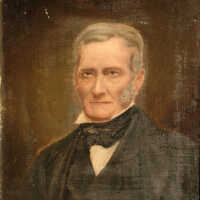
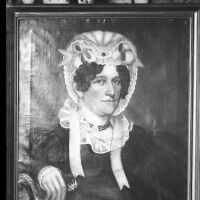
Artist Unknown | Portrait of Henry Tilton Emery, Eastport, Maine (1783-1865) |
Artist: Artist Unknown Medium: Oil on canvas Classification: Paintings Gift of Joyce Emery Kinney Old Accession Number: 118 Henry T. Emery captained the schooner Ripley for Audubon on Audubon's trip to Labrador.
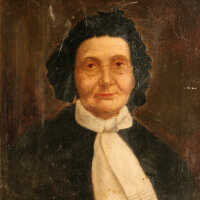
Artist Unknown | Portrait of Wife of Henry Tilton Emery (likely Mary Stover Emery), Eastport, Maine |
Artist: Artist Unknown Medium: Oil on canvas Classification: Paintings Gift of Joyce Emery Kinney Old Accession Number: 119
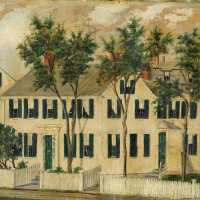

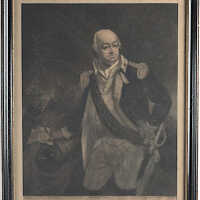
Benjamin Lincoln
Artist John Rubens Smith, 1775 - 1849 Copy after Henry Sargent, 1770 - 1845 Printer Enos Jacques Sitter Benjamin Lincoln, 24 Jan 1733 - 9 May 1810 Date 1811 Type Print Medium Mezzotint on paper Dimensions Image: 45 x 35 cm (17 11/16 x 13 3/4") Dennysville, Maine.
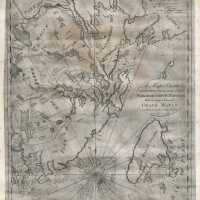
Benjamin R. Jones (1776-1859) | A map & chart of the bays harbours post roads and settlements in Passamaquoddy & Machias with the large island of Grand Manan
An early 19th century map of the Passamaquoddy Bay and Machias region by Benjamin R. Jones, surveyor. The full title of the map is: “A Map & Chart of the Bays Harbours Poft Roads and Settlements in Passamaquoddy & Machias With the large Island of Grand Manan. Compiled from Actual Survey by B.R. Jones, Surveyor.” The map was first published in 1810 with additions to the plate made in 1822 soon after Maine became a state. The engraving of the map was produced by T. Wightman of Boston, Massachusetts. Benjamin Jones was born in Milton, Massachusetts in 1776. His family moved to what is now Robbinston, Maine in 1788. As a young man with a wife and children, Jones moved to Eastport, Maine in 1803 to serve as town clerk, and then two years later, to Dennysville where he took a job teaching school. He began to work as a surveyor as well. Jones died in 1859. His map of Passamaquoddy and Machias is 20 1/2 inches (51 cm) high by slightly more than 16 inches (41 cm) wide. The map had been in the collections of Barracks Museum of the Border Historical Society of Eastport, Maine, but the Society voted to transfer its Museum collections to the Tides Institute in 2020 and the map is now in the institute’s collections. The institute also owns an original survey map by Jones of the south division of Trescott, Maine that Jones surveyed between 1806 and 1834. Artist: Benjamin R. Jones Medium: Engravings Classification: Maps Circa: 1822 Old Accession Number: 3025 Description: A rare original copy of "A map & chart of the bays harbours post roads and settlements in Passamaquoddy & Machias with the large island of Grand Manan” in our collections by map surveyor, Benjamin R. Jones. The engraved map was originally published in Boston in 1810 with plate editions on this copy of the map dating to 1822.
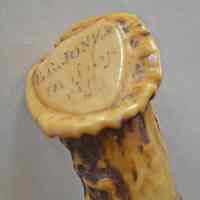
Benjamin R. Jones (1776-1859) | Walking Stick | Dennysville, Maine
Gift from estate of June Hallowell, Dennysville, Maine, 2022.
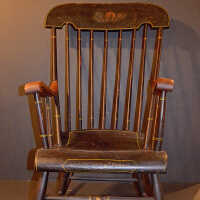
Boston Rocker, c.1820 | Eastport, Maine
Classification: Furniture Circa: 1820 Old Accession Number 2260 Description: Boston rocker. c. 1820. From Eastport, Maine house.
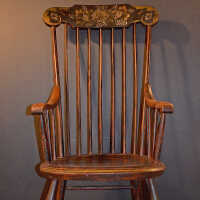
Boston Rocker, c.1830 | Eastport, Maine
Classification: Furniture Circa: 1830 Old Accession Number: 2261 Description: Boston rocker. c. 1830. From Eastport, Maine house.
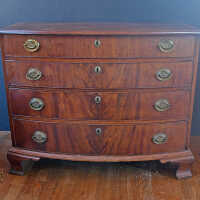
Bow Front Chest of Drawers | Indian Island, New Brunswick | C. 1810
Classification: Furniture Circa: 1810 Old Accession Number: 3004 Description: Bow Front Chest of Drawers that originally came from Indian Island, New Brunswick.
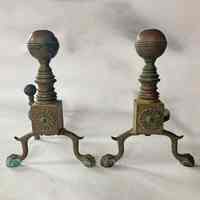
Brass Andirons | Hayden House, 17 Boynton Street, Eastport, Maine
From Hayden House, 17 Key Street, Eastport, Maine.
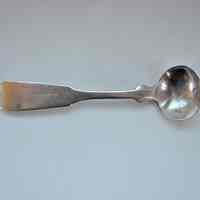
Calais Temperance House Coin Silver Mustard Spoon, c.1840.
CALAIS TEMPERANCE HOUSE, C.1840! Coin silver spoon in our collections that dates to about 1840. It was made by Boston silversmith, Newell Harding. The silversmith maker’s mark with the initials NH are on the back of the spoon as are stamped the words, Calais Temperance House. The Calais Temperance House building in Calais, Maine was built in 1835. By the late 1840s, the house had changed hands and it become known as the American House. Later still, in the early 1900s, the building became the local Masonic Hall. The building still stands on Calais Avenue in Calais.
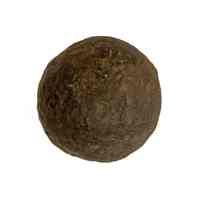
Cannon Ball, Indian Island, New Brunswick
Possible artifact donation From hartlandnavy@gmail.com on 2023-06-15 01:55 Details Headers Dear Mr French, I got your name from Mark Borton as someone who might be interested in a couple of artifacts in my possession. One is a cannon ball that I found on the beach on Indian Island below the salt box house, owned at that time by Janet Pope, who had been looking for it for some time. She told me it had been fired by an American privateer during the war of 1812, at a couple of British schooners anchored at Indian Island. The other is a trigger guard from a fowling piece that I found in a “secret” room in the center chimney cape at the top of the field, above Mrs Popes house. At the time, the house was owned by my mother and the room was formed by the three fireplaces on the first floor and was accessed by removing a panel in the back wall of the front hall closet. One suggestion was that the guard came from a weapon used in the Fenian raids and, being loose, had been hastily pulled off and left behind. I have no idea if this is a possibility , but the room was intriguing and the piece has become one of my treasured possessions, along with the cannon ball.That being said, my wife rightly pointed out that eventually these artifacts would become meaningless to future generations of our family and really should be in a museum or historical society, to which I reluctantly agreed. Mark suggested the Tides Institute as a good place for them to go, and I am hoping you would be interested in them. I will be at the Institute on July 1st, along with Mark, to celebrate the publication of his book and would be happy to bring the cannon ball and trigger guard, if you are interested. Looking forward to meeting you on the 1st. Sincerely, Dexter P. Cooper, III Sent from my iPad
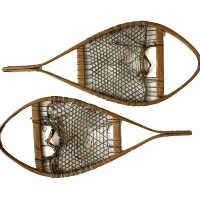
Capt. Samuel Watts | Wooden Snowshoes, c. 1810 | Roque Bluffs, Maine
A pair of handmade wooden snowshoes made over 200 years ago by Capt. Samuel Watts of Roque Bluffs, Maine for his son, Stephen Watts. They date to about 1810. Capt. Watts was born in Boston in 1745 and he died in 1816. His son was born in Jonesboro, Maine in 1803 and died in Roque Bluffs in 1876. The snowshoes are about 38 1/2” in length and 16” in width at their widest point. The hardwood used in making the frame of the snowshoes is mostly likely ash and the webbing between the frame is made from rawhide most likely from deer. Capt. Watts was a veteran of the American Revolutionary War, having taken part in the capture of the British schooner, HMS Margaretta, in nearby Machias Bay on June 11 and 12, 1775. Capt. Watts’ son in turn passed the snowshoes on to his son who wrote the following handwritten note about the snowshoes in the early 20th century: “Roque Bluffs, Maine, June 17th, 1925: These snowshoe raquetts [raquettes] were made by the Samuel Watts who took part in the taking of the Margaretta at Machias for his son Stephen J. Watts and by him given to me John N. Watts his grandson over 50 years ago and I now pass them on to my son Samuel Watts who is named for the same Samuel Watts.” A separate handwritten note by Capt. Watts’ grandson goes on to say: “These Snowshoes are over 100 years old. Presented to Samuel J. Watts by his Father, John N. Watts.” The snowshoes remained in the Watts family for nearly another 100 years and were still in Roque Bluffs when a descendant of the Watts family there decided to sell the family property and move away. The snowshoes were then acquired by the Tides Institute to keep them in the region. Photo Caption: a pair of handmade wooden snowshoes made over 200 years ago by Capt. Samuel Watts of Roque Bluffs, Maine for his son. They date to about 1810.
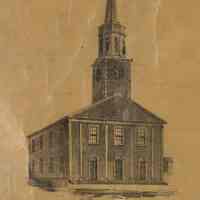
Central Congregational Church
Illustration on Map of the Town of Eastport Washington Co. Maine, From Actual Survey by D.S. Osborn, Civil Engineer; Published by E.M. Woodford, N.E. Cor. 4th & Chestnut Streets, Philadelphia, 1855. Printed by Wagner & McGuigan. Map is in collections of the Tides Institute & Museum of Art. The Central Congregational Church is located on Middle Street in Eastport, Maine. It was built in 1828 and dedicated in February, 1829. This illustrated view is the only known view of the church with its original steeple which was blown over in the Saxby Gale of 1869. The original steeple was replaced with a new steeple of different design.
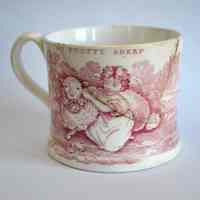
Child's Cup | c.1820
An early 19th century transfer mug that was pieced back together from a two pieces.The mug dates to about 1820. One side of the mug reads “A Pretty Sheep” while the other side reads “The Young Sportsman.” The larger part of most of the mug was unearthed in 2018 during the excavation of a six foot deep 19th century household “dump” in this region that was filled with thousands upon thousands of beautiful, but broken early 19th century ceramic and glass shards. The “dump” was on the site of a large house built in 1824 and torn down in the early 1960s. The house underwent considerable renovation in the mid-19th century. During this renovation, the existing house pantry full of ceramic and glass ware was likely cleared out and thrown in the “dump.” Some ceramic and glass shards came into the institute’s collections during this initial excavation, but much was also taken out of the region to Portland, Maine and to North Dakota. The institute sought the return of what was removed from the area. All that went to the Portland area is now back in the institute’s collections. Nearly all (including this piece), with the exception of two pieces, that went to North Dakota is now back in the institute’s collections. In 2020, another excavation of the same household “dump” was undertaken and several hundred more ceramic and glass shards were found, some of which perfectly matched shards unearthed two years before, including one piece that completed this mug. About 100 ceramic and glass pieces have been put back together, either entirely or nearly entirely.
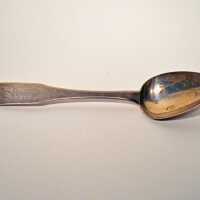
Coin Silver Spoon | Stephen Boardman | C.1815 | Eastport, Maine
Artist: Stephen Boardman Classification: Silver Circa: 1815 Old Accession Number: 1550 Description: Coin silver spoon by Stephen Boardman. c.1815. Boardman was working at Eastport, Maine at this time. Gift of Joyce Emery Kinney of Eastport, Maine. Stephen Boardman Born: 24 May 1782, Islesboro ME Marriage: Elizabeth Farrow in 1811 in Islesboro ME Died: 30 Jun 1855, Hope ME General notes: Silversmith Events in his life were: He worked c 1810 as a silversmith in Eastport ME with a shop opposite Market Wharf. He specialized in making flatware goods. 3

Daniel Low: Eastport's Ingenious Architect | Earle Shettleworth, Jr. | 2025
24 pages plus cover. Published by the Tides Institute & Museum of Art, Eastport, Maine 2025 in an edition of 500 copies.
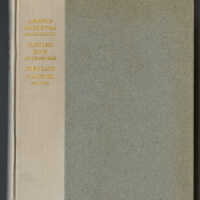
Diary of Sarah Connell Ayer, 1805 - 1835: Andover and Newburyport, Massachusetts; Concord and Bow, New Hampshire; Portland and Eastport, Maine
For about a decade, Sarah Connell Ayer lived in Eastport, Maine from about 1823 to 1833. 3 copies, one in slipcase, two without

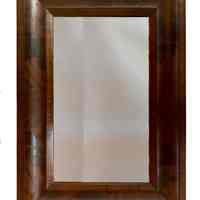
Empire Mahogany Ogee Mirror | Captain William Shackford | Eastport, Maine
Dimensions: 22 7/8" wide by 32 3/4" high.
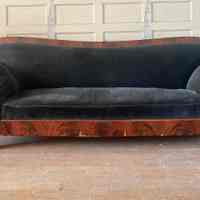
Empire Sofa, c.1830 | North Church | Eastport, Maine
Old Accession Number: 2230 From Free Will North Baptist Church, 82 High Street, Eastport, Maine. Sofa was in Free Will North Baptist Church building when it was gifted to the Tides Institute & Museum of Art in 2014.
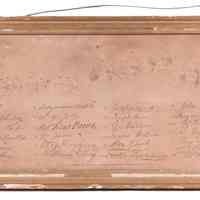
Engraving | Line Portraits of all 48 Signers of the Declaration of Independence as They Appeared on that Day, along with Their Signatures
Long unsigned engraving with line portraits of all 48 signers of the Declaration of Independence as they appeared on that day, along with their signatures, unmarked other than the line at bottom which reads "The above names, except those marked with a star; are imitations of the several signatures to the original act". Old note on back reads "Daniel Kilby, Eastport, 1823". Found in Maine. In 9" x 33" gold molded frame, under glass, toned, and stained. Acquired at Thomaston Place Auction, Thomaston, Maine, 2024/ The Daniel Kilby house stands at 15 Boynton Street, Eastport, Maine and was built in 1820.

Enoch Ilsley Bookplate | Enoch Ilsley
Artist: Enoch Ilsley Classification: Prints Circa: 1820 Old Accession Number: 1381 Description: From inside bound front cover of account book made by Enoch Ilsley, Eastport, Maine.
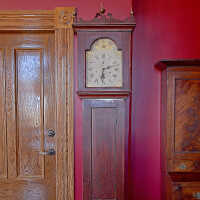
Federal Case Clock | Elm Cottage | C.1825 | Eastport, Maine
Circa: 1825 Old Accession Number: 3007 Silas Hoadley, Plymouth, Connecticut. Federal Long Case Clock. From Joyce Emery Kinney, Eastport, Maine. From the Emery family Elm Cottage, Elm Street, Eastport, Maine. Gift from Joyce Emery Kinney, Eastport, Maine.
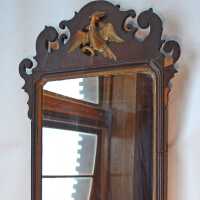
Federal Mirror | C.1780 | Calais, Maine
Classification: Furniture Circa: 1780 Old Accession Number: 3023 From Calais, Maine house.
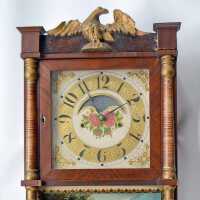
Federal Period Clock, c.1830s | Elm Cottage | Eastport, Maine | Eight day clock. Barns, Bartholomew & Company, Bristol, Connecticut,
Old Accession Number: 3020 Federal period clock, c. 1830s. Eight day clock. Barns, Bartholomew & Company, Bristol, Connecticut, 1836-37. Barnes, Bartholomew & Co. 8-day shelf clock, 1833-1836 Gift from estate of Walter Emery, Sea Girt, New Jersey, 2018. Letter from Walter Emery: 605 Philadelphia Blvd. Sea Girt, N.J. 08750 December 3, 1998 Mr. Christopher Bailey c/o Bristol Clock Museum Bristol, Conn. 06810 Dear Mr. Bailey; At your request of my friend Stephen Petro, who visited your museum recently, I have enclosed pictures and brief comment on the clock that has been in my family for many years. As you can see from the pictures, it is an eight-day clock. However, it is not operated by springs. The weight on the extreme right of the picture with the door open is very heavy. The label to the left of the pendulum, states that it was repaired in Calais Maine October 5, 1942. The label above the pendulum, partly obscuring the words Brass Clocks, indicates that it was sold by S. Adams, Calais/Milltown, Maine. (The first label showed that it was repaired by George Adams.) We have used this clock, which kept very good time, but erratic striking of the hours, up until recently when it quit. We have been hesitant about having someone repair it, but hope to find a qualified repairman in our area. Thank you for your interest in this clock. We would appreciate any comments that you might have. Sincerely, Walter L. Emery
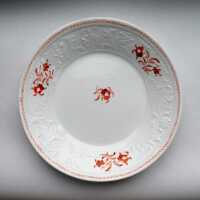
Federal Plate | c 1810 | Eastport, Maine
Circa: 1810 Old Accession Number: 3021 From Eastport, Maine house.
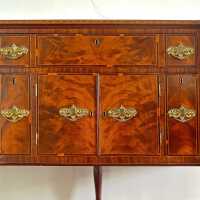
Federal Sideboard | Anna Whalen House | Eastport, Maine | c.1810
Gift from estate of Frances Whalen Strout, 2020. From Anna Whalen House, 7 Key Street, Eastport, Maine. An early 19th century mahogany sideboard that came down through one family in this region for over 200 years. It measures 74 inches long, 25 1/2 inches wide and 41 inches high. It was first owned by Seward Bucknam (1783-1868) and his wife Irene McLellan (1796-1865). Seward was born in Falmouth, Maine and then moved to Eastport, Maine at a young age. He became a well established merchant with stores and wharves on the south end of Eastport. Ellen Irene Bucknam (1826-1900) was their only child and daughter. She married Joseph Mason Livermore (1824-1872) and they eventually inherited the sideboard. They had eight children, among them Anna Bucknam Livermore (1859-1933). Anna’s first marriage to Albert Pike was short lived as he died shortly after they were married. She then married Lincoln Hamlin Newcomb (1860-1923), a lawyer. Anna inherited the sideboard from her parents. When Anna and her second husband died, the sideboard went to Anna’s younger sister, Sarah Preble Livermore Whalen Hayes (1867-1961), who married Leverett Mitchell Whalen (1850-1912) and then George Hume Hayes (1851-1935) after Leverett died. When the sideboard came to Sarah, it would have been in the large 7 Key Street house in Eastport that had been in the Whalen family for generations. It stayed in this house after Sarah’s death as the house and sideboard were inherited by Sarah’s daughter, Anna K. Whalen (1894-1986) who continued to live in the house until her death. Anna had no children and when she died, the house, sideboard and other household furnishings were inherited by Anna’s niece, Frances Whalen Strout (1933-2020). Frances sold the house and moved the sideboard and most of the household furnishings to her ranch style home with attached garage in Brewer, Maine. She converted her garage into a 19th century parlor room filled with the furnishings from her aunt’s Eastport house including the sideboard. Frances had no children and when she died the sideboard along with many with many other of the family furnishing were placed with the Tides Institute in 2020. A note found in the sideboard written by Frances reads: “Originally had black knobs. Henry Newcomb put on new brass pulls.” Federal Sideboard, c.1810. Gift from estate of Frances Whalen Strout, 2020. From Anna Whalen House, 7 Key Street, Eastport, Maine. Anna Whalen was the aunt of Frances Whalen Strout. Sideboard was first owned by Seward Bucknam of Eastport, Maine. One note from Frances Whalen Strout reads: "Seward Bucknam, born June 7, 1783, owned this sideboard." Another note from Frances Whalen Strout reads: "The Livermore sideboard - once was Aunt Nan's - at her death went to Sara P. Whalen Hayes. Originally had black knobs. Henry Newcomb put on new brass pulls." Email from Margaret Whalen, July 6, 2022: "I think I figured the history of that sideboard out. Here goes: Joseph Mason Livermore (1824-1872) married Ellen Irene Bucknam (1826-1900); the sideboard must have come to them from Ellen’s family. (Joseph and Ellen were my great-great-grandparents. It was she who must have made the crazy quilts, based on Grandpa’s letter to me.) They had eight (8!) children, among them Anna Bucknam Livermore (1859-1933). She was known in the family as Aunt Nan; her first marriage was to Albert Pike, who died pretty young. She then married Lincoln Hamlin Newcomb (1860-1923), a lawyer who was known as Linc. When they died, the sideboard went to Anna/Nan’s younger sister, Sarah Preble Livermore Whalen Hayes (1867-1961), who married Leverett Mitchell Whalen (1850-1912) and then George Hume Hayes after Leverett died. When the sideboard came to Sarah, it would have been in the 7 Key Street house, where it stayed under Anna K. Whalen’s stewardship until she died in 1986. From there it went to Dimpy’s house, where it stayed until it was given to the Tides Institute in 2020." Seward Bucknam, born in Falmouth, July 7, 1783, died Feb. 14, 1868, aged 84. His wife Anna died Nov. 22, aged 38. His wife Irene, died Oct. 19, 1865, aged 69. Ellen Irene Bucknam (1826-1900) was the daughter of Seward Bucknam (1783-1868) and Irene McLellan (1796-1865)
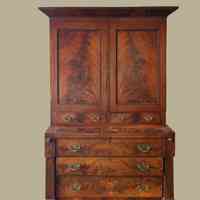
Federal/Empire Secretary Desk, c.1820 | Elm Cottage | Eastport, Maine
Old Accession Number: 3008 Federal/Empire Secretary Desk, c.1820. From the Emery family home, Elm Cottage, Elm Street, Eastport, Maine. Obituary for Joyce Emery Kinney (Emery) September 20, 1924 — October 4, 2016 Eastport – Joyce Emery Kinney, born September 20, 1924, the daughter of Roscoe C. and Vera (Leonard) Emery died October 4, 2016. Mrs. Kinney was predeceased by her husband Grover Bradford Kinney of Eastport and Auburn. Mrs. Kinney is survived by her brother, Walter Emery and his wife Violet of Sea Girt, NJ; nephew Scott Emery, M.D., and his first wife, Carla Hellekson, M.D., and their children, Olivia and Teal Emery of Seattle, WA. Joyce Kinney graduated from Shead Memorial High School, class of 1941, W.S. Normal School in Machias, class of 1945, the U. of Maine at Orono, in 1948 where she also received her Master’s in Education in 1955. Mrs. Kinney taught school most of her life: Vanceboro, 1945-47 and Thomaston, CT, 1948-50. In September 1950 Mrs. Kinney began teaching for the American Dependent Schools in Japan; first at Tagajo, then as a traveling teacher for the Island of Shikoku; in 1952 at Eta Jima and in 1953 at the U.S. Navy Dependent School at Yokosuka. After returning to the States, Mrs. Kinney taught at Lincoln, Kittery and Farmington. She returned to Eastport in 1959 and worked as a secretary in her father’s real estate and insurance business. In 1960 she founded the Border Historical Society; the first meeting was held in Elm Cottage, the family home, and she served many times as president of that organization. In 1969 Mrs. Kinney began teaching grades 1-4 Remedial Reading in Eastport. She developed Pernicious Anemia in 1973 and increasing weakness made early retirement necessary. One of the original members of the Saint Croix Garden Club, Mrs. Kinney was vice president the first two years of the club’s existence, and the third year served as president. Mrs. Kinney’s interest in local history led her to research the maritime history of eastern Washington County, and to publish the historical reference “Vessels of Way Down East” in 1989. Over a period of years Mrs. Kinney was guest speaker at the school classrooms, Retired Teachers and at Historical Society meetings. Her brief historical articles have been published in the Down East Coastal Press and the Quoddy Tides. Mrs. Kinney spent several of her later years researching the maritime history of western Washington County, using old newspaper files of the Eastport Sentinel, The Calais Advertiser and The Machias Union. Her manuscript of this extensive work remains unfinished. Mrs. Kinney was a member of the Machiasport Historical Society, the V.F.W. Auxiliary and the Eastport Nursing Home Auxiliary. A funeral service will begin at 3:00 p.m., Friday, October 7th at Blakey Memorial United Methodist Church, High St., Eastport. Burial will follow at Hillside Cemetery, Eastport. Arrangements by Mays Funeral Home, Calais & Eastport.
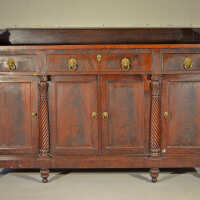
Federal/Empire Side Board, c.1830 | Wells-Shober Cottage | Campobello, New Brunswick
Old Accession Number: 2201 Originally from Wells-Shober Cottage, Campobello, New Brunswick. Acquired from Joyce Emery Kinney of Eastport, Maine. Side board came from the Emery family Elm Cottage, 2 Elm Street, Eastport, Maine. Joyce's father, Roscoe Emery who was involved with real estate as well as the Eastport Sentinel newspaper, had once purchased the Wells-Shober Cottage and its contents including this side board. Joyce tells of her father and brother bringing a truckload of furniture from the Cottage over to Eastport. From Sunrise County Architecture (2nd revised and enlarged edition) 1996, p.119 WELLS-SHOBER COTTAGE Willard T. Sears, of Boston, designed the Wells-Shober Cottage for American lawyer Samuel Wells, once president of the Campobello Company. This building was finished in 1884, at about the same time as the building of the three Campobello hotels for which Sears drew the plans. All four buildings were Queen Anne Revival designs. With a steep hip roof, dotted with gables and dormers, this two-and-a-half story cottage was built with railings, both inside and on the facade. The roof was a bell-cast design with two chimneys. Walls of this wooden frame building are protected by clapboards, first painted brown (with white trim), but since painted all white by the Park Commission. When the living room, with fireplace, was given an addition encircling that room, the outside veranda had to be rebuilt as well. Besides dining room and kitchen, on the first floor, there are not only four second floor bathrooms but two railed verandas, while three bedrooms, each with a bath, occupy the third floor. The Park Commission remodeled the Well-:Shober Cottage for use as a guest house. This cottage is across the street (Route 774 from Lubec to Welshpool, N.B.) from the Hubbard Cottage, which is seven years younger. The Wells family sold their cottage to Mary Norris Cochrane in 1912, and her daughter Edith Shober (Mrs. Rex) inherited it in 1918. The Park Commission acquired the Wells-Shober Cottage in 1965, and it was the first cottage to be redecorated and used for Commission meetings. NHSD, JCB
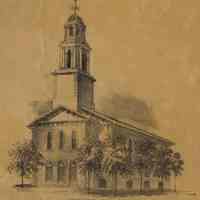
First Congregational Church (Unitarian) |
Illustration on Map of the Town of Eastport Washington Co. Maine, From Actual Survey by D.S. Osborn, Civil Engineer; Published by E.M. Woodford, N.E. Cor. 4th & Chestnut Streets, Philadelphia, 1855. Printed by Wagner & McGuigan. Map is in collections of the Tides Institute & Museum of Art.
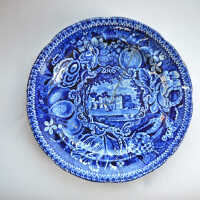
Flow Blue Plate | R. Hall's, Select Views, Warleigh House, Somersetshire, England | Stone China | c.1825
An early 19th century flow blue English stone china dish that was pieced back together from a number of shards. On the back of the dish is stamped: R. Hall's, Select Views, Warleigh House, Somersetshire, Stone China. The 8 1/2 inch wide dish was made in England and dates to about 1825. This dish was unearthed in 2018 during the excavation of a six foot deep 19th century household “dump” in this region that was filled with thousands upon thousands of beautiful, but broken early 19th century ceramic and glass shards. The “dump” was on the site of a large house built in 1824 and torn down in the early 1960s. The house underwent considerable renovation in the mid-19th century. During this renovation, the existing house pantry full of ceramic and glass ware was likely cleared out and thrown in the “dump.” Some ceramic and glass shards came into the institute’s collections during this initial excavation, but much was also taken out of the region to Portland, Maine and to North Dakota. The institute sought the return of what was removed from the area. All that went to the Portland area is now back in the institute’s collections. Nearly all (including this piece), with the exception of two pieces, that went to North Dakota is now back in the institute’s collections. In the summer of 2020, another excavation of the same household “dump” was undertaken and several hundred more ceramic and glass shards were found, some of which perfectly matched shards unearthed two years before. About 100 ceramic and glass pieces have been put back together, either entirely or nearly entirely. ( ) From Eastport Sentinel, March 29, 1882, p.2, c.5-6: Some old Eastport Houses, — AND THEIR OCCUPANTS.— A FAMILIAR RETROSPECT. — PAPER NO. 2 In the fine modern looking residence of Edward C. Pike on the same side above Elm street it would be difficult to recognize the outgrowth of one of these old hipped roof houses, but this one was built in that style in 1824 by Charles Peavey. In my earliest memory it was the home of Levi Ingols, a prominent dry goods dealer, and held of the well known firm, Ingols, & Chace and Ingols & Eustis. They kept in the brick store on Water street under the old Commercial Coffee House, and Edward H. Burgin and William P. Bucknam were boys learning the business behind the counter. Afterwards the house was occupied by Edward Ilsley, at one time in the hardware business, and the first Cashier of the Frontier Bank. Mr. & Mrs. Ilsley are still living at an advanced age in Wisconsin, and their sons have achieved marked success as business men. I well remember when immediately after one of the weddings which I attended at the Hayden house, this house was opened as the home of George W. McLellan. He had a natural turn for politics, represented the town in the State Legislature, as he afterwards did Cambridge in the General Court of Massachusetts, was Sheriff of Washington County, Deputy Collector of the Port of Boston and finally Assistant Post Master General of the United States. Among later occupants of the house were Charles H. Hayden of the family first named in this article, who was the second Cashier fo the Frontier Bank, and John W. Bass a merchant of large business when ship building was at its height in Eastern Maine. QUODDY
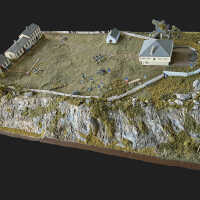
Fort Sullivan Model, Eastport, Maine
From Border Historical Society (Eastport, Maine) Newsletter, Winter, 1990, p. 1: "The Border Historical Society is pleased to announce the it is in the process of receiving from Mr. Harry C. Bibber of Alexandria Virginia the donation of his family's property adjoining the Barracks Museum. It will be known as The Crosby-Bibber House. "Mr. Bibber also built for the society the model of Fort Sullivan, which was presented at the November/December meeting. The reconstruction represents the fort as it appeared in 1817-1818. It was painstakingly crafted and will be exhibited in The Barracks Museum where it will enhance the museum's growing collection. ...."
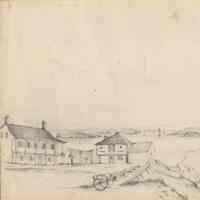
Fort Sullivan | Eastport, Maine, 1837
An original sketch by an English visitor at Fort Sullivan and titled, "Yankee Fort, 1837."
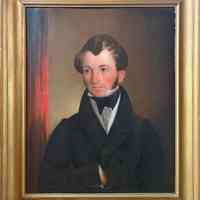
George Ferdinand Wadsworth (1808-1903), Eastport, Maine | Oil on Canvas Painting | c.1835
Married to Mary Lincoln Cutter Wadsworth in 1830.
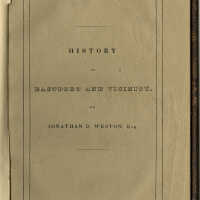
History of Eastport and Vicinity [Cover of Book] | Jonathan D. Weston
1834. Three copies. Artist: Jonathan D. Weston Circa: 1834 Old Accession Number: 1591
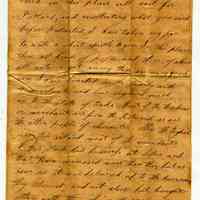
J. Parsons | Letter, February 5, 1820 | Eastport, Maine
LETTER DRAFT TRANSCRIPT: Letter is addressed on the outside of the folded letter to: Major Solomon H. Chandler, New Gloucester, Maine. Eastport February 5th 1820 Dear Cousin, As Mr. Neal Shaw, who is Mr. Wheeler’s clerk in this place will sail for Portland, and recollecting what you said before I started, I have taken my pen to write a short epistle to you. In this place there all kinds of people and those of almost all nations yet among these are many good men. I have boarded in the family with 4 merchants and have enquired much as to the state of trade. Most of the traders or merchants are from the Westward as are the other people of character. When the English held this island most of the merchants of this place did business at Lubec and that town increased more than this, but as soon as it was delivered up to the Americans they returned and not alone but brought others with them. Since that time the growth of the place has been astonishingly rapid. In the course of the last summer they have established a bank and built 2 new meeting houses, and they have now contracted for the frame of a third. The advantages for trade here are many. It is near the line, money is plentier than with you, and there is much business done here in the summer season. Smuggling is carried on upon a high scale at all seasons of the year. But a stranger knows not at first whom to trust and often loses for rogues will cross the line to escape punishment and avoid paying their debts. There is no doubt but that they will have a gaol and a courthouse here soon and make a half shire town of it. There are many men of property here, of whom I have heard it said that Mr. Wheeler my employer is the richest. The Bucknams are men of good standing. There are on this island 3 ministers 2 lawyers 2 or 3 doctors and 3 school masters besides a school mistrefs. There were another master & mistrefs more and the master who was a Scotsman who could read sermons to the people But he drank a little too much Christmas Day and they dismifsed him. The mistrefs a Scottish woman had a few scholars but we divided them amongst us so that she had but one left and she could not prevail on her to stay. I think you had better come down and see this place next spring for I think you will like it and if you do not you will see the country and it will not cost much. Mr. Thuston told me that what goods they had sold the last summer in 7 or 8 months cost them 7,000 dollars in Boston and certainly The profits could not be small. I intend to have written a letter to Uncle Pence to send by Mr. Shaw but I have not time. I have written this letter in great haste and do not know as you can read it but want of time must be my excuse as also for closing here. J Parsons Give my love to to uncle and aunt and all enquiring friends. I remain your affectionate cousin J Parsons, Eastport
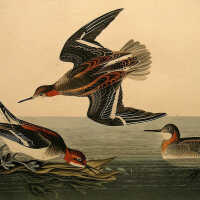
John James Audubon (1785-1851) | Hyperborean Phalarope | 1834
A large hand-colored engraving and aquatint by American artist and naturalist, John James Audubon (1785-1851), of a Hyperborean Phalarope. The print is based on a watercolor Audubon completed from a drawing he did of the bird in this border region during one of his two trips to the area in 1831 and 1833 on his way to Labrador. Audubon observed and drew several birds during his time in the area where he stayed in Dennysville and Eastport, Maine and visited Grand Manan, New Brunswick and the Fundy shore of Nova Scotia. In addition to the Hyperborean Phalarope, the other drawings included the Lincoln Sparrow (named for Audubon’s Thomas Lincoln of Dennysville), Harlequin Duck, and Thick Billed Murre. The Hyperborean Phalarope print (19 3/4”/50.2 cm x 12 1/4”/31.1 cm) is Plate CCXV of Audubon’s massive Birds of North America that contains 435 life-size watercolors by Audubon of North American birds (including the birds drawn in this area) printed between 1827 and 1838, all reproduced from hand-engraved plates by Robert Havell. The Hyperborean Phalarope was engraved and printed in 1834. The Tides Institute acquired the print at the Heritage Auction in Dallas, Texas and raised the necessary funds to secure the print. At the time of his encounters with the Hyperborean Phalaropes, Audubon wrote: “As we advanced eastward in the month of May, we saw more and more of them, and while at Eastport in Maine my son JOHN shot several out of flocks of sixty or more. At one time a flock consisting of more than a hundred was seen in the Bay of Fundy. They were exceedingly shy, and the gunners of Eastport, who knew them under the name of Sea Geese, spoke of them as very curious birds.” Artist: After John James Audubon Medium: Etching and aquatint, hand-colored Classification: Prints Old Accession Number: 58 Description: No. 43, Plate CCXV
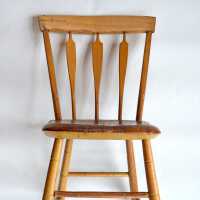
Joseph Very (1793-1831) | Thumb Arrow Back Chair, c.1822 | Eastport, Maine
A hand made wooden thumb back / arrow back chair that was made in Eastport, Maine by chair maker, Joseph Very. It dates to about 1822. Written in stencil on the underside of the chair seat are the words: “Warranted, Eastport by J. Very.” Little is known about Very. He evidently was born in Salem, Massachusetts in about 1793 and moved to Eastport some time in the early 19th century. He began making wooden chairs shortly after this and quickly became involved in a chair making war with a competing business person selling chairs in Eastport. An advertisement by Very in the Eastport Sentinel of April 13, 1822 reads: “Great Cry and Little Wool. The Subscriber observing a puffing advertisement in the last Eastport Sentinel, ‘City Chairs’ is induced to inform the public that he has taken a shop in this place … where he now carries on the Chair Making Business in its various branches. Although he cannot, with propriety, give his work the title of ‘city chairs’ (which a certain chair vender calculates a great recommendation) yet he will give them a more substantial title, that of WARRANTED CHAIRS, a name which he thinks the ‘city chairs’ are not entitled to, and will suit purchasers far better in the end.” Two years later, in 1824, Very was still advertising his Warranted Chairs along with his intentions of going into the painting business which he claimed he had 16 years of experience in. The chair was purchased by the Tides Institute from an individual in Eastport in 2018 just before the chair was to go up for auction. Very died in Eastport in 1831 at the age of 38. Photo Caption: Hand made wooden thumb back / arrow back chair that was made in Eastport, Maine by chair maker, Joseph Very. It dates to about 1822. Old Accession Number: 3019 Chair made in Eastport, Maine, c.1825. Name of maker and Eastport is on bottom of seat reads: Warranted by J.[Joseph] Very, Eastport. Advertisement from Eastport Sentinel, March 27, 1824, p. 3: House, Ship & Sign Painting. The Subscriber informs the Public, that he intends carrying on the PAINTING BUSINESS in the above branches the ensuing season, and having had sixteen years experience in the business, feels confident of getting ample satisfaction to this employers. Constantly on hand at his Shop in Boyenton-street, (one door east of Capt. Swett's Hotel) a dozen warranted CHAIRS (not city made) which will be sold low for cash or exchanged for the going currency of the place (i.e.) Pollock Fish, Herring, Oil or Lumber. Employment solicited by the public's Humble Servant, JOSEPH VERY. Eastport, March 27 ________ Eastport Sentinel, March 2, 1831: Deaths: In Eastport, 24 Feb 1831, Maj. Joseph VERY, 38y, f/o Salem, MA
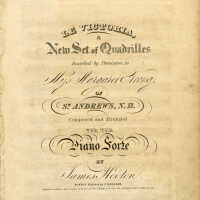
Le Victoria, A New Set of Quadrilles | James Hooton | 1835
Artist: James Hooton Classification: Books and manuscripts Circa: 1835 Old Accession Number: 1365 Description: Le Victoria, A New Set of Quadrilles. Inscribed by Permission, to Mifs Margaret Strang, of St. Andrews, N.B. Composed and Arranged for the Piano Forte by James Hooton. Boston: Published by C. Bradlee. Entered according to Act of Congress, in the year 1835 by J. Hooton, in the Clerks Office of the District Court of Massachusetts. St. Andrews, New Brunswick
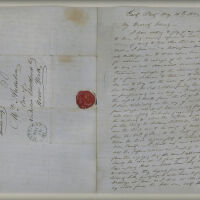
Letter from John James Audubon to his wife written from Eastport, Maine | John James Audubon | May 16, 1833
Artist: John James Audubon Medium: Letter Description: Gift of Charles and Keithe Moore Old Accession Number: 27 Eastport May 16, 1833 My Dearest Friend – I have nothing to say of any importance to thee, but cannot refrain to write a few lines, if merely to tell thee that we are all well - I have received a letter from Doc Shattock (?) who authorizes me to draw upon him the ___ ____ for whatever the expenses of his —- may be to me, it will somewhat finish our own tremendous expenses of the charter by ourselves of a fine schooner to take us to Labrador, we are to pay at the rate of $350.00 per month, the captain and crew finding themselves in provisions and we in ours. - I expect to ____ this _____ of month from the first of June which I have appointed as the day of our sailing - from advice which I have received from men who have visited Labrador frequently I shall be induced to order the captain to sail directly for the coast to between latitudes 53 & 54 {where} the birds are to be met by millions from the 20th of June to the last of August. When the birds begin south to return to our own coast. - I shall ___ ____ anticipate all the information which I expect to collect from this voyage but the more I approach that country the more do I feel ___ of ____ I am afraid that we shall have but little time to draw any thing beginning and finishing outlines with coloring bills, ___ ___, I will have to finish the drawings at home as I did at Charlottetown on my return from the Floridas Page 2 I am led to think that I shall have no opportunity of sending thee letters after our sailing and yet will try every chance however impractical they may be. - Should I meet with B___ C___ I may from thy dear ___ I cannot hope for a line, yet write to the care of ___ ___ ____ ____ who will forward to St. John’s Newfoundland where probably we shall touch on our return. - The fishermen from this place do not return until the middle of October merely because they thereby gain a bounty in their ____ but I am told that I ought to return by the last of September to here I shall be moved by the seafarers and will act with all the ___ I can in my happinesses (?) not derogatory from my preferred purpose doing all in my power during this voyage. - The climate is expected as being fine although cold with the exception of a few days toward the end of July and beginning of August. - The captain whom will convey us is a man of information and I am pleased to say a gentleman besides, our pilot is well acquainted with the coast having been [or seen?] several voyages to it for the purpose of egging which I find to be quite a trade. - I shall have every man around with ___ and have seen very fine boats ___ to fail ___ the islands, the others to be carried on our crew’s shoulders to the lakes of the interior ____ I am having a few warm clothes of a coarse kind made here hats such as Mr. ___ wore at Houlton boots a la fishermen ___ ____ our ship will be our home ___ ___ in the interior of the country when of course we will camp and under the protection of ___ John is in good spirits and away shooting this morning __________________. It is now 6 O’clock I have been writing 2 1⁄2 hours Page 3 I find thee in ___ a letter for ___ I began to have the hope of having my good friend ___ should he not come it will be a great disappointment to me and John ___ thee. The first of June tell him is the last day and the surest way to join us if he thinks proper to ___ by mail after his ___ ___. The ___ Lincoln to ___ Shattock are going with us and will be agreeable company I shall write a long letter for Victor and ___ and to thee also. - We are quite comfortable in the Weston family ___ has been expected to be confined for several days I have seen but little of the captain, Lieutenant Green is a fine fellow and well informed should the reverend Culter Swift ___ in a day or so we shall immediately set sail in ___ ___ ___ to Grand Manan and surrounding islands perhaps as far as the last islands above 100 miles of ___ the morning is beautiful but cold and we cannot do at all without good ___ I may find myself obliged to draw on Nicholson for some money when we return to make up the balance of our charter above what we have on hand I shall write to him to that effect. ___ and something by return of mail what his determination is and will augment our stores accordingly to be prepared for his reception and accommodations. We dine today with mayor Shatburn whom we could not well refuse although we are anxious to go to Lubeck back to shoot all this day. - God bless thee my dearest friend Thine ever faithful friend John J. Audubon
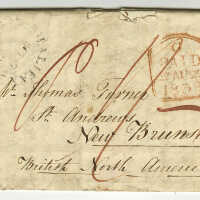
Letter to Thomas Turner, St. Andrews, New Brunswick, British North America | 1839 | View of Front Side
Classification: Books and manuscripts Circa: 1839 Old Accession Number: 1619
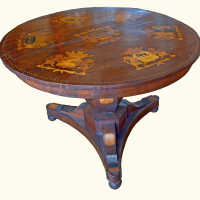
Lincoln Table | Lincoln House | Dennysville, Maine
A round wooden table with a series of coat of arms inlaid on its top. The top of the table is about 43 inches in diameter and the table stands about 29 inches tall. The table long resided in the historic Lincoln house in Dennysville, Maine, and likely dates to the early 19th century, but the actual date and origin of the table are still to be determined. The Lincoln house was built beginning in 1787 for Theodore Lincoln, son of American Revolutionary War general Benjamin Lincoln, who led a group of Massachusetts proprietors that had been granted thousands of acres in the area. Local lore claims that the table was one of four such tables presented by French general Lafayette to American general Washington’s top four generals including Benjamin Lincoln. In 1968, a photograph of the table was sent to a curator at the Metropolitan Museum of Art in New York City to see what they might suggest about the table’s history. They thought the table belonged to the style of the period around 1840, but that the inlaid coat of arms on the top of the table might have been added much later, perhaps around 1900. They had no information about any presentation of such tables by Lafayette to Washington’s generals and they could not identify the coat of arms on the table other than to say they were not associated with Lafayette. The table was purchased in about 1950 at auction from the last Lincoln family descendant to live in the Lincoln house by an individual who lived in nearby Eastport, Maine. This individual, in turn, gave it to their nephew who lived in New Jersey and there the table resided for nearly 50 years. The nephew promised the table to the Tides Institute upon his death and when he died in 2018 the table returned to the area and became part of the collections of the Tides Institute. Photo caption: Round wooden table with a series of coat of arms inlaid on its top. The table long resided in the historic Lincoln house in Dennysville, Maine, and likely dates to the early 19th century, but the actual date and origin of the table are still to be determined. Gift from estate of Walter Emery, Sea Girt, New Jersey, 2018. https://www.findagrave.com/memorial/22268818/william-morang-emery William Morang Emery BIRTH 28 Nov 1878 DEATH 30 Aug 1964 (aged 85) BURIAL Hillside Cemetery Eastport, Washington County, Maine, USA From: https://www.findagrave.com/memorial/135266620/anna-maxwell-lincoln Anna Maxwell Brown Lincoln BIRTH Jun 1857 Scotland DEATH 19 Mar 1951 (aged 93) Calais, Washington County, Maine, USA BURIAL Dennysville Cemetery Dennysville, Washington County, Maine, USA Show Map MEMORIAL ID 135266620 · View Source
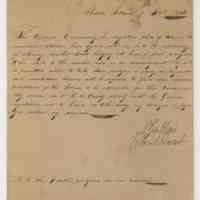
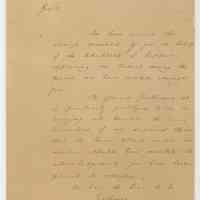
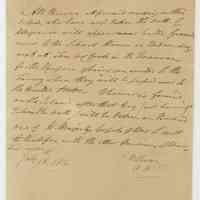
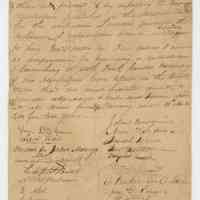
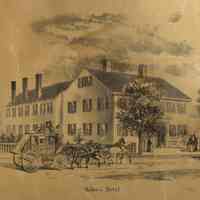
Mabee's Hotel
Illustration on Map of the Town of Eastport Washington Co. Maine, From Actual Survey by D.S. Osborn, Civil Engineer; Published by E.M. Woodford, N.E. Cor. 4th & Chestnut Streets, Philadelphia, 1855. Printed by Wagner & McGuigan. Map is in collections of the Tides Institute & Museum of Art.
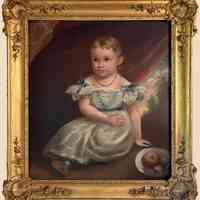
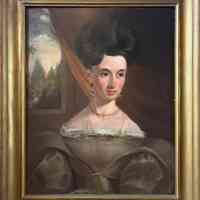
Mary Lincoln Cutter Wadsworth (1809-1870), Eastport, Maine | Oil on Canvas Painting | c.1835
Married to George Ferdinant Wadsworth in 1830.
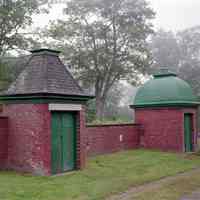
Masonic Tomb and Shackford, Kilby and Hayden Tomb | Hillside Cemetery, Eastport, Maine | 1828
• From Eastport Sentinel, May 7, 1890, p.3, c.3: “The body of Col. E.B. Knox whose death took place a short time since in Chicago, was brought here on Tuesday’s Boston s|eamer for burial in the family lot in the Old Cemetery. A delegition from St. Bernard Commandery, K.T., took charge of the remains upon arrival here, and conveyed the body to Masonic Temple where it remained until ten o’clock this morning, when under escort of the Sir Knights of St. Bernard Commandery, accompanied by a large number of citizens, it was deposited in the Masonic tomb at the Cemetery.” • From Eastport Walking Tour Brochure, 2010: The Masonic Tomb Hillside Cemetery. October 14,1828 the Masonic Order had a mausoleum built large enough to house several hundred members and their families. It was intended to be the final resting place, or a holding place until family or friends had the bodies of their loved ones reinterred. Often reburial was many years later. The Masonic Tomb was turned over to the City of Eastport in the 1990s and no longer houses the remains of Masons. • Eastport Sentinel, December 23, 1829, p.2: MASONIC TOMB Extract of a letter from a gentleman, who visited the town of Eastport, Maine, in the month of Sept. 1829, to his friend at the Westward, Dear Sir, Having occasion to spend a few days at this place, [Eastport,] I availed myself of what opportunity I had to become acquainted as well as I could with the people, their customs, their public and social institutions, &c. The number and appearance of the school houses, denote that the education of the young is not neglected. The several churches, five in number, indicate that the people have a deep interest in religious workship. Their public Library and News Room, are very useful establishments and do much credit to the liberality, good sense, and literary taste of the citizens. At the suggestion of a friend , I went to see their Burial Ground. It was in a retired, but suitable and convenient place, well enclosed and kept. At the South East corner of which, I was showed a Tomb, which was built by the Masonic Fraternity in that town, and knowing you to belong to that order, I thought some account of it would be interesting to you. The Tomb presents to the West a broad front of brick, painted in imitation of stone work. Through a door in the centre, you pass into a spacious entry room; from this, other doors open to the several vaults, which are capable of containing about four hundred coffins. Some twenty or thirty bodies, I was told, had already been deposited there. On the top of which an obelisk is to be erected, it is begun, but not yet completed. The object of this Sepulchre Tomb, is to afford a convenient and deepest receptacle for the bodies of desecrated Masons, their families, and strangers of the order who may happen to die in the place, where burying may by this means be found by their enquiring friends, and removed, or not, at their pleasure. This is the first and only one of the kind, that has come to my knowledge, built in the Unite States, for the express object. And certainly it reflects much honor on the liberality, generosity and affection of the Masonic Fraternity here, toward their deceased brethren, and others. And I think it ought to be recommended to Lodges elsewhere, especially to those in populous towns and cities to do likewise. True friendship has respect not only for the characters of the living, but for the ashes of the dead. Yours, &c. T. • Eastport Sentinel, December 13, 1893, p.3: The Masonic fraternity of the city, have had their receiving tomb at the cemetery nearly rebuilt and put in thorough repair at an expense of $500, during the past few weeks; the mason work, cementing of floors, tinning of roof surmounting the dome over the entrance doors, etc., being all completed and little more remaining to be done. • From Eastport Sentinel, August 4, 1880, p.2. c,4-5: “They Rest in Peace. — In our recent notices of the industries of the town and people who are now active in its business pursuits we are reminded of many familiar faces seen upon the streets in years gone by, but now are no more. Their stores, offices, and places of business have new occupants. Most of the old citizens are gone. Where are they? we must visit the cemetery to read their names upon the monuments and head stones. It is the Sabbath day stillness while we tread lightly over the sacred grounds of the departed ones. Twenty years have passed away since we last visited the spot, and saw the sod turned back to cover all that remained on earth of one we loved. How fast time flies, and in its rapid flight our friends pass away. The old burial place is fast filling up. It is estimated that the population of silent inmates of the cemetery out number the inhabitants of the town. There is much of interest in the history of the cemetery of Eastport, in it could be written as old historians on other local matters have done before. The grounds of the cemetery are beautifully located. Nature seems to have especially designed them for a peaceful resting place for the dead. Added to her rich adornings the enterprising ladies of the town a few years ago, by fair and generous contributions raised $500 for fitting up and decorating the grounds, and from year to year since, large improvements have been made. While standing beside an old moss grown, slate stone slab, we read the name of “Walter St. John Esq., Lieut. 102d Reg. Died May 29, 1818.” The town was then in possession of the British. Close beside his grave is Thomas Raymond’s Master in His Majesty’s Royal Navy, born at Aldoborough, Suffolk, England, died Sept. 27, 1817. The remains of, these two persons were removed from the old grave yard of 1820, a short time ago leaving only one grave, marked by a slate stone, erected by the Eastport Mechanics Association to the memory of Henry S. Pitman aged 27 years, who perished from exporure on the Island of Campobello, Jan. 4, 1818. We learned from the late Joseph Gunnison and John Hinkley, a short time previous to their demise, the name of the first person interred in the cemetery of to-day. He was the brother of the late Thomas Haycock, and died in the year 1820. Messrs. Gunnison and Hinkley were at the time of the reporter’s interview, probably the only persons living who were present at Mr. Haycock’s funeral. From the elevated grounds in the locality of the first graves a fine view of Head Harbor and the river looking towards Pembroke and Dennysville is given. The eastern portion of the ground is occupied by the Catholics, formerly it was their place of burial. Near it is a stone marking a soldier’s grave who died at Fort Sullivan in the year 1827. In a lot enclosed by a rustic fence appears the name of “Jackman” aged 97 years, died in 1817. In the same lot is a beautiful red granite stone, with the nime of Robert Kerr. The stone is highly polished and very attractive. The slab was obtained from Magaguadavic quarry. There are a number of beautiful monuments, prominent among them is one erected by the citizens and comrads [?typo, “comrades”] of company K. to the memory of Capt. Thomas Roach and members of the 6th Maine Regiment who died in the service of our country. The honored fame of Captain Roach is still sacred among the surviving comrades. The G.A.R. post bear it upon their escutcheon. The name of a highly esteemed friend of school boy days, Geo. W. Sabine, Major of the First Maine Heavy Artillery, recalls incidents in the days of the rebellion which have been effaced from memory. In the death of Major Sabine, Eastport lost one of its best young men. Major Sabine was a noble man, a brave soldier, and an exemplary christian. The inscription upon the stone, reads, “Wounded June 17, 1863, died May 28, 1864.” A beautiful monument erected by the young men of Eastport in memory of Theodore Lincoln Chadbourne's son of the late I.R. Chadbourne, and grandson of Gen. Lincoln, who was killed in one of the first battles at Mexico. There are a number of monuments erected to the memory of the first settlers of the town. Among them the family names of Paine, Noyes, Chapman, Hayden, Kilby, Monroe, Livermore, Andrews, Bradford, Coffif, Pike, Crosby, and scores of others meet the eye at every turn. The old tomb bearing the significant emblem of the square and compass marks the temporary resting place of departed brothers of the mystic tie. The other known as the “Shackford, Kilby and Hayden tomb.” While looking upon the old tombs and graves, the mind is carried back to days, gone by, and we seem to see the persons, whose names are before us cut in solid stone, standing erect by our side directing the work that has so successfully been dgne to make the grounds what they are, beautiful and attractive. When a favorable opportunity permits, we shall speak more fully of this important locality.” From Diary of Sarah Connell Ayer: Andover and Newburyport, Massachusetts; Concord and Bow, New Hampshire; Portland and Eastport, Maine. Portland, Maine: Lefavor-Tower Company, 1910. Copy is at the Tides Institute & Museum of Art. Page 295 — Saturday 11th [1829]. Mr. Ayer got a chaise, and took me out to ride. When we reach'd the burying ground, he fastened the horse and we got out. Having the key with him, he opened the door of the Free-Mason's-tomb, and we entered it. It was the first time I had ever entered one of these dwelling places of the dead, or seen a body after it had been buried. I scarcely dared to indulge the feelings that oppressed me. My husband raised the lid of the coffin that contain'd all that remain'd of my poor Father. He had been taken from the grave and laid in the tomb. I gave one look, it was nothing but a mere skeleton, alas ! how altered, many others were deposited there. Mr. Ayer left me at Mr. Bailey's. Staid to meeting. Page 338-339 — Sabbath November 25th. 1832. I now sit down to record the events of the last four weeks. Betsy and the children have gone to meeting, I have not felt well enough to go out, the walking being bad. But what shall I say? Is the past only a dream? No tis sad reality. I weep, my hand trembles, my heart seems ready to break; the tie which for 22 years bound me to my husband, death has severed, and though I shall ever cherish the remembrance of him with the fondest affection, I shall see his face here no more forever ; no more hear his voice, or listen to hear the well known foot-step at the door, or stand ready to perform the many little offices, to which I had long been accustomed. He is no longer here, his spirit has fled, his body laid in the cold tomb. Never did I know how dear he was to my heart, till death enter'd, and I was call'd to part with him forever. And am I now a widow ? Is it, can it be that my dear children have no longer a kind father, to watch over their childhood, and youth ; to protect and guide them through this world of temptation. I would not murmur. I would hear a voice saying to me "Be still and know that I am God." I will now attempt to collect my wandering thoughts, to record the events of the trying scene, as well as I can remember. It may hereafter be read with interest by the dear, dear children. Page 341-342 — Monday 12th of November 1832. I went down into the parlour to look at all that was now left of my dear husband. There was a smile on his countenance, he look'd pleasant and natural. I felt as if he was conscious I was near him, that he would open his eyes once more upon me, and speak to me. I could not realize that he was dead, that he would never again look upon me, that I should never hear his voice again. I left the room, and return'd to my own chamber. Many kind friends came in to offer assistance, and to sympathize with me. Tuesday I rose and endeavoured to prepare for the last offices to be performed for my husband. I went down and took a last look, the effort was violent, it was almost more than I could bear, I look'd to God, and felt that he alone could support and comfort me. The hour came, the bell struck, minute guns were fired from the cutter, friends collected, an appropriate prayer was made by Mr. Gale, the coffin was then placed in the hearse, a carriage was brought to the door, and in it was placed myself, and children, Mr. Gale and wife; then followed the custom house officers, physicians, and friends of the family. The procession moved slowly on, it moved to the grave yard, my husband was laid in the tomb, and placed by the side of my father, the door closed upon him, and I return'd to my now solitary dwelling, with an aching- heart. The scene which I had dreaded was over, I had been supported through it ; I lookM into the chamber in which my early friend, my dear husband died, it look'd deserted and desolate, my soul was exceeding sorrowful, I felt forlorn, and wept. Mr. Gale wrote to Sarah, poor child! little did she dream when she left her home, that she should see her father no more in this world. Page 349 — Thursday 9th of May 1833. Gen. Ripley call'd me very early to go on board the Boundary; he said she would sail in the course of twenty minutes. I had to hurry on my cloaths. collect my things to send down, and leave the house, not a moment to take leave of my friends, or, kiss the dear children, Gen. Ripley accompanied me down to the vessel. There Mr. Leavitt met me; my things were all on board. Dea. Wheeler, Mr. Eustis and several other friends, stood on the wharf to bid me farewell. I found Mr. and Mrs. Gale already on board, and a large number of English gentlemen. I knew none of the passengers but Mr. and Mrs. Gale. My heart was full, and I retired to the cabin as the vessel push'd from the wharf to weep in secret. I dared not take a last look at East port, which for 11 years had been my home, which contain'd many dear friends, and the tomb of my husband. Oft shall I in imagination visit the spot, where lies all that now remains of my Father, and the partner of my life ; often weep over the green sod which covers them. Farewell sweet Isle, farewell ye dear departed ones ; soon will the rolling waves bear me far from scenes dear to memory. I go to a distant spot, to return to the birthplace of my husband, to take my abode with his aged Mother, and again to meet his brothers and sisters, and my own children. Page 356 — Friday [August 23, 1833]. Mother and myself rode down to Hooksett, to visit Mary Gale. When I entered the house, I was much affected. A thousand painful recollections crowded upon my mind. Mary opened the door, and led the way into the parlour, and seating myself on the sofa, I look'd round, to see if there was any object that look'd familiar. In that room I was married, and there, I had spent many happy hours with the dear companion of my life, my husband, he, who now lies low in the tomb, at a far distant place.
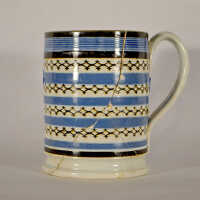
Mochaware Mug | c.1820
An early 19th century mochaware mug that was pieced back together from a number of shards.The mug dates to about 1820. This mug was unearthed in 2018 during the excavation of a six foot deep 19th century household “dump” in this region that was filled with thousands upon thousands of beautiful, but broken early 19th century ceramic and glass shards. The “dump” was on the site of a large house built in 1824 and torn down in the early 1960s. The house underwent considerable renovation in the mid-19th century. During this renovation, the existing house pantry full of ceramic and glass ware was likely cleared out and thrown in the “dump.” Some ceramic and glass shards came into the institute’s collections during this initial excavation, but much was also taken out of the region to Portland, Maine and to North Dakota. The institute sought the return of what was removed from the area. All that went to the Portland area is now back in the institute’s collections. Nearly all (including this piece), with the exception of two pieces, that went to North Dakota is now back in the institute’s collections. In 2020, another excavation of the same household “dump” was undertaken and several hundred more ceramic and glass shards were found, some of which perfectly matched shards unearthed two years before. About 100 ceramic and glass pieces have been put back together, either entirely or nearly entirely. Photo caption: An early 19th century mochaware mug that was pieced back together from a number of shards.The mug dates to about 1820. ( ) From Eastport Sentinel, March 29, 1882, p.2, c.5-6: Some old Eastport Houses, — AND THEIR OCCUPANTS.— A FAMILIAR RETROSPECT. — PAPER NO. 2 In the fine modern looking residence of Edward C. Pike on the same side above Elm street it would be difficult to recognize the outgrowth of one of these old hipped roof houses, but this one was built in that style in 1824 by Charles Peavey. In my earliest memory it wis the home of Levi Ingols, a prominent dry goods dealer, and held of the well known firm, Ingols, & Chace and Ingols & Eustis. They kept in the brick store on Water street under the old Commercial Coffee House, and Edward H. Burgin and William P. Bucknam were boys learning the business behind the counter. Afterwards the house was occupied by Edward Ilsley, at one time in the hardware business, and the first Cashier of the Frontier Bank. Mr. & Mrs. Ilsley are still living at an advanced age in Wisconsin, and their sons have achieved marked success as business men. I well remember when immediately after one of the weddings which I attended at the Hayden house, this house was opened as the home of George W. McLellan. He had a natural turn for politics, represented the town in the State Legislature, as he afterwards did Cambridge in the General Court of Massachusetts, was Sheriff of Washington County, Deputy Collector of the Port of Boston and finally Assistant Post Master General of the United States. Among later occupants of the house were Charles H. Hayden of the family first named in this article, who was the second Cashier fo the Frontier Bank, and John W. Bass a merchant of large business when ship building was at its height in Eastern Maine. QUODDY
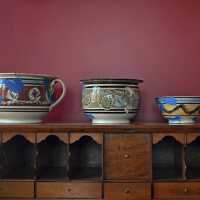
Mochaware | C.1830 | Eastport, Maine
Circa: 1830 Old Accession Number: 2270 ( ) From Eastport Sentinel, March 29, 1882, p.2, c.5-6: Some old Eastport Houses, — AND THEIR OCCUPANTS.— A FAMILIAR RETROSPECT. — PAPER NO. 2 In the fine modern looking residence of Edward C. Pike on the same side above Elm street it would be difficult to recognize the outgrowth of one of these old hipped roof houses, but this one was built in that style in 1824 by Charles Peavey. In my earliest memory it wis the home of Levi Ingols, a prominent dry goods dealer, and held of the well known firm, Ingols, & Chace and Ingols & Eustis. They kept in the brick store on Water street under the old Commercial Coffee House, and Edward H. Burgin and William P. Bucknam were boys learning the business behind the counter. Afterwards the house was occupied by Edward Ilsley, at one time in the hardware business, and the first Cashier of the Frontier Bank. Mr. & Mrs. Ilsley are still living at an advanced age in Wisconsin, and their sons have achieved marked success as business men. I well remember when immediately after one of the weddings which I attended at the Hayden house, this house was opened as the home of George W. McLellan. He had a natural turn for politics, represented the town in the State Legislature, as he afterwards did Cambridge in the General Court of Massachusetts, was Sheriff of Washington County, Deputy Collector of the Port of Boston and finally Assistant Post Master General of the United States. Among later occupants of the house were Charles H. Hayden of the family first named in this article, who was the second Cashier fo the Frontier Bank, and John W. Bass a merchant of large business when ship building was at its height in Eastern Maine. QUODDY
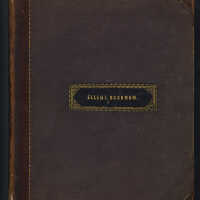
Music for the Piano Forte | Vol. II | Ellen Irene Bucknam (1826 - 1900), Eastport, Maine
Ellen Irene Bucknam (1826 - 1900), Eastport, Maine. Bound Volume of Musical Scores Mostly Published in Boston, Massachusetts and Dating to the 1830s and 1840s | Name of Volume Owner on Front Cover: Ellen I. Bucknam Gift from Frances Whalen Strout Estate, 2020.
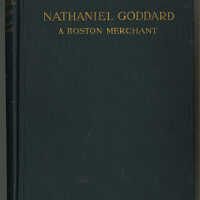
Nathaniel Goddard: A Boston Merchant, 1767 - 1853
For a time, Nathaniel Goddard lived and ran a business in Eastport, Maine. 2 copies.
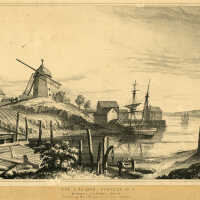
New England Scenery No. 4 Windmill, Eastport, Maine | Published by M.J. Whipple 35 Cornhill Boston
Artist: Published by M.J. Whipple 35 Cornhill Boston Medium: Engraving Classification: Prints Old Accession Number: 352
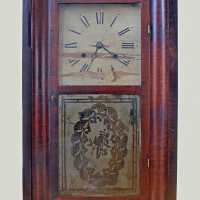
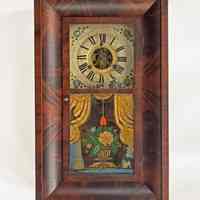
Ogee Clock, c.1840s | H.Hunt & Company | St. Stephen, New Brunswick
Classification: Furniture Circa: 1840 Old Accession Number: 2256 Description: Ogee clock. Made in St. Stephen, New Brunswick by H. Hunt & Company. c.1840s.
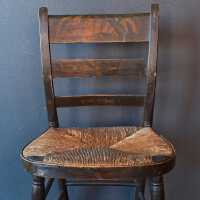
Painted Chair, c.1830 | Eastport, Maine
Old Accession Number: 3017 Painted Chair, c.1830. From Eastport, Maine.
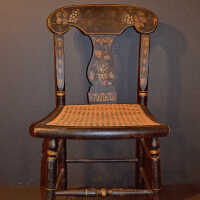
Painted Side Chair, c.1840 | Calais, Maine
Classification: Furniture Circa: 1840 Old Accession Number 2257 Description: Painted side chair. From Calais, Maine house. c. 1840-50.
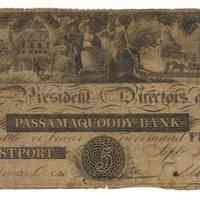
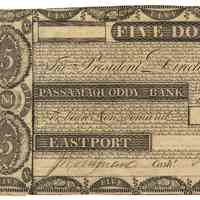
Passamaquoddy Bank | Five Dollars | Eastport, Maine | 1824
Commonwealth of Massachusetts 1819 Chap. 0066. An Act to incorporate the President, Directors and Company of the Bank of Passamaquoddy. Sec. 1. Be it enacted by the Senate and House of Representatives, in General Court assembled, and by the authority of the same. That Theodore Lincoln, Lemuel Trescot, Jabez Mowry, Seward Bucknam, Ichahod R. Chadbourne, Moses Fuller, Jonathan D. Weston, Samuel Wheeler, Worster Tuttle, Leonard Pierce, Jonathan Bartlett, Horatio G. Balch, and Samuel Tuttle, their associates, successors and assigns, shall be, and hereby are created a corporation, by the name of the President, Directors and Company of the Bank of Passamaquoddy; and shall so continue, from the first day of August next, until the first Monday of October, which will be in the year of our Lord one thousand eight hundred and thirty one ; and the said corporation shall always be subject to the rules, restrictions, limitations, taxes, and provisions, and be entitled to the same rights, privileges and immunities, which are contained in an act, entitled * An act to incorporate the President, Directors and Company of the State Bank," except in so far as the same are modified or altered by this act, as fully and effectually as if the several sections of said act were herein specially recited and enacted : Provided, however, the amount of bills issued from said bank, at any time, shall not exceed fifty per centum beyond the amount of their capital stock, actually paid in. Sec. 2. Be it further enacted, That the capital stock of said corporation, shall consist of the sum of one hundred thousand dollars, in gold and silver, to be, besides such part as this Commonwealth may subscribe, in manner hereinafter mentioned, divided into shares of one hundred dollars each, which shall be paid in four equal instalments ; the first, on or before the fifteenth day of August next; the second, on or before the fifteeuth day of November next; the third, on or before the fifteenth day of June, eighteen hun-fdred and twenty ; and the fourth, on or before the fifteenth day of August, eighteen hundred and twenty ; or at such earlier time as the stockholders, at any meeting thereof, may order. And no stockholder shall be allowed to borrow at said bank, until he shall have paid in his full proportion of the whole of said capital stock, of one hundred thousand dollars ; and that no dividend shall be declared, on the capital stock of said bank, until the whole of said capital stock shall have been paid in, conformably to the provisions of this act: And the stockholders, at their first meeting, shall, by a majority of votes, determine the mode of transferring and disposing of said stock, and the profits thereof; which being entered in the books of said corporation, shall be binding on the stockholders, their successors and assigns, until they shall otherwise, determine : And the said corporation are hereby made capable inlaw, to have, hold, purchase, receive, possess, enjoy, and retain, to them, their successors and assigns, lauds, rents, tenements, and hereditaments, to the amount of ten thousand dollars, and no more, at one time ; with power to bargain, sell, dispose and convey the same by deed, under the seal of said corporation, and signed by the President, or two of the Directors, and to loan and negociate their monies and effects, by discounting on banking principles, on such security as they shall think adviseable : Provided, however, that nothing herein contained, shall restrain or prevent said corporation from taking and holding real estate, in mortgage or on execution, to any amount, as security for, or in payment of any debts due to the said corporation : And provided, further, that no monies shall be loaned, or discounts made, nor shall any bills, or promissory notes, be issued from said bank, until the capital subscribed, and actually paid in, and existing in gold and silver, in their vaults, shall amount to fifty thousand dollars. Sec. 3. Be it further enacted, 'I hat the said bank shall be established, kept, and transact their business, at Eastport; and five of the Directors thereof, at least, shall be inhabitants of Lubec, Skc. 4. Be it further enacted. That no more than three fourths of the Directors elected, who shall be in office, at the time of an annual election, exclusive of the President, shall he elected for the next succeeding year; and no Director shall hold his office more than three years out of four, in succession, except the Di-1 rector that is President, at the time of an annual election, who may be reelected. Sec. 5. Be it further enacted, That whenever the Legislature shall require it, the said corporation shall loan to the Commonwealth, any sum of money which shall be required, not exceeding ten per centum of the capital stock, actually paid in, at. any one time, reimbursable by five annual instalments, or any shorter period, at the election of the Commonwealth, with the annual payment of interest, at a rate, not exceeding five per centum per annum: Provided, however, that the Commonwealth shall never stand indebted to the corporation, without their consent, for a larger sum than twenty per centum of their capital actually paid in. Sec. 6. Be it further enacted, That the persons herein before named, or any three of them, are authorized to call a meeting of the members and stockholders of said corporation, as soon as may be, at Eastport, by advertising the same for one week, in the Eastport Sentinel, for the purpose of making, ordaining and establishing such by laws, ordinances, and regulations, as the said stockholders shall deem necessary, an;1 for the choice of the first Board of Directors, and such other officers as they shall see fit to choose. Sec. 7- J5e it further enacted, That the Commonwealth shall have a right, whenever the Legislature shall make provision therefor, by law, to subscribe, on account of the Commonwealth, a sum, not exceeding1 one half of the capital stock actually paid in, to be added to the capital stock of said corporation, subject to -such rules, regulations, and provisions, as to the management thereof, as shall, by the Legislature, be made aud established. Sec. 8. Be it further enacted, That whenever the Commonwealth shall subscribe to the capital stock of said corporation, in manner herein before provided for, in addition to the Directors, by law, to be chosen by the stockholders, the Legislature shall have a right, from time to time, to appoint a number of Directors! 39 to said bank, in proportion, as the sum paid from the treasury of the Commonwealth, shall bear to the whole amount of stock actually paid into said bank, if at any time hereafter, they shall see fit to exercise that right. Sec. 9- Be it further enacted, That the Cashier, before he enters upon the duties of fns office, shall give bond, with two sureties, to the satisfaction of the Board of Directors, in a sum, not less than twenty thousand dollars, with conditions for the faithful discharge of the duties of his office. Sec. 10. Be it further enacted, That the said corporation, from and after the first day of October next, shall pay, by way of tax, to the Treasurer of this Commonwealth, for the use of the same, within ten days after the first Monday of April and October, annually, the half of one per centum on the amount of stock which shall have been actually paid in. Sec. 11. .Be it further enacted, That the said corporation shall be liable to pay to any bona fide holder, the original amount of any note of said bank, counterfeited or altered in the course of its circulation, to a larger amount, notwithstanding such alteration. And that the said corporation shall not, at any place whatever, �directly or indirectly, purchase, receive, pay or exchange any bill or note of said bank, or of any other bank, incorporated within this Commonwealth, for any less sum than the nominal value expressed in such bill or note. [Approved by the Governor, June 19th, 1819.]

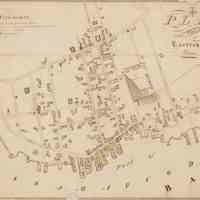
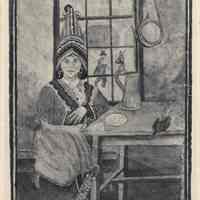
Portrait of Denny Neptune Soccabeson | Lt. Alexander Henry Charles Villiers (d. 1847-1849) | Photograph of Original Watercolor Painting
Photograph of original watercolor painting. Original painting is now in the collections of Colonial Williamsburg. See web link to Colonial Williamsburg entry on this painting. Description from Colonial Williamsburg web site: An interior scene with a Native woman seated, her arms crossed, on a bench in front of a table set with a pitcher, two dishes (one seems to be slipping off the table), and a feather object hanging over the edge of the table. The woman is dressed in an elaborate costume including a high-crowned, decorated hat completely covering her hair. She wears a cross on a chain around her neck and large hoops in her ears. A small cradleboard supporting a bound figure is propped beside her against a table leg. A water canteen hangs from a strap to the right of the window. The scene outside the window includes two men in military dress marching towards one another; one carries a rifle on his shoulder and the other carries a sword. Two large buildings are situated beyond the marching men. Artist unidentified. Label Text from Colonial Williamsburg web site: Native American women often accompanied their husbands on trading missions, sometimes carrying on the active business of bartering on these excursions. Likely this Passamaquoddy woman came to Fort Sullivan (now part of Eastport, Maine) for such a purpose. Shown seated in one of the barracks buildings, the sitter was the daughter of Francis Joseph Neptune, hereditary leader of the Passamaquoddy who occupied nearby Point Pleasant. Her colorful traditional attire includes a conical cap and overdress with leggings; she also wears two circular silver brooches, earrings, and a pendant cross on a bead necklace. The figure strapped onto the cradleboard in front of her represents a baby, not a doll. The town of Eastport was occupied by British troops during the War of 1812, with a garrison at Fort Sullivan. Access to the fort was strictly controlled during 1814-1818, so it is surmised that this 1817 portrait of Soccabeson was rendered by one of the British officers stationed there. Sketches of the bay and harbor executed by Lt. Alexander Henry Charles Villiers survive, making him a candidate for the portrait artist. A nineteenth-century history of the area describes Villiers as being "extremely fond of drawing."
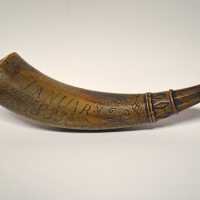
Powder Horn | 1833 | Lubec, Maine
Circa: 1833 Old Accession Number: 1549
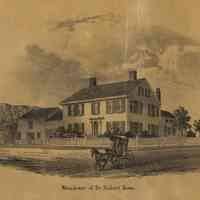
Residence of Dr. Robert Mowe
Illustration on Map of the Town of Eastport Washington Co. Maine, From Actual Survey by D.S. Osborn, Civil Engineer; Published by E.M. Woodford, N.E. Cor. 4th & Chestnut Streets, Philadelphia, 1855. Printed by Wagner & McGuigan. Map is in collections of the Tides Institute & Museum of Art.
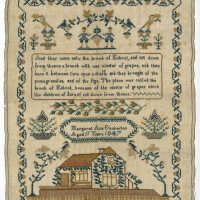
Sampler [Needle Point] | Margaret Ann Dunkerton | 1847 | Eastport, Maine
A mid-19th century hand stitched sampler that according to stitched writing on the sampler dates to 1847 and was made by 11 year old Margaret Ann Duckerton of Eastport, Maine. There appears to be some discrepancy as to Margaret Dunkerton's actual age at the time she made the sampler or the date of the sampler as records indicate she was was born in 1838 in Windsor, Nova Scotia. This would put her age at nine and not 11 when she made the sampler. Soon after Margaret’s birth, her family moved to Eastport. The making of samplers was a common activity for girls during this time as a way to help teach basic needlework skills while including the alphabet, numbers, important quotations and family history. Margaret’s sampler has several of these elements in a well made and well balanced design. There is what might represent the family house and fence at the bottom of the sampler, a quotation from the King James version of the Bible (the Book of Numbers, Chapter 13, Verse 23), and above the quotation two men in period clothing with a hawk in a tree branch on either side. Three sides of the sampler are framed with a vine like scroll. Margaret went on to marry James Lawrence in 1855 and together they had six children. She lived the rest of her life in Eastport until 1935 dying at the age of 97 and is buried in Hillside Cemetery in Eastport. The sampler was handed down through later generations of the Dunkerton-Lawrence family and eventually turned up for auction in California in 2008. The Tides Institute acquired the sampler at this auction. Photo caption: Mid-19th century hand stitched sampler that according to stitched writing on the sampler dates to 1847 and was made by 11 year old Margaret Ann Duckerton of Eastport, Maine. Artist: Margaret Ann Dunkerton Medium: Needlepoint Circa: 1847 Old Accession Number: 117
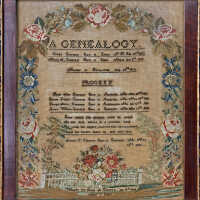
Sarah Ann Cheney | Sampler | 1846
A large (24” x 20 1/2”) mid-19th century needlework sampler by Sarah Ann Cheney of Eastport, Maine that she did when she was 11 years old. The sampler dates to 1846. The sampler is silk on Penelope weave linen and features cross and straight stitches. It is in remarkable condition for its age. Within the sampler, Sarah included information about her parents and their children, even adding her baby brother below the verse years after she had finished the piece. The sampler was part of an exhibition of early to mid-19th century federal period Maine needlework samplers held at the Saco Museum in Maine in 2013. The curator of the exhibition, Leslie Rounds, wrote in the accompanying exhibition catalogue: “Sarah Cheney's sampler is the ‘newest’ of all the samplers in the exhibition and shows many signs of the new styles of needlework that were emerging at the time. However, it also continues to demonstrate stylistic elements that clearly tie it to the earlier works in the exhibition, with its lavish rose border and family register format that appears to be a near-copy of many Portland samplers. She was mimicking the Berlin work that was quickly becoming the needle arts rage of the era. Sarah was the eldest of the five children of George Cheney and his wife, Mary. On the 1850s census, George was listed as a “trader” and the family was residing in Eastport. On July 20, 1858, Sarah married George Kilborn in Boston, Massachusetts. The Kilborns seem to have lived in Boston for the rest of their lives.” The Tides Institute acquired this sampler earlier in 2022 from a dealer in Connecticut that specialized in antique needlework samplers.
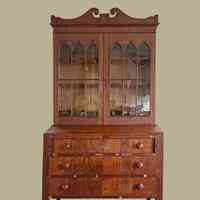
Secretary Desk | Chadbourne House, Eastport, Maine | c.1820
Gift of Ruth McInnis, 2026.
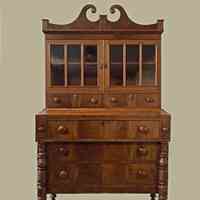
Secretary Desk | Wadsworth-Raye Family | Circa 1840 | Eastport, Maine
Gift from John Lester Raye, Canton, Connecticut, 2023 Telephone conversation with John Raye, October 19, 2023: John said the desk came from the house of his great-great-grandfather, George Ferdinand Wadsworth (November 1, 1808 - May 15, 1903), at 62 High Street in Eastport, Maine. The desk then descended to George's son, Henry Howard Wadsworth (March 1, 1833 - February 10, 1934), and to his house at 22 Key Street. The desk then descended to Henry's daughter, Mary Howard Wadsworth (July 13, 1872 - November 6, 1970), who never married and lived at 22 Key Street until she died in 1970. John's father, John Franklin Raye (September 27, 1918 - March 5, 2009), got the desk around 1960 and brought it to his home in Simsbury, Connecticut. His mother was Helen Prince (Wadsworth) Raye. John Franklin Raye had the desk restored by a well known furniture restorer in Riverton, Connecticut next to the historic Hitchcock Furniture Company. The desk then descended to his son, John Lester Raye, of Canton, Connecticut.
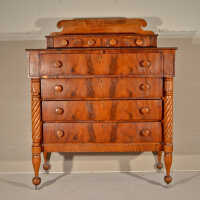
Sheraton Chest of Drawers, c.1830 | Dennison House | East Machias, Maine
Old Accession Number: 2221 From the Dennison House, East Machias, Maine.
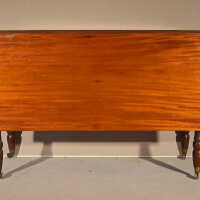
Sheraton Drop Leaf Table, c.1830 | Elm Cottage | Eastport, Maine
Classification: Furniture Old Accession Number: 2217 Description: From the Emery family Elm Cottage, Elm Street, Eastport, Maine. Gift of Joyce Emery Kinney, Eastport, Maine.
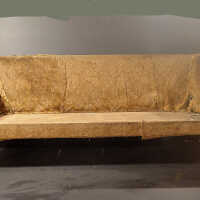
Sheraton Sofa, c.1820 | Grady House | Eastport, Maine
Old Accession Number: 2281 Sheraton Sofa, c.1820. Gift from Gregory Noyes, 122 Water Street, Eastport, Maine. From Grady House, 1 Adams Street, Eastport, Maine.
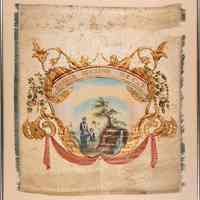
Temperance Banner | Cadets of Temperance | Eastport, Maine | 1849
Temperance banner dating to 1849. 41" x 44" hand-painted silk banner. It depicts a man and his son standing alongside a stream and waterfall. It is inscribed "Border Section, No. 1 C. of T. Presented by Ladies of Eastport, July 4, 1849." The banner is constructed of two panels stitched together with blue fringe on the sides. "C. of T." stands for Cadets of Temperance. Eastport refers to Eastport, Maine. Neal Dow was Governor of Maine where the "Maine Law" banning sale of alcoholic beverages was enacted in 1851. Condition: Two relatively small areas of loss along right side, in the blank field. Scattered spotting and wrinkling. A horizontal split crosses the two figures in mid-section. Framed to an overall size of 47" x 53".
The Fault Lines of Empire: Political Differentiation in Massachusetts and Nova Scotia, ca. 1760-1830 | Elizabeth Mancke
Compares development of Machias, Maine and Liverpool, Nova Scotia.
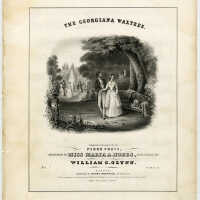
The Georgiana Waltzes | William C. Glynn | 1844
Artist: William C. Glynn Classification: Musical scores Circa: 1844 Old Accession Number: 995 Description: The Georgiana Waltzes. Composed & arranged for the Piano Forte, Dedicated to Miss Maria A. Hobbs, Eastport, Me by William C. Glynn. No. 1. Pr. 25 cts nett. Boston. Published by Henry Prentiss, 33 Court St., Entered according to act of Congress in the year 1844 by H. Prentiss in the Clerk's office of the District Court of Massachusetts. Thayer & Co.' Lithog'y. Boston. A mid-19th century published sheet music score, “The Georgiana Waltzes,” composed and arranged for the piano forte by William C. Glynn. It dates to 1844 and was dedicated to Miss Maria Archibald Hobbs of Eastport, Maine. Maria Hobbs was born in 1821, the daughter of George and Salome Hobbs. The piano forte was an early small piano that was popular in homes at the time. The sheet music was published by Henry Prentiss of Boston and printed by Thayer and Company, lithographers, also of Boston. Whether Maria’s parents paid to have the music score composed in their daughter’s honor is unclear, but her parents were originally from the Boston area. The institute has another slightly earlier dedicated piece of published sheet music in its collections, “Le Victoria, A New Set of Quadrilles,” dating to 1835, composed by James Hooton of Boston and inscribed to Miss Margaret Strang of St. Andrews, New Brunswick. In 1847, three years after “The Georgiana Waltzes” was published, Maria Hobbs married Peter Asley Scott, a lieutenant in the British Royal Navy, who at the time was serving on the Columbia steamship that was engaged iin surveying the coast of North America under the command of Capt. William Fitzwilliam Owen of nearby Campobello Island in New Brunswick. They were married in the Washington Street Baptist Church in Eastport by the Reverend Kendall Brooks. She died in 1895. The Tides Institute acquired the “The Georgiana Waltzes” sheet music through ebay auction.
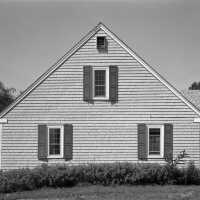
Todd House | 1 Capen Avenue, Eastport, Maine
-CAPEN001 H7-0B5-5 Built:1775-1783 Address: 1 Capen Avenue Eastport, Maine National Register ARCHITECTURAL STYLES Cape Cod From Sunrise County Architecture (2nd revised and enlarged edition) 1996, p.25: TODD HOUSE. A classic New England full cape, with a massive center chimney, Todd House was originally built as a cabin in the 1775-1783 era, and later enlarged. It has a unique "good morning" staircase and low hanging eaves. A cornerstone marks the chartering of Eastern Lodge No.7, of the Masonic Order, in what is now a guest room, in 1801. It later served as a barracks for soldiers manning the nearby mud battery on Todds Head. The second family which owned this cape were Bucknams. In recent years a dormer has been removed. The Todd House, a bed and breakfast, which is furnished with period antiques and a library of local history, is at 11 Capen Avenue, off Water Street. RM, JCB From Eastport Walking Tour Brochure, 2010: Todd House (NR) 1 Capen Avenue, Colonial center chimney Cape built between the 1770s and 1780s. John Campbell Todd of Steuben, Maine, a merchant and trader, owned this restored cape located on Todd's Head. In the fall of 1800 Todd bought 73 acres from James Bradbury who acquired this land from John McGuire, sea captain, and his wife Abigail. The McGuires arrived on Moose Island in the 1780s and were the original owners of the 100-acre Lot NO.6. On May 1, 1801, Todd bought, for $1 000.00, the rest of the McGuire lot from the widow Abigail. On August 11, 1801, Eastern Lodge No. 7 of the Masonic fraternity held its first meeting at this house. The Todd House may be the oldest standing structure remaining in Eastport.
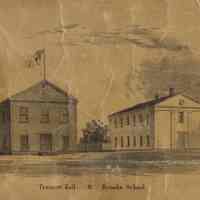
Trescott Hall & Brooks School
Illustration on Map of the Town of Eastport Washington Co. Maine, From Actual Survey by D.S. Osborn, Civil Engineer; Published by E.M. Woodford, N.E. Cor. 4th & Chestnut Streets, Philadelphia, 1855. Printed by Wagner & McGuigan. Map is in collections of the Tides Institute & Museum of Art.
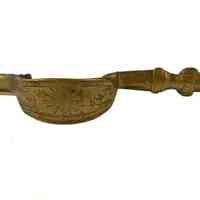
Trigger Guard, Indian Island, New Brunswick | 1770-1820
Possible artifact donation From hartlandnavy@gmail.com on 2023-06-15 01:55 Details Headers Dear Mr French, I got your name from Mark Borton as someone who might be interested in a couple of artifacts in my possession. One is a cannon ball that I found on the beach on Indian Island below the salt box house, owned at that time by Janet Pope, who had been looking for it for some time. She told me it had been fired by an American privateer during the war of 1812, at a couple of British schooners anchored at Indian Island. The other is a trigger guard from a fowling piece that I found in a “secret” room in the center chimney cape at the top of the field, above Mrs Popes house. At the time, the house was owned by my mother and the room was formed by the three fireplaces on the first floor and was accessed by removing a panel in the back wall of the front hall closet. One suggestion was that the guard came from a weapon used in the Fenian raids and, being loose, had been hastily pulled off and left behind. I have no idea if this is a possibility , but the room was intriguing and the piece has become one of my treasured possessions, along with the cannon ball.That being said, my wife rightly pointed out that eventually these artifacts would become meaningless to future generations of our family and really should be in a museum or historical society, to which I reluctantly agreed. Mark suggested the Tides Institute as a good place for them to go, and I am hoping you would be interested in them. I will be at the Institute on July 1st, along with Mark, to celebrate the publication of his book and would be happy to bring the cannon ball and trigger guard, if you are interested. Looking forward to meeting you on the 1st. Sincerely, Dexter P. Cooper, III Sent from my iPad
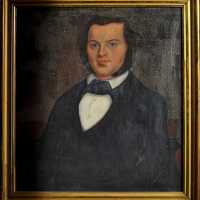
Unknown Artist | Portrait of Aaron Hayden, Jr. |
Artist: Unknown artist Classification: Paintings Circa: 1835 Old Accession Number: 2305 Gift of Sydney Hungerford of 17 Boynton Street, Eastport, Maine in 2017. Painting had come down through the house since it was built and first owned by the Hayden family.

Victor De Grailly (1804-1887) | View of Passamaquoddy Bay | c.1845
An oil painting, “Eastport and Passamaquoddy Bay,” by Victor de Grailly. It dates to about 1845. De Grailly was a French landscape artist who studied under Jean-Victor Bertin and exhibited in Paris. The painting was based on an engraving of a very similar scene in the book, American Scenery, published in London in 1840 by George Virtue, and that contains a large number of engravings of scenes across the United States based on drawings by William Henry Bartlett. It is doubtful that de Grailly ever came to the United States to paint the scene first hand. The painting captures a view of the U.S. / Canada coastal border country of Passamaquoddy Bay as seen from Lubec, Maine looking north to Pope’s Folly island with the then town of Eastport, Maine in the distance. Several well-dressed people are shown along the shore in the foreground of the painting with numerous ships under sailing in the bay beyond. This was one of the first works of art acquired by the Tides Institute and the institute did so, in part, to make a statement of its aims and ambitions. It was purchased from C.L. Prickett of Yardley, Pennsylvania in 2003. De Grailly evidently had success with the painting that he made several copies, one of which was acquired by the White House in Washington, D.C. during the administration of President Gerald Ford. Artist: Victor De Grailly Medium: Oil on canvas Classification: Paintings Circa: 1840 Old Accession Number: 72
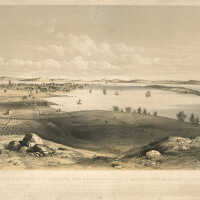
View of the Town of St. Andrews, New Brunswick, with Its Magnificent Harbour and Bay | Frederick Wells | 1840
Artist: Frederick Wells Medium: Lithograph Classification: Prints Circa: 1840 Old Accession Number: 49 Description: View of the Town of St. Andrews, New Brunswick, with Its Magnificent Harbour and Bay
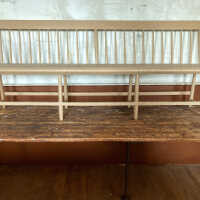
W.O. Haskell Wooden Bench | Congregational church, 26 Middle Street, Eastport, Maine | c.1840
One of thirteen wooden benches at the Central Meeting House (former Congregational Church) building, 26 Middle Street, Eastport, Maine made by W.O. Haskell, Boston, Massachusetts. Benches are 84" long by 34" high. The Haskell label is on the bottom of many of the bench seats.
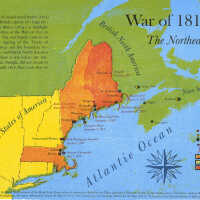
War of 1812: The Northeast | David Wolfe
Artist: David Wolfe Medium: Woodcut and Letterpress Dimensions: 19 1/2”w x 13 3/4”h Classification: Prints Circa: 2014 Old Accession Number: 1436 Description: Poster designed and printed by David Wolfe as part of the Hand Line Press series of posters produced for the Tides Institute & Museum of Art. Large thanks go to historian, Joshua M. Smith, for his assistance and review of this map's development. For more information about the War of 1812 in the Northeast, see his book, Battle for the Bay (2011). This poster is a limited edition of 300 copies produced in 2014.
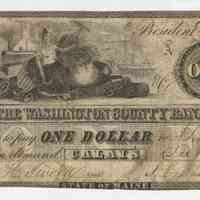
Washington County Bank | One Dollar | Calais, Maine | 1838
The Washington County Bank of Calais, Maine, was a state-chartered antebellum bank organized in 1835 and operating during the 1830s before its charter was repealed and the bank failed in 1841.
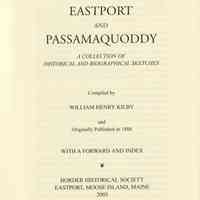
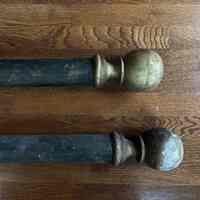
Wooden Curtain Rods | Grady House, 1 Adams Street, Eastport, Maine | c.1840
Two wooden “curtain” rods, 2 3/4 inches in diameter; one is 118” (9 feet, 10 inches) long and the other is 113” (9 feet, 5 inches). Date: 1840. From Grady house, 1 Adams Street, Eastport, Maine. Gift of Ross Y. Furman, 2022. Part of the Ross Y. Furman Advance Collection.
Wooden Trench Bowl | c.1820-1830 | Dennysville, Maine
25 1/8" x 16 1/4" x 4 1/8"